

Alumnus/Alumna profile
Share:


Alexander Bailey
BSc Psychology (Behavioural Neuroscience) 20
Pursuing a career as a physician-scientist
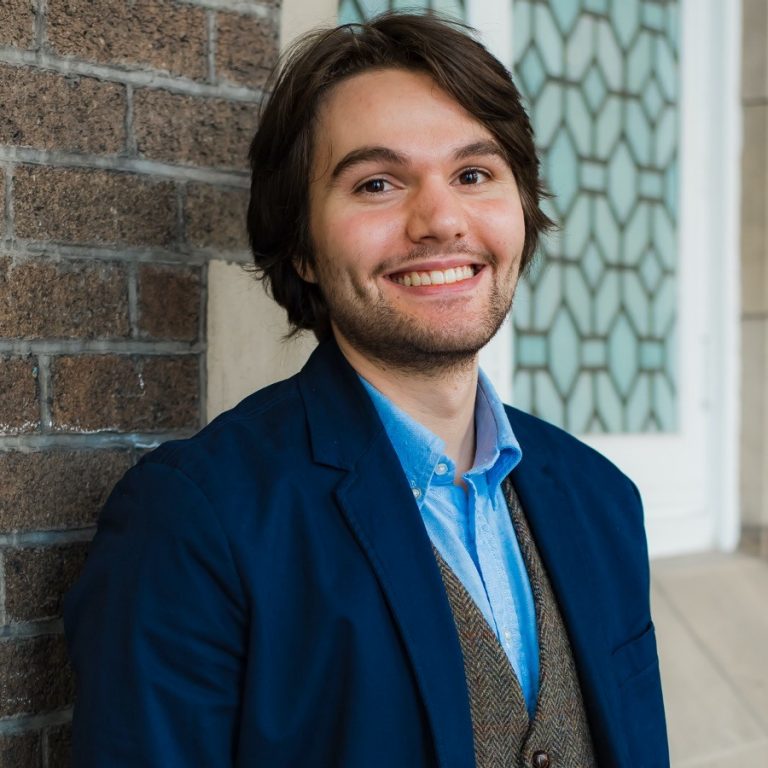
Concordia trained me to become a thoughtful and critical thinker, and taught me the value of integrating knowledge from many different perspectives to fully appreciate a system as complicated (and dare I say beautiful!) as the brain.
Career questions with Alexander
What do you love most about your work, and what inspired you to pursue this career in the first place?
What I love most about my MD-PhD program is that it has provided me with the opportunity to pursue both my passion for brain research while developing clinical skills to provide patients, from all walks of life, with holistic care from bench to bedside.
I was inspired to pursue this route due to my personal experience of being a family caregiver for nearly a decade, which instilled in me a desire to understand why something as complex as the brain is also so fragile. Concordia is where I became passionate about research, which opened many new and exciting opportunities for me, setting me on my MSc (McGill University) and MD-PhD (University of Toronto) program journeys.
Looking back, what skills have been the biggest gamechangers in your career?
I am grateful to have been taken under the wings of several incredible professors at Concordia, whom I regard as mentors, who taught me the value of embracing complex situations as puzzles that that can be understood by thinking about them from an organized, empirical, and systematic approach.
Perhaps most importantly, I was taught that one is defined by, and only as good as, the methods that they use; a lesson that has not only driven me to focus on honing my methodological knowledge and skills, but to develop a strong moral code to try to do right by others and to consider the overarching ethical implications of my work.
How did Concordia prepare you for your career?
Concordia provided a supportive and non-competitive environment in which I felt encouraged by my professors to question everything and to become a lifelong learner. Concordia trained me to become a thoughtful and critical thinker, and taught me the value of integrating knowledge from many different perspectives to fully appreciate a system as complicated (and dare I say beautiful!) as the brain.
The Concordia community (from fellow students, to my professors, the program administrators, to the kind staff at the Loyola Campus Food Services) taught me the importance of communicating in a transparent and honest manner and of being a compassionate, thoughtful and non-judgmental listener – which I consider to be some of the most important skills for a physician in training!
What is a standout memory from your time at Concordia?
In my third year at Concordia, I was feeling hesitant about whether neuroscience was really the right path for me, and I decided to reach out to my neuroanatomy professor. While mentioning my curiosity about how the brain created the mind, I vividly recall how my professor, without skipping a beat, turned on his space heater, grabbed his laptop, took a sip of coffee and proceeded to excitedly show me some of his work on brain networks. Little did I know that I had not only met my future supervisor, but became hooked on cognitive and systems neuroscience, and in many ways, have never really looked back.
If you could give your younger self one powerful piece of advice, what would it be?
I remember experiencing periods of self-doubt as an undergraduate student where I felt insecure about my future. I would want to encourage my former self to continue marching to the beat of his own drum by being a "happy warrior" (to quote Wordsworth). To me, being a happy warrior involves recognizing that it is normal to be afraid, but to appreciate that one can mitigate immediate stresses by being prepared, having contingency plans and by reframing the concept of "failing." By taking on a proactive, compassionate, and, dare I say, upbeat attitude towards oneself and others in the face of adversity, even if someone may not succeed, they are never failures.
What’s the most exciting shift happening in your industry right now?
This might be a bit of a controversial take: while some might argue that the most exciting shift is the development of AI, I would argue instead that it is the development and slow, but steady, adoption of open science policies. This is because open science represents an interesting alternative philosophy to the rather toxic and often non-reproducible world of "publish or perish."
Under an open science paradigm, researchers are encouraged to share their codes, data and knowledge with others to build research connections and to enhance human knowledge by raising all parties up, while ensuring that credit goes to whom it is due. Overall, I think that open science, in combination with some very cool new advances in technology, has the potential to lead to some very exciting new spaces for exploration!
Feeling inspired?
- Register for Homeroom’s Psych Pod to connect with like-minded peers.
- Explore research opportunities at one of the Psychology research labs.
- Attend an event hosted by the Concordia Undergraduate Psychology Association.
- Consider research assistant positions in the psychology department.
- Connect with Career Counselling & Education Transitions to plan your career path.