

Student profile
Share:


VeloSim
2nd Tier Capstone SDG Impact Award Winner, 2025-2026
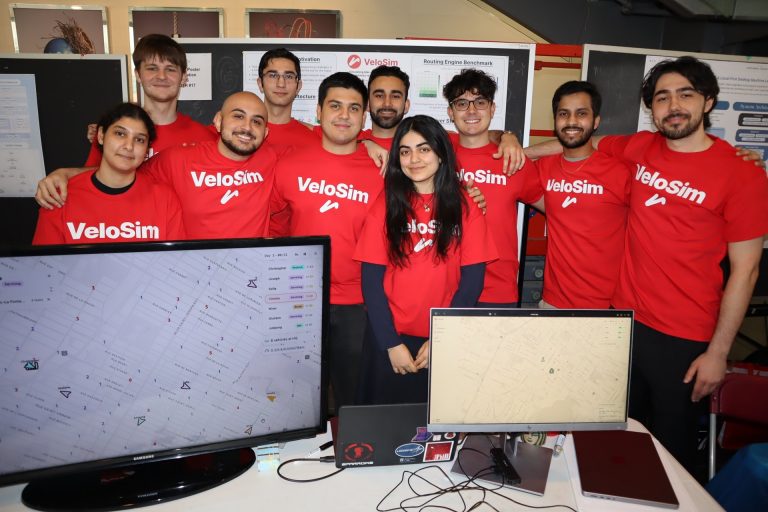
Project members
- Sumer Abd Alla
- David Carciente
- Thomas Mahut
- Vinisha Manek
- Ambrose McLaughlin
- Christopher Mezzacappa
- Michael Mezzacappa
- Nirav Patel
- Jutipong Punteleng
- Brian Tktach
- Giuliano Verdone
Related Sustainable Development Goals
- Goal 1: No poverty
- Goal 3: Good health and well-being
- Goal 9: Industry, Innovation and Infrastructure
- Goal 11: Sustainable cities and communities
- Goal 13: Climate action
- Goal 17: Partnership for the goals
An open-source simulation platform for bike-sharing operations
Bike-sharing systems such as BIXI in Montreal depend on field agents to maintain the network by moving bikes between stations to respond to shifting demand and by replacing e-bike batteries. The strategies used to dispatch these tasks directly influence operational efficiency and bike availability. Evaluating new dispatching approaches on the live network can lead to service disruptions, unnecessary vehicle trips and increased costs. VeloSim is an open-source simulation platform that allows dispatchers to test and compare dispatching strategies in a virtual environment before deploying them in the real world.
The platform enables users to run scenarios on an accurate model of Montreal’s bike-sharing and road network and observe how different approaches perform in real time. Dispatchers can evaluate competing strategies, identify the most efficient option and make informed decisions without risking negative impacts on customers. By improving planning and reducing inefficiencies, VeloSim helps operators increase bicycle availability and support reliable active transportation.
VeloSim was developed as a complete, production-quality system that includes a simulation engine, a web-based interface for launching and monitoring simulations, and a data layer for storing and comparing results. Its novelty lies in combining a realistic simulation environment with live city street routing based on actual Montreal map data, allowing dispatchers to evaluate rebalancing strategies on a real urban network rather than an abstract model. The platform’s modular architecture makes it easy to introduce new algorithms and adapt the system for different cities and bike-sharing networks.
Quality was validated through a comprehensive automated testing framework covering both the simulation engine and the user-facing application, with testing requirements enforced on every code contribution. The platform was further validated through routing usability tests and stakeholder demonstrations with BIXI. Because the system relies on globally available map data and configurable station information, it can be adapted to other cities with minimal effort, providing a scalable tool for bike-sharing operators seeking to improve service reliability, reduce operational costs and support more efficient urban mobility.