

Alumnus/Alumna profile
Share:


Ally Rosilio
BFA Art History 23
Works as a researcher and independent curator
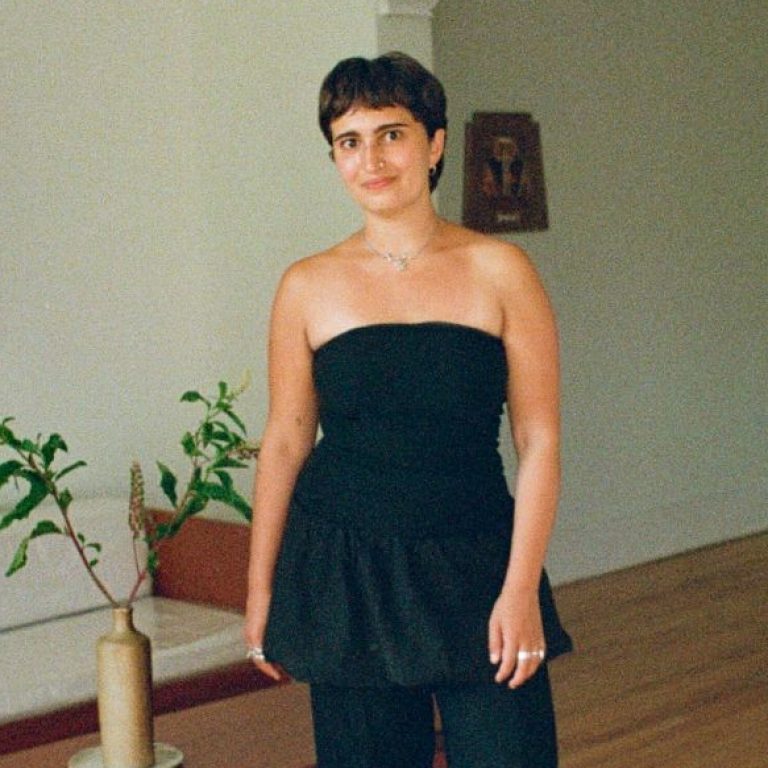
Being able to shift with projects as they evolve, work with what’s available and clearly communicate ideas across different contexts has shaped how I move through curatorial work.
Photo credit: Hamza Abouelouafaa
Career questions with Ally
What do you love most about your work, and what inspired you to pursue this career in the first place?
What I love most about my work is being close to artists’ processes — following a project from its earliest research and development stages through to production and exhibition. There’s something about that continuity that feels very real to me, in the sense that ideas are allowed to be uncertain, to fail and to take shape over time rather than arriving fully formed.
I was first drawn to this work through my first job in the arts at Fonderie Darling, working with artists in residence, and I’ve continued to pursue that closeness to process across my curatorial and programming work since.
Looking back, what skills have been the biggest gamechangers in your career?
Adaptability, resourcefulness and communication have been the biggest gamechangers in my practice. Being able to shift with projects as they evolve, work with what’s available and clearly communicate ideas across different contexts has shaped how I move through curatorial work.
How did Concordia prepare you for your career?
Concordia gave me a strong foundation in art history, but what I really took from it was research as a curatorial tool.
What is a standout memory from your time at Concordia?
I had a professor at Concordia who would call on you to answer questions, often when your ideas were still half-formed. You’d respond, and he would keep pushing: “Okay, but why?” That question stayed with me as a way of working through research and of learning how to properly articulate and communicate my intentions.
If you could give your younger self one powerful piece of advice, what would it be?
Work collaboratively. Art history can often feel isolating, like you’re alone with your ideas and trying to make sense of them in isolation. One of the biggest shifts for me was realizing how much richer the work becomes when it’s done with others, as a form of shared knowledge production.
What’s the most exciting shift happening in your industry right now?
One of the most exciting (and necessary) shifts right now is the growing focus on solidarity and collective conversations around working conditions in the arts. There’s a clearer push to name precarity and to think more seriously about how curatorial work is supported and valued. For me, it feels important that these discussions are actively shaping better conditions for future generations of curators and arts workers.
Feeling inspired?
- Visit local museums, including Montreal Museum of Fine Arts, Musée d'art contemporain de Montréal, and PHI Centre.
- Take part in Art Matters, the largest student-run festival in North America.
- Connect with Career Counselling & Education Transitions to plan your career path.