

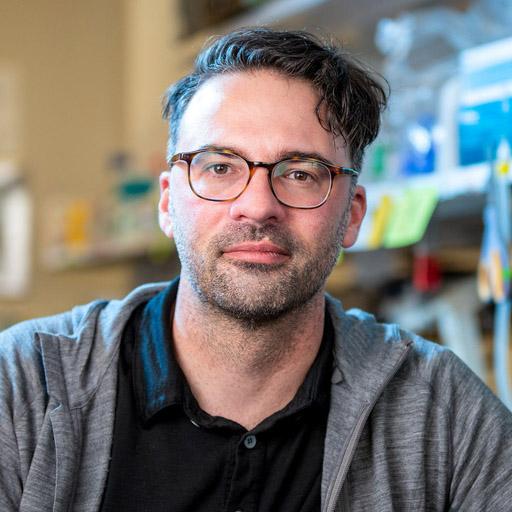
©Concordia University, photo by Lisa Graves
Dr. Christopher L Brett, PhD
- Professor, Biology
- Director, Centre for Microscopy and Cellular Imaging

Are you the profile owner?
Sign in to editThesis supervision details
Supervised programs: Biology (MSc) | Biology (PhD)
Research areas: Applied Synthetic Biology, Biotechnology, Exosomes, Drug Delivery, BioFoundry, Bioprocessing, Extracellular Vesicles for Health Applications, Applied Biosciences
Contact information
Website:
Biography
Education
PhD (Johns Hopkins University)
PDF (University of Washington)
Awards
Canada Research Chair Tier 2, 2011-2016
Concordia University Research Fellow, 2019
Distinguished Alumnus Lecture, Johns Hopkins University (Baltimore, USA), 2019
Concordia University Research Chair Tier 1, 2020-2025
Research interests
Applied synthetic biology, microscopy, extracellular vesicles, engineered exosomes, applied biosciences, anti-cancer, anti-inflammation, immunomodulation, drug delivery, biotechnology
*I am currently recruiting graduate (MSc, PhD) and undergrad (BSc Honours thesis, MITACS, USRA) students.
I am a cell physiologist and applied synthetic biologist with degrees from the University of British Columbia and Johns Hopkins Medical Institute. My research lab uses approaches rooted in advanced synthetic biology to study extracellular vesicles (also called exosomes) and to engineer them for health applications. We use state-of-the-art robotic equipment in Concordia's Genome Foundry and Bioprocessing Facility to conduct iterative design-build-test-learn cycles for development of novel engineered exosomes prior to validation and scale up using advanced biomanufacturing approaches.
Extracellular vesicles are nature's lipid nanoparticles, tiny packages shared by all eukaryotic cells (from yeast to human) that mediate intercellular communication underlying diverse physiology, from immune responses to tissue development. Their membranes protect complex bioactive payloads (DNAs, RNAs, peptides, secondary metabolites) and display molecules for cell and tissue targeting, suggesting they have enormous therapeutic potential. My group is using baker's yeast as a platform to engineer humanized yeast extracellular vesicles to hijack these processes with the aim of developing them for many health applications, including anti-cancer and anti-inflammatory treatments.
Publications
Selected publications
Bouffard J, Trani J, Pawelczak AC, Laufens M, Nunez-soto M & Brett CL (2026) Engineering S. cerevisiae extracellular vesicles using synthetic biology. BioRxiv.
Logan CJ, Staton CC, Oliver JT, Bouffard J, Kazmirchuk TDD, Magi M & Brett CL (2024) Thermotolerance in S. cerevisie as a model to study extracellular vesicle biology. Journal of Extracellular Vesicles 13: e12431.
McNally EM & Brett CL (2018) The intralumenal fragment pathway mediates ESCRT-independent surface transporter down-regulation. Nature Communications. 9: 5358.
Karim MA, McNally EM, Samyn DR, Mattie S & Brett CL (2018) Rab-effector-kinase interplay regulates intralumenal fragment formation during lysosome fusion. Developmental Cell. 47: 80-97.
McNally EK, Karim MA & Brett CL (2017) Selective lysosomal transporter degradation by organelle membrane fusion. Developmental Cell. 40: 151-67.
Media
"Discover how Synthetic Biology is reshaping our world at 4th SPACE" Concordia NOW (2020)
"Concordia celebrates the exceptional research achievements of 9 faculty members" Concordia NOW (2019)
Research activities
Funding Sources
CIHR, NSERC, FRQ-NT, CFI, CRC, MITACS
Teaching activities
Courses
Cellular Neuroscience (BIOL 474/632E)
Comparative Animal Physiology (BIOL 382)