

Headshot image

Dr. Gengrui (Edward) Zhang, PhD

Thesis supervisor Seeking students
  • Assistant Professor, Electrical and Computer Engineering

Thesis supervision details


Supervised programs: Electrical and Computer Engineering (MASc) | Computer Science (MCompSc) | Computer Science (PhD) | Electrical and Computer Engineering (PhD)

Research areas: Distributed Systems, Blockchains, Cloud Computing, Databases, Systems for AI

Contact information

Biography

Education

Ph.D. (University of Toronto, 2024)

Short Bio

Dr. Gengrui (Edward) Zhang is a Tenure-Track Assistant Professor in the Department of Electrical and Computer Engineering at Concordia University, where he leads the Distributed Computing and Systems (DISCOS) Research Group.


Dr. Zhang’s research focuses on advancing the development of high-performance, highly scalable, and highly available distributed systems. His work spans the full spectrum of theoretical foundations, mathematical analysis, system design, efficient implementation, and rigorous experimentation. He addresses real-world challenges in key areas of AI-supporting distributed systems, blockchain, cloud computing, and data management. He is particularly interested in designing new algorithms and system architectures for vector databases, data governance, distributed training systems.


Dr. Zhang obtained his PhD from the University of Toronto in 2024. He has served as program committee member of various international conferences, including ACM Middleware, IEEE ICDE, ICDCS, and VLDB. He actively collaborates with both academia and industry.
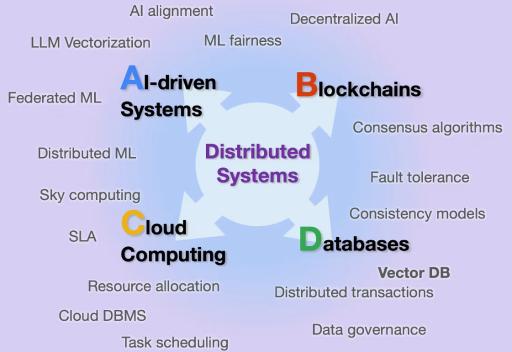

The "ABCD" of our research at DISCOS.

Research activities

The "ABCD" of Our Research

We address real-world system challenges and advance state-of-the-art solutions. Our work is grounded in the core of distributed systems and supports a broad range of applications, including AI-driven systems, Blockchains, Cloud computing, and Data management.

At DISCOS, we are devoted to designing foundational components of distributed computing systems that advance performance, scalability, and availability. We rigorously prove their correctness and implement them in real-world systems (e.g., physically distributed servers or cloud environments). We then evaluate their performance using standard benchmarks and real-world workloads.

R1: Cloud DBMS

Our research on Cloud DBMS focuses on designing scalable, reliable, and cost-efficient data management infrastructures for real-world production systems. We study how cloud DBMS can serve as a foundation for centralized data governance while supporting heterogeneous, distributed, and data-intensive workloads. Our topics include, but are not limited to:​​​
  • Edge-Cloud DBMS for cost-efficient data ingestion
  • Data quality and lean processing
  • Cloud DBMS interoperability​
  • Agentic DBMS
We actively collaborate with Airbus Canada to develop next-generation Cloud DBMS with Agentic technologies for Industry 4.0. Our work targets complex discrete manufacturing and directly supports the ramp-up of the Airbus A220.

R2: Vector Database (VDB)

VDBs are becoming a foundational component of AI-driven data systems, enabling efficient similarity search over high-dimensional representations (typically generated by LLMs). Our research focuses on system-level challenges, including:
  • ANN indexing and similarity search (e.g., HNSW, IVF, PQ, OPQ) for high accuracy and low latency across multi-modal data
  • Distributed indexing and query processing, supporting sharding, replication, and parallel search at the scale of billions of vectors
  • Cloud-native VDB architectures that provide elasticity, fault tolerance, and cost efficiency​
In addition, we design LLM-centric middleware systems, including key-value caching and memory management layers, for large-scale AI inference and retrieval-augmented generation (RAG) pipelines.

R3: Consensus, Consistency, and Fault tolerance

Research on distributed system fundamentals has always been a core strength of our group. Blockchains, cloud computing infrastructures, and distributed DBMS are intrinsically distributed and operate under failures, asynchrony, and adversarial behaviors. Our research studies and advances the following fundamentals in distributed systems: 
  • Data consistency and replication protocols in distributed DBMS
  • Security of distributed computing, including adversarial and fault-prone environments
  • Consensus algorithms under crash (CFT) and Byzantine fault tolerance (BFT)
  • Coordination-as-a-Service, providing modular and scalable coordination primitives for cloud and blockchain systems.
Our summary on BFT is used by Hyperledger Fabric (first link!) as part of its official documentation to introduce the BFT problem and its design considerations. We are proud to be recognized by the world's largest and widely deployed permissioned blockchain system.

R4: Data governance in GenAI

Under the rapid adoption of GenAI systems, training and inference pipelines increasingly rely on large volumes of copyrighted, often proprietary, data, yet current systems lack transparent and enforceable governance mechanisms.​ Our research explores blockchain- and decentralized solutions that enable trustworthy, auditable, and incentive-compatible data governance in GenAI systems.
  • Measurable training influence, quantifying how individual data inputs contribute to model training and inference outcomes
  • Decentralized revenue-sharing mechanisms, enabling fair compensation between GenAI service providers and copyright data owners
  • Emerging legal and policy frameworks for GenAI data governance, bridging system design with regulatory requirements
​Through this research, we aim to establish system-level foundations for responsible and sustainable GenAI, where data usage, value creation, and incentives are aligned across technical, economic, and societal dimensions.

Took 80 milliseconds
Back to top

© Concordia University