

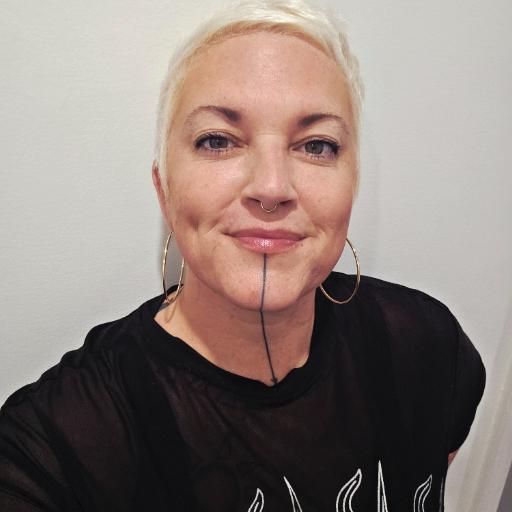
Dr. Mel Lefebvre
Pronouns: They/Them
- Full-Time Faculty, School of Community and Public Affairs
Are you the profile owner?
Sign in to editResearch areas: *Areas of interest & convergence* Artistic practices and aesthetics, ancestral skin marking, traditional tattooing, literature, culture and cultural revival, history, Indigenous health, environmental and social justice, Indigenous ways of being, sovereignty, Indigenous methods and methodologies, Indigenous futurisms, Indigenous cosmology
Contact information
Biography
Biography
My name is Dr. Mel Lefebvre. I am a Two-Spirit (2S) Michif and Irish mother and ancestral skin marker (traditional tattoo practitioner). I am also a community worker, artist, writer, and scholar in Concordia University's First Peoples Studies program.
I am a member of the Manitoba Métis Federation and a descendant of many Red River Michif, Nehiyaw, Nakoda, Saulteaux, and French families on my father’s side including Desjardins, Delorme, and Guiboche. I am a direct descendant of Madeleine Vivier and Urbain Delorme, leaders of the bison hunt. Side by side with Louis Riel, my ancestors fought for Red River free trade, in the 1885 Resistance at Duck Lake with Gabriel Dumont, and were members of the Cypress Hills Métis hunting brigade (Barkwell, 2016, p. 33-34).
On my mother’s side, we are Irish of the Doyle, Griffin, and MacDonald clans from Limerick, Ireland. Some of the places my Michif relations are from include Fisher Branch, Saint Francois Xavier, St. Vital, and Carman, Manitoba; La Ronge, Saskatchewan; and Pembina, North Dakota. I am sharing my family names because that is how we understand our kinship relations and how other Indigenous Peoples can identify us: through our communities and the lands we belong to.
I offer skin marking as a mode of healing and (re)connection for urban Indigenous Peoples, particularly 2SLGBTQIA and Indigenous women, as well as uncovering,(re)claiming, and creating skin markings in contemporary and future contexts. My practice is rooted in the Michif and Nehiyaw relational methodologies of kiyôkêwin (visiting), wâhkôhtowin (kinship), kitimahkinawow (pity and compassion), and tâpwêwin (truth telling).
I have worked closely with the Native Women's Shelter of Montreal (NWSM) for many years where I am vice-president of the board. I also sit on the Indigenous Organizational Advisory Table developed through the Montreal Indigenous Community NETWORK, was a co-creator of Kanekó:ta Indigenous Adult Education School in downtown Montreal, and developed an Indigenous library for both the NWSM and the Leclerc Prison where a large portion of those incarcerated are Indigenous women.
Teaching activities
Courses
First Peoples Studies (FPST)
- Ancestral Skin Marking
- First Peoples & Education
- First Peoples & Social Issues
- First Peoples & Contemporary Politics
- First Peoples & Globalization
- Indigenous Futurisms (Design & Computation Arts (DART))
- Indigenous Research Methods
- Anthropology, Indigenous Resurgence
- Applied Human Sciences, Indigenous Perspectives
- Land-based Education, microprogram
Publications
Publications
Lefebvre, M. (2026). [Review of the book IndigenousTattoo Traditions: Humanity through Skin and Ink, by L. Krutak]. IndigenousReligious Traditions, (forthcoming, 2026).
Lefebvre, M. (2026). AncestralSkin Marking as Healing and (Re)Connection for Indigenous 2SLGBTQIA . In D.Kaszas (Ed.), TrulyTribal Contemporary Indigenous Tattooing.Fernwood Publishing. https://fernwoodpublishing.ca/book/truly-tribal
Smith, M., Lefebvre, M., &Leggett, S. (2025). MakingFamily (Famii) and Building our Nation in the diaspora : Red River Métisexperiences in Quebec. Pawaatamihk:Journal of Métis Thinkers, 2(1), 25–42.https://doi.org/10.36939/pawaatamihk/vol2no1/art89 (Original work publishedJuly 14, 2025)
Lefebvre, M. (2025). Commentary - Beading Witness: Notes on(S)kin. Pawaatamihk: Journal of Métis Thinkers, 2(1), 56–58.https://doi.org/10.36939/pawaatamihk/vol2no1/art101 (Original work publishedJuly 14, 2025)
Lefebvre, M. (2025). centeringstories by urban indigiqueers/trans/two-spirit people and indigenous women: onpractices of decolonization, collective care, and self-care. In Carriere, J.& Richardson, C. (Eds). Stitching Our Stories Together, Journeys intoIndigenous Social Work. University of Regina Press.
Kaszas, D. (Host). (January 21,2025). ReclaimingHeritage and Identity: The Healing Power of Indigenous Tattooing with MelLefebvre (No. 57) [Audio podcastepisode]. In Transformative Marks Podcast.
Kaszas, D. (2023) A. Clyburn,M. Lefebvre, M. Tamez (Eds.) Nlaka’pamux Visual Dictionary: A KnowledgeBasket.
Owens, R., Lynn, C. D. &Smetana, M. R. A. (Hosts). (June 2022) Mel Lefebvre Talks Care & Community Under Capitalism [Audio podcast episode]. In Inking of Immunity.
Fast, E., Lefebvre, M., Reid,C., Deer, B.W., Swiftwolfe, D., Clark, M., Boldo, V., Mackie, J., Tutanuak, K.,Mackie, R. (2021). Restoringour Roots: Land-based community by and for Indigenous youth. International Journal of Indigenous Health.
Lefebvre, M., Fast, E. (2021). Indigenous perspectives on Child andYouth Care Ethics. Varda Mann- Feder. Doing Ethics in Child and Youth Care:A North American Primer. CanadianScholar / Women's Press.
Fast, E., Lefebvre, M., Boldo,V., Clark, M., Smith, S., Richardson, C. (2019). Coming together around the fire to understand M(m)étisidentities in Québec. Red Rising Magazine, Issue 9, pages 66-67.
Fast, E.,Lefebvre, M., Boldo, V., Nakuset, Philips, A., Lamore, L. (2019). One Step Forward, Two Steps Back: Child Welfare Servicesfor Indigenous Clientele Living in Montreal.