



Traces of Home
Framed as a “genocide of memory,” Traces of Home asked: what does it mean to lose not only land, but the intimate archives of belonging? How do communities grieve when the material anchors of memory are erased?
An oral history dimension grounded the discussion across three generations: a daughter remembering a father who passed before witnessing the demolition of the home he built in his village; a son carrying the memory of a his Palestinian father; and a young man holding onto his grandparents’ call to return to Bint Jbeil as home.
The conversation also opened into an open mic, inviting participants to share their own stories of loss and grief, creating a collective space of witnessing. Through decolonial perspectives, speakers explored storytelling and remembrance as forms of resistance, and asks how dignity, identity, and connection to place can be reclaimed in the face of erasure.
The conversation featured a panel of scholars and practitioners: Diana Moukalled, a co-founder and managing editor of Daraj Media, an independent media platform founded in 2017 in Beirut focusing on covering corruption and underreported stories. Guillaume Jabbour, French Canadian Palestinian, who centers his practice around sound, research-creation and community engagement. Jad Orphée Chami, an artist-researcher and composer from Beirut, based in Tiohtià:ke/Montreal. Zeina Ismail Allouche, Research Coordinator at the Centre for the Study of Learning and Performance (CSLP) and the Associate Director of CPN-PREV, facilitated the discussion.
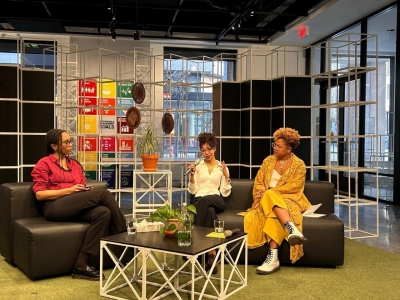 Dalia Elsayed, Leena Abdelrahim & Marlihan Lopez. Photo by Azfar Adib.