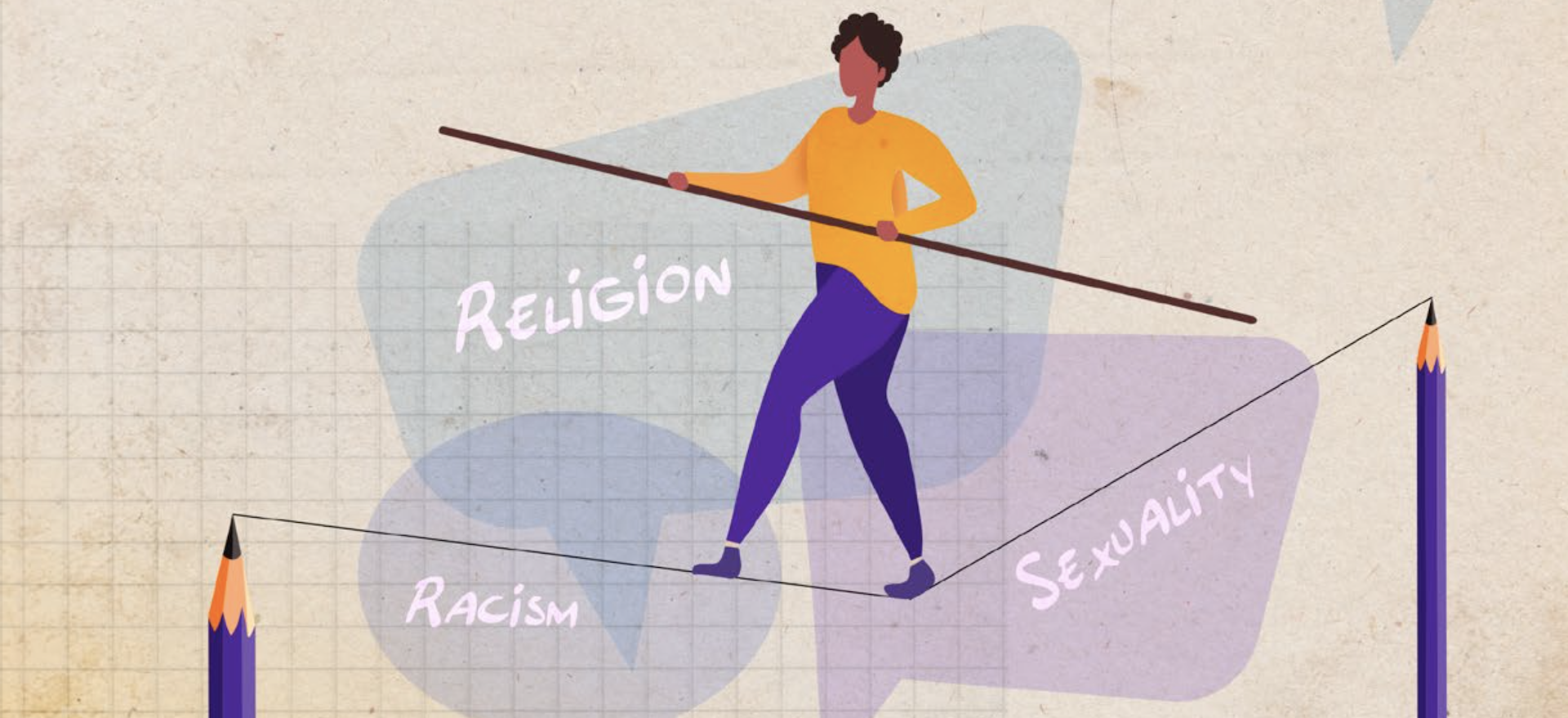
WILD WILLI Design – Fabian Will WILD WILLI Design – Fabian Will
Addressing the polarized classroom

Politically speaking, classrooms have never been a more challenging space to navigate. Students come to school armed with new and ever-changing conspiracy theories with which to provoke their classmates and teachers. Anti-vax parents demand that their scientifically suspect views be aired and given respect. Teachers find themselves under fire from local communities and politicians when they attempt to give instruction on politically tense topics like climate change, or respect for gender diverse people.

Several members of the CSLP have focused their research and scholarly interests on confronting this growing polarization, and aim to provide teachers with the skills and resources needed to operate in these higher stress environments.

The Team

David Waddington - CSLP co-director, Concordia University, Department of Education

Kevin McDonough - McGill University, Department of Integrated Studies in Education

Bruce Maxwell - Université de Montréal, Département d'administration et fondements de l'éducation

Ilya Zrudlo - Département d'éducation et pédagogie, Université du Québec à Montréal

Hicham Tiflati - Department of Humanities, Philosophy and Religion (HPR), John Abbott College

Tessa MacLean - PhD Student, McGill University, Educational Studies


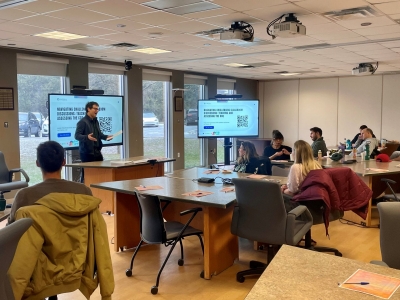
Photo from the WQSB workshops CSLP co-director David Waddington addresses school teachers at the WQSB workshops.

WQSB Workshops

On November 28, 2025, the CSLP, in collaboration with CIVIX and the Centre for Civic Religious Literacy (CCRL), hosted a full day of professional development workshops for educators and consultants at the Western Quebec School Board (WQSB). Designed to support teachers implementing the Culture and Citizenship in Quebec (CCQ) curriculum, the event was held at the WQSB offices and brought together researchers, pedagogical leaders, and classroom practitioners to address one pressing question: How can educators confidently navigate controversial issues in today’s polarized social climate?

The opening keynote, Teaching for Democracy in Divided Times, was delivered by Joel Westheimer (University of Ottawa), who explored the growing challenges teachers face when facilitating democratic discourse in polarized environments.

Tessa MacLean and David Waddington led a discussion on teacher positionality and navigating personal beliefs in classroom dialogue, “Should I Share My Views?” 

Alice Chan and Hicham Tiflati, representing CCRL, led a discussion of Religion in the CCQ.
Read our full event coverage.

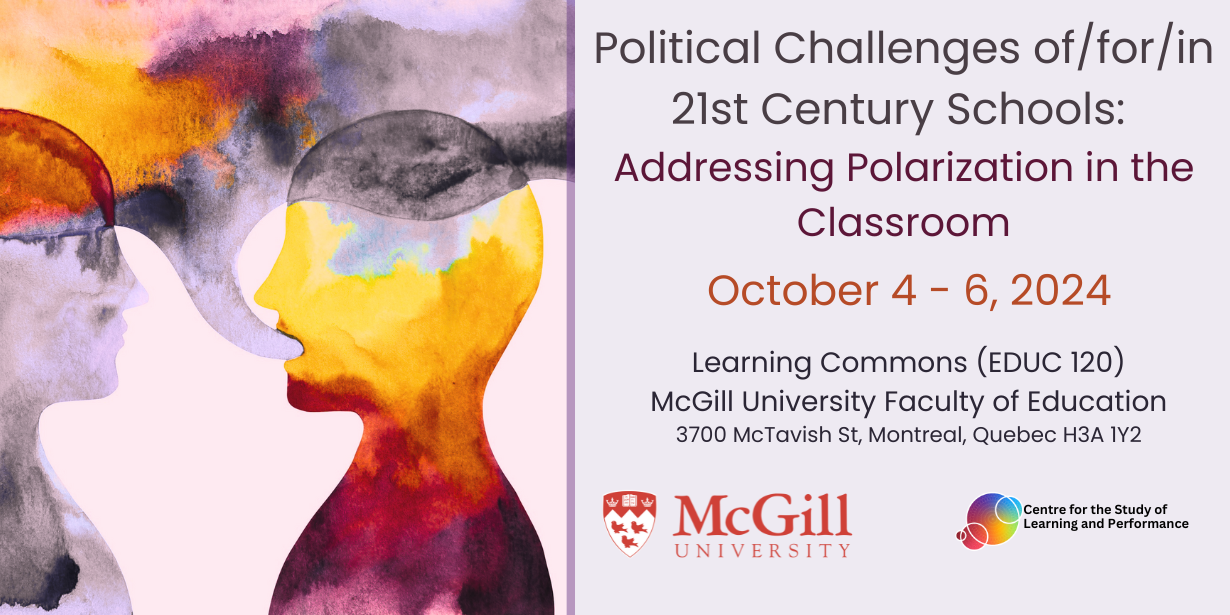
Political Challenages of/for/in 21st Century Schools: Addresssing Polarization in the Classroom

October 4-6, 2024, the team convened a Fall Institute to address urgent theoretical and practical questions and solutions about the role of education in politically polarized societies. Jointly organized by McGill University and Concordia University, the Institute was held at McGill University and featured two days of knowledge mobilization activities designed to further understanding of what problems arise when political polarization infiltrates schools and classrooms, and how teachers and schools can productively address these problems.

Academic Publications

  • Waddington, D., Maxwell, B., MacLean, T., McDonough, K. & Tavassoli, N. (2024). How free are classroom teachers? Understanding teacher academic freedom in the United States and Canada. Teachers and Teaching, Advance online publication. https://doi.org/10.1080/13540602.2024.2422859
  • Maxwell, B., McDonough, K., & Waddington, D. I. (2022). Teachers' freedom of speech in the classroom. In M. A. Peters (Ed.), Encyclopedia of Teacher Education (pp. 1946-1950). Springer. [PDF link]
  • Maxwell, B., McDonough, K., & Waddington, D. I. (2020). La liberté d’expression des enseignants en classe: quatre principes directeurs et leurs fondements juridiques. Revue des sciences de l’éducation, 46(3), 174-198. https://doi.org/10.7202/1075992ar
  • Maxwell, B., Waddington, D. I., McDonough, B. (2019). Academic freedom in primary and secondary school teaching. Theory and Research in Education17(2), 119-138. https://doi.org/10.1177/1477878519862543
  • Maxwell, B., McDonough, B., & Waddington, D. I. (2018). Broaching the subject: Developing law-based principles for teacher free speech in the classroom. Teaching and Teacher Education, 70, 196-203. https://doi.org/10.1016/j.tate.2017.11.020
  • Maxwell, B., McDonough, K., & Waddington, D. I. (2017). Does state secularism require teachers to abstain from wearing religious symbols at school? Philosophy of Education Archive, 422-430.
  • McDonough, K., Maxwell, B., & Waddington, D. (2015). Teachers, the state and religious symbols: A question of professional ethics. Theory and Research in Education, 13(3), 249-266. https://doi.org/10.1177/1477878515598054
  • Maxwell, B., Waddington, D. I., McDonough, K., Cormier, A.-A., & Schwimmer, M. (2012). Interculturalism, multiculturalism, and the state funding and regulation of conservative religious schools. Educational Theory, 62(4), 427-447. https://doi.org/10.1111/j.1741-5446.2012.00455.x

Speaker Series on Interdisciplinary Perspectives in Education

This series, launched by David Waddington and Kevin McDonough in 2021, has continued to attract substantial online audiences from around the world, as well as significant in-person audiences. Significant guests in the series include Sigal Ben-Porath (Penn) and Daniel Weinstock (McGill) on educational polarizationDaniel Weinstock on autonomySarah Stitzlein on educating citizens in a populist context, and Maya Goldenberg on the nature of disinformation.

All recorded sessions from the Speaker Series are available through our YouTube channel.

Back to top

© Concordia University