

Indigenous artworks transform Concordia's Hall Building terrace


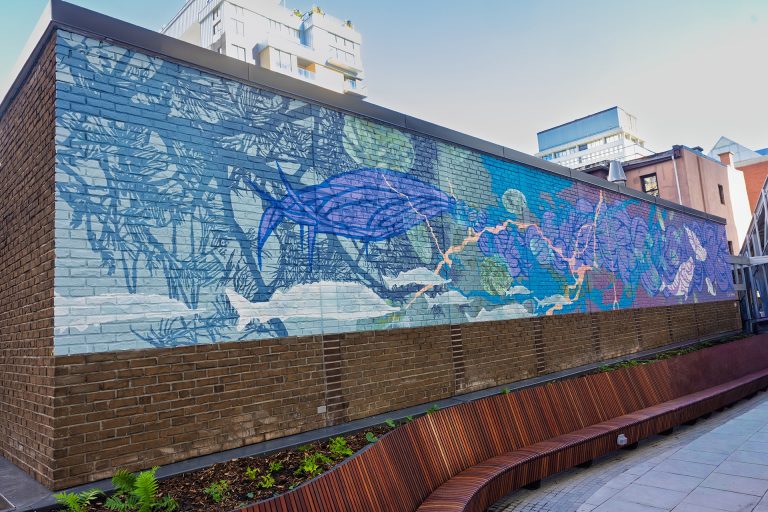
The redesigned Henry F. Hall Building terrace on Concordia’s downtown campus now features two new Indigenous public artworks.
The terrace provides a space for reflection, gathering and connection. The works, co-commissioned by the Indigenous Directions Leadership Council (IDLC) and Concordia's Public Art office, reflect the university’s commitment to inviting ongoing dialogue and fostering relationships with Indigenous communities.
The artwork also addresses one of the recommendations in Exploring Concordia’s Colonial Past. The recently published report recommends increasing the visibility of Indigenous peoples on campus through public art, produced and curated by Indigenous peoples.
The artworks were unveiled on September 30, the National Day for Truth and Reconciliation.
"These two memorable works by Indigenous artists with connections to Concordia affirm that Indigenous perspectives, knowledges and presence are integral to, and literally embedded in, the daily life of our campuses,” says Concordia President Graham Carr.
“The pieces bring a renewed energy to the Hall terrace by creating a welcoming, vibrant atmosphere for students, faculty, staff and indeed all Montrealers and visitors to the city," he adds.
The Indigenous Directions Action Plan published in 2019 includes recommendations that support the inclusion of Indigenous peoples on campus and the celebration of Indigenous cultures.
"The renovation of the Hall terrace was the perfect opportunity to design a significant and visible space on campus that reflects Indigenous cultures and that includes two wonderful works of public art," says Manon Tremblay, senior director of Indigenous Directions.
"We hope that this is just the beginning and that such efforts will contribute to a sense of belonging for our Indigenous students, staff and faculty," says Tremblay.
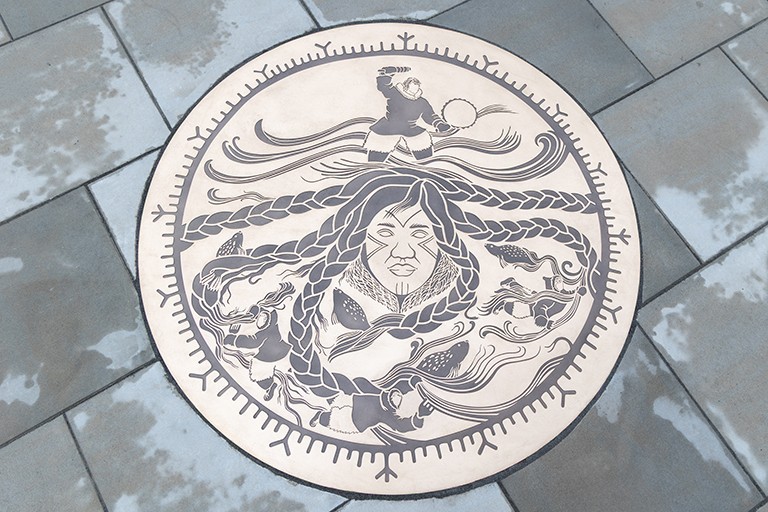 A Song for Nuliajuk, 2026, by artist Jason Sikoak.
Artworks designed for gathering and reflection
The bronze medallion A Song for Nuliajuk (2026), created by artist and Concordia student Jason Sikoak, is embedded in the terrace pavement and surrounded by a circular seating area which serves as a focal point and a gathering space for storytelling, reflection and communal presence.
The medallion illustrates an Inuit ceremony meant to honour and appease Nuliajuk, also known as Sedna, a figure whose name and story vary across Inuit Nunangat and the Circumpolar North.
The artwork marks an important milestone as the first Indigenous permanent public artwork to enter Concordia's public art collection.
Nearby, the panoramic mural Teionihtiohtia:kon (2026), by artist duo Hannah Claus and Kaia'tanó:ron Dumoulin Bush, transforms a brick wall facing the Indigenous-designed terrace. The mural weaves together multiple perspectives – sky, water and land – to activate Indigenous understandings of time, memory and presence.
Teionihtiohtia:kon launches Concordia’s new Indigenous mural program, part of the temporary public art program. Led by the Public Art office in partnership with MU, a Montreal-based mural company, the Indigenous mural program reflects the university’s commitment to reconciliation and the Public Art Strategy and Policy, which promotes equitable representation in the university's public art collection.
"Working with Manon and the artists on these projects has been a privilege,” says Sandra Margolian, public art lead at Concordia. “For me, the significance of this work extends beyond the addition of new artworks to the collection. These pieces create space for Indigenous stories and ways of knowing to be experienced and celebrated on our campuses.”
“I hope they contribute to a sense of belonging and connection, and that they encourage people to engage with Indigenous perspectives in ways that are respectful, accessible and lasting."
Located behind the Hall Building, the terrace is a central and symbolic gathering space on Concordia's downtown campus. Facilities Management oversaw several improvements to increase the Hall Building's capacity, including the construction of a new exit stairwell.
“The redesign created an opportunity not only to upgrade infrastructure, but also to reimagine how the space serves the university community,” says David D’Arcangelo, senior director of project management.
“Alongside these essential upgrades, the terrace was redesigned to create a more aesthetic, accessible and inviting environment. Integrating Indigenous design elements, such as an Indigenous garden, onto the terrace played a central role in the project,” he adds.
Discover Concordia’s public art collection.
Read the report, Exploring Concordia’s colonial past.