

John Molson School students develop and present an AI solution to industry client



Artificial Intelligence (AI) has become ubiquitous since the public launch of ChatGPT in 2022. Its applications for business are far reaching, but understanding the risks is critical for the next generation of responsible business leaders.
Students in Concordia’s John Molson School of Business were given a real-world business challenge and tasked with applying an AI solution by creating an app in a course offered by the Department of Supply Chain and Business Technology Management, BTM 490: Introduction to Artificial Intelligence for Business.
The course introduced students to all aspects of AI — its history, the different types and their functions, use cases in organizations, governance and the regulatory environment, its social and environmental impact, and the ethical challenges.
The final project was a business challenge provided by AuChamp, a platform for agronomists, who are experts in the science of soil management and crop production for the food and wine industry.
The agronomists who use the platform provide services subsidized by the Ministry of Agriculture, and need to produce reports to qualify for funding.
Students in the course were given sample anonymized data representing the kind of data the agronomists collect, the format it’s stored in, and the template for the reports. Using this information, they worked in teams to create an app that would address Auchamp’s challenges. They then presented it to Jean-François Péloquin, the platform’s developer.
“The client was extremely impressed with the students’ skills, capabilities and ideas,” says Tanya Giannelia, the assistant professor who developed and teaches the course.
“I was impressed with their creativity and professionalism. This is about as real life as it gets.”
Students not only presented their app to Péloquin, but he was responsible for evaluating their presentations, asking questions, providing feedback and ultimately giving a grade to each final project.
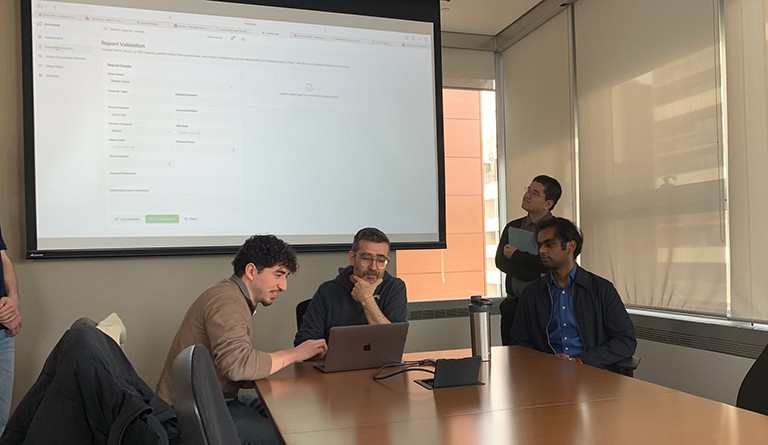 From left: Diego Caporuscio with Jean-François Paquin, agronomist, Vient Thanh Nguyen and Rakesh Thiyagarajah.
‘The course teaches essential skills in using AI for work’
One of the students, Hasan Al-Thawr, is in his final year, majoring in Business Technology Management with a minor in Supply Chain Operations Management. He says his perception of AI changed after taking BTM 490.
“One of the biggest shifts for me was realizing that AI is not the solution to every problem,” he says.
“Instead of approaching a situation with ‘how can AI solve this?’, the better approach is to first understand the business problem and the value the organization is trying to achieve, then determine whether AI is even the right tool. That mindset change was really important.”
Hasan says he also gained a deeper understanding of responsible AI, particularly as it relates to bias and how that can be addressed.
Judy El Kadi is a second-year student studying business technology management. She says the course is important for all business students, not just those in business technology management.
“It teaches essential skills in using AI for work and it also allows us to understand the impact and effects it has, whether sociological, ecological, or financial,” she says.
Giannelia is currently teaching an adapted version of the course for master’s students with a stronger research focus.
The course will be offered to undergraduate students as an elective in Winter 2027 and to MBA students as BTM 695.
Beginning in the 2027-2028 academic year, the course will be offered more frequently under the course code BTM 385, and will be a mandatory course for the Business Technology Management undergraduate major and minor.
“I learned so much in the course through both theoretical and hands-on activities,” says Rakesh Thiyagarajah, a Business Technology Management Co-op student. “I plan on using the skills I have learned from this class in the workplace.”
Learn more about the Department of Supply Chain and Business Technology Management at Concordia’s John Molson School of Business.