

ARTH 371 Studies in Canadian Architecture
- Instructor: Ariele Dionne-Krosnick
“Architecture is politics in three dimensions.” That is a useful principle to keep in mind when you walk around any town or city, or drive through the countryside in Canada. It means that the kind of buildings people put on a landscape do more than merely reflect prevailing political or social views or economic conditions. They also play a large part in shaping those political and social views. – Alan Gowans, Canada’s Urban History in Architecture (1982)
A wide-ranging survey of modern and contemporary architecture across Canada and its significance in the political, social, and cultural context of the country. Inspired by the publication Canadian Modern Architecture: A Fifty Year Retrospective (1967-2017)(Princeton Architectural Press, 2019), the course is organized thematically around four axes: National Movements; International Influences; Regional Responses; and Centers of Influence. We will question architecture’s role in promoting dominant nationalist narratives and its enmeshment with systems of power by looking at buildings that have contributed to defining Canadian institutions and infrastructure. We will explore Canada’s role and participation in global architectural and urban trends, and learn to define major architectural styles, typologies, and movements that have transformed Canadian cities. Students will learn to distinguish Canada’s regional architectural styles and investigate their development as responses to the unique geographic, cultural, and political identities of the West Coast, Prairies, Atlantic Provinces, and the North. Finally, we will explore how the culture of architecture in Canada has been shaped by its three largest cities: Montreal, Toronto, and Vancouver.
This course is shaped by the acknowledgement that Canada is a settler-colonial state. Adopting a decolonial approach, we will consider how architecture has historically transformed First Nations and northern communities, and the strategies of Indigenous architects who have continually produced counternarratives through their practices of the built environment. Throughout the semester we will pay attention to the different forces—such as settler colonialism, multiculturalism policy, immigration, economic urban renewal reforms, housing alienation, climate—that contribute to the transformations of Canada and its buildings over time. Understanding that systemic racism has historically shaped the Canadian landscape—through infrastructures to support the slave trade, indentured labor of Chinese railway workers, etc.—we will uncover how historic contributions to the built environment by racialized people continue to impact our understanding of contemporary architecture to this day. We will consider architecture as an instrument of violence, exclusion, extraction, and exploitation, but also as a potential tool for resistance, refusal, and reparation.
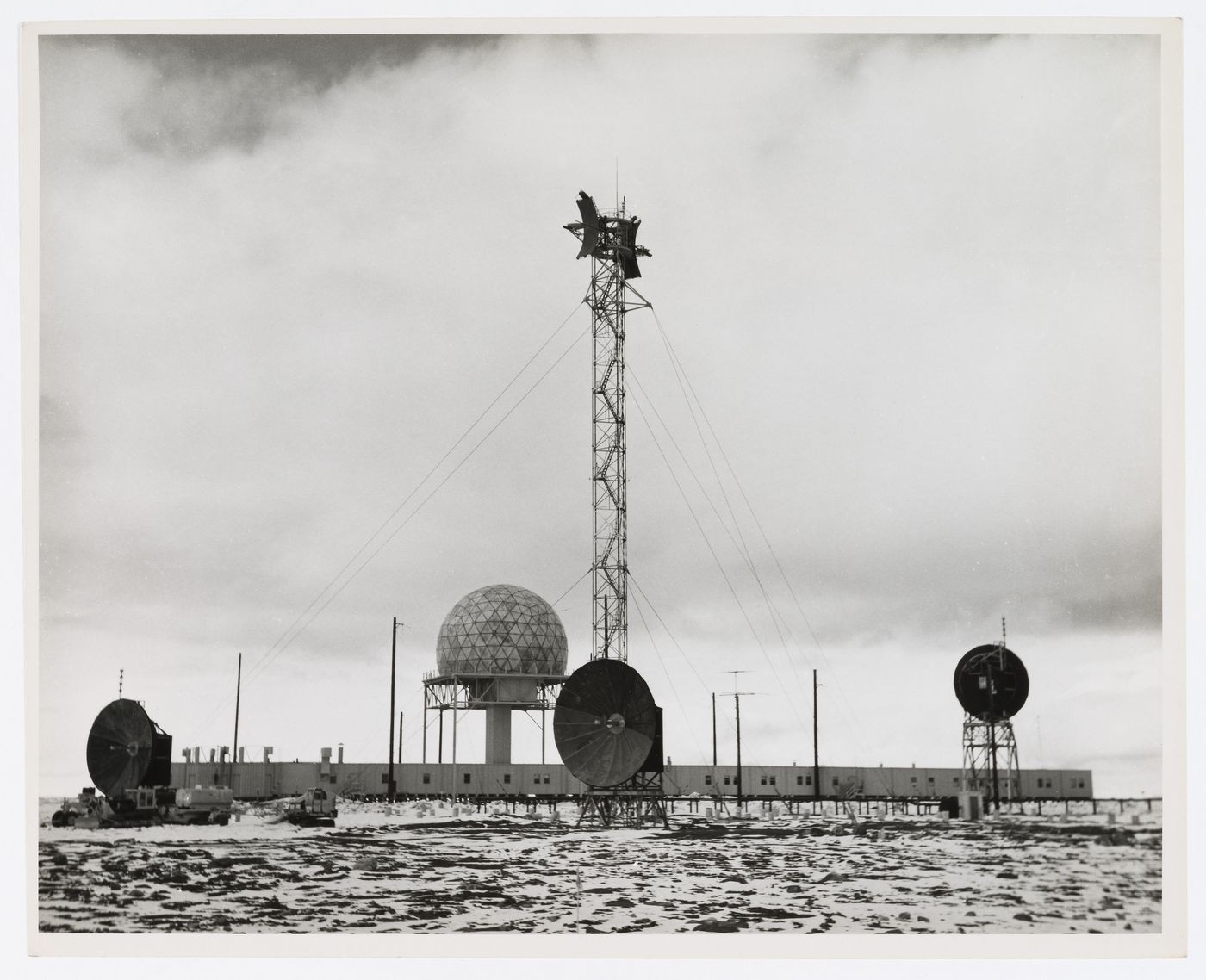 Unknown photographer. View of DEW Line radar station BAR-3, Tuktoyaktuk, Northwest Territories, Canada, circa 1960. CCA, PH2016:0004:015