

ARTH 263 Aspects of the History of the Print: Early Modern Print Culture
- Instructor: Dr. Laurence Garneau
This course examines European printmaking from the fifteenth to the eighteenth century (c. 1450-1750), with particular attention to artistic exchanges between Germany and Italy, as well as to print production in the Netherlands, France, Spain, and Britain. Adopting an historical perspective, the course traces the emergence of Early Modern woodcuts and engravings while acknowledging the influence of East Asian technologies on European print practices.
Alongside the study of key techniques, such as chiaroscuro woodcut, intaglio, and etching, and a wide range of iconographies, including mythological figures, biblical narratives, medical treatises, maps, esoteric texts, scientific publications, and military manuals, students will explore the political and social roles of printmaking within religious, urban, scientific, technical, and economic contexts. Through a combination of lectures, discussions, workshops, readings, and close visual analysis, the course addresses central questions such as: how did the circulation of images contribute to the democratization of art? What role did print play in the Protestant Reformation? How did scientific knowledge shape artistic practices? And in what ways did printmaking challenge artists’ social and professional status? By the end of the semester, students will have acquired a solid technical vocabulary, will be able to articulate connections between prints and historical events, and will demonstrate the ability to analyze Early Modern woodcuts, engravings, and etchings with rigor.
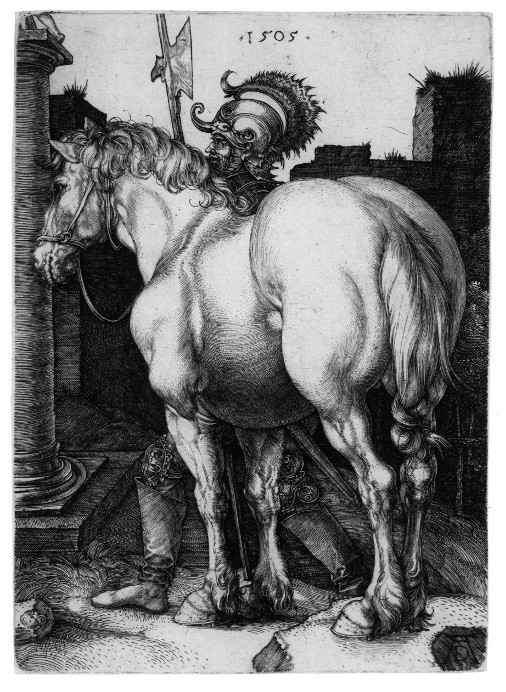 Albrecht Dürer, Large Horse,1505, print, The MET collection