

ARTH 611 Landscapes and Built Environments: Utopian Terrains
- Instructor: Dr Nicola Pezolet
This graduate seminar is structured around a series of critical and historical discussions on the significance of the concept of “utopia” and how it has played a key role in both the religious and the secular imagination in Europe and the transatlantic world over the modern period. We will begin by looking critically at the foundational text Utopia by Thomas More (1516), as well as older works considered to be precursors, such as Plato’s Republic(c. 380 BC). Then, we will consider the various ways the concept of utopia may be connected, as Jürgen Habermas has argued, to various interpretations of religious scripture (more specifically “to the hope, familiar in Jewish and Protestant mysticism, of the ‘resurrection of fallen nature’”). We will also analyze the ways that artists, architects and city planners have attempted to develop comprehensive solutions, both formally and socio-economically, to address the perceived problems of modern societies. Each week will be devoted to specific case studies of social utopias, built and/or unbuilt, oriented towards the past, the present or the future. Class discussions will attempt to draw up a critique of how such utopian visions, which purported to be democratic and emancipatory, have often been ideologically coopted and compromised by socially destructive phenomena like totalitarianism, colonialism and what anthropologist James C. Scott has famously called “authoritarian high modernism.” Each student will be invited to pay particular attention to the mediation/dissemination of utopian thought and visions through print culture (books, magazines), media and more recent forms of digital technologies. Emphasis will also be place on the interface between utopian buildings and their environments/landscapes.
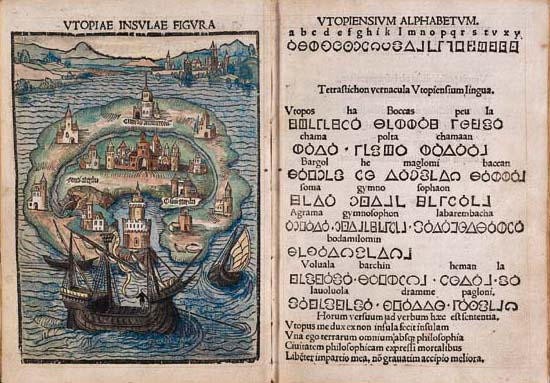 Colorized map of Thomas More, Utopia, 1516.