
John and Pina Sicard’s $1-million gift to Concordia supports neurodiverse students and innovation at the Gina Cody School


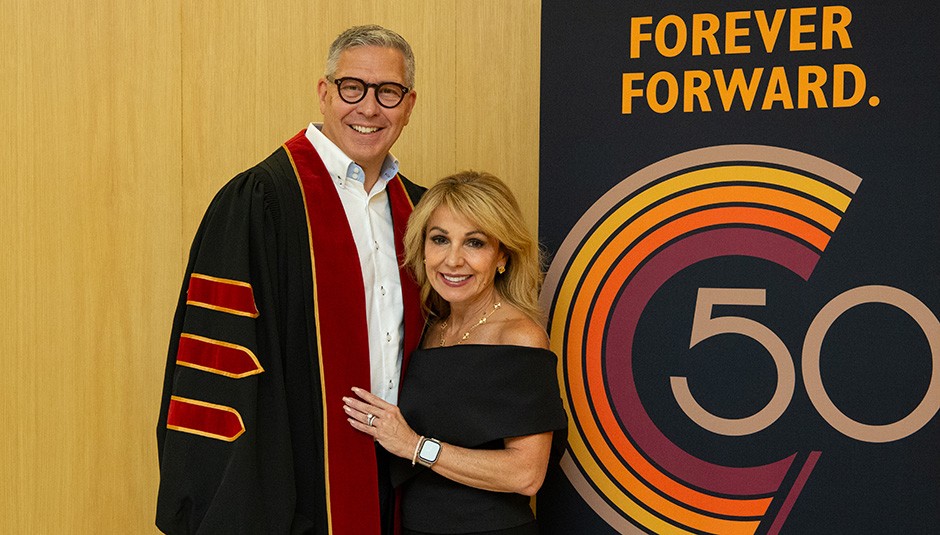 “Creating conditions where brilliant minds can colour outside the lines — that’s where big innovations are born,” says John Sicard, pictured here with his wife Pina Sicard, BA 87, in 2024.
For John Sicard, BCompSc 88, DSc 24, returning to Concordia in 2024 to receive an honorary doctorate and speak at Homecoming felt like coming full circle.
“Concordia took a chance on me when I was a 20-year-old mature student,” he says. “That ‘yes’ changed my entire life. It gave me a path, a career and a purpose.”
Sicard, the retired president and CEO of Kinaxis, a global leader in supply-chain management software, has often described his admission to Concordia as the turning point that made his career possible.
Before that, he’d been an aspiring musician — “U2’s next drummer,” he jokes — who was rejected from the university’s fledgling music program. Only later, after upgrading his academics and discovering an unexpected talent for mathematics, did he apply to the computer science program through Concordia’s mature-student pathway.
“When I walked onto campus and touched a computer for the first time, it felt like a calling,” he says.
A gift to spark creativity — and open doors
Now, through a $1-million gift, John and his wife Pina Sicard, BA 87, are helping future generations of students at the Gina Cody School of Engineering and Computer Science find their own way forward.
Their generosity will establish the John and Pina Sicard Endowment for Students in Engineering and Computer Science with Autism Spectrum Disorder, as well as a series of scholarships and fellowships to foster innovation and inclusion across the school.
“John and Pina’s generosity embodies the Concordia spirit of learning and inclusion,” says Concordia President Graham Carr. “Their commitment will make a lasting difference for students and researchers at the Gina Cody School and across our university.”
Part of the Sicards’ gift will support the school’s innovation ecosystem, including interdisciplinary student teams working on entrepreneurial and research projects with real-world impact.
“Creating conditions where brilliant minds can colour outside the lines — that’s where big innovations are born,” says John. “I love programs where students collaborate, riff off each other and build Canadian-made ideas that can change the world.”
The gift will also fund fellowships in supply chain and logistics, the field in which Sicard built his three-decade career at Kinaxis, helping transform a small Ottawa software firm into a global powerhouse operating in more than 20 countries.
For the Sicard family, the most meaningful part of the gift supports students with Autism Spectrum Disorder (ASD). Their son Nicholas, diagnosed at age two, is now 31 and thriving — a software tester and, as his father proudly notes, “a wonderful young man.”
But the family’s long journey also revealed gaps in support for neurodiverse adults.
“There are very few resources for people on the spectrum once they turn 18,” says John. “We want families and students to know that there is a place for them at Concordia.”
At Kinaxis, Sicard made a public commitment to hire at least one per cent of the workforce from the neurodiverse community — a goal the company surpassed, reaching two per cent with the help of Specialisterne, a global organization specializing in neurodivergent recruitment.
“It was a win-win,” he notes. “You have to do it on purpose — inclusion doesn’t happen by accident. And we saw first-hand how powerful it can be.”
A community built for every kind of mind
Pina Sicard — a Translation alumna and long-time advocate for autism awareness — shares that conviction. John and Pina’s lived experience as parents has inspired much of their philanthropy, including a major contribution to QuickStart Autism, an Ottawa-based organization promoting early intervention and awareness.
“Concordia has always held a special place in our lives,” she says. “As parents of a neurodiverse son, we know how transformative the right environment can be. Our hope is that students on the spectrum will feel supported and seen — and discover their own path, just as John and I did at Concordia.”
Sicard remains deeply impressed by how far the Gina Cody School has advanced since his student days.
“Even in the 1980s, we loved to say our computer science program was leagues ahead,” he recalls with a smile. “To see the school now ranked among the top in North America — it hasn’t lost an ounce of what made it great. It’s built on 50 years of pedigree.”
Receiving his honorary doctorate in 2024 was, he says, one of the most emotional experiences of his life. “More than anything, it gave me a meaningful way to say thank you for the risk Concordia took on me,” he reflects.
The Sicards’ donation will support students and researchers through 2030 and beyond, ensuring sustained investment in inclusion, innovation and academic excellence.
“John and Pina’s vision aligns perfectly with the school’s priorities of student success, equity and innovation,” says Mourad Debbabi, dean of the Gina Cody School. “Their gift ensures that talented students — including those on the autism spectrum — can thrive in a supportive environment designed to unlock their creativity.”
For John Sicard, that impact is ultimately about people — and potential.
“Innovation isn’t just about technology,” he says. “It’s about creating space for every kind of mind. When we do that, everyone moves forward.”