

A new chapter for Concordia’s Laptop Orchestra


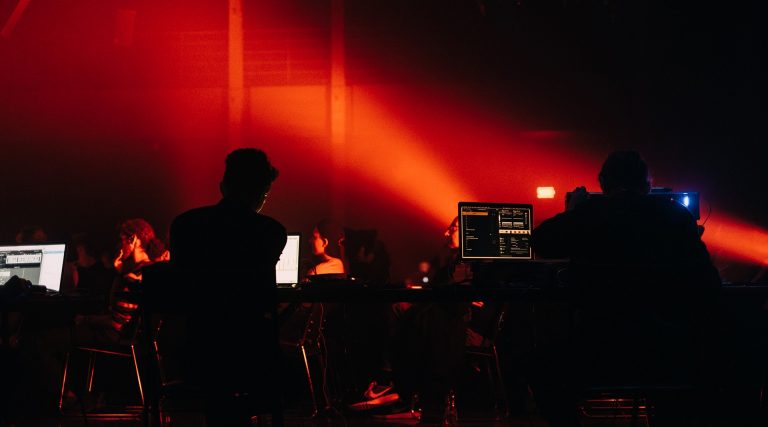
Fifteen years after Concordia’s Laptop Orchestra (CLOrk) began experimenting with what an ensemble of digital instruments could do, its work is being recognized in a new chapter of The Oxford Handbook of Orchestration Studies.
Written by CLOrk founder Eldad Tsabary, electroacoustics professor and head of music in Concordia’s School of Performance “Orchestrating the Laptop Orchestra” is the latest milestone for an ensemble that has spent the past decade and a half pushing at the boundaries of electronic performance, research-creation and genre.

Breaking down isolation
Founded in 2011, CLOrk was created in response to the solitude experienced by many electroacoustic musicians.
“It was a very different time,” Tsabary says. “Electroacoustic musicians and students differed — they still do — from other musicians, in that their work is mostly in the studio, mostly alone. It felt like there was a missing element in their musicianship.”
Driven by a “Whatever Works (WheW)” — a term coined by Tsabary and Jamie Woollard to describe an action-centred, adaptive approach to collaborative creation and problem-solving — CLOrk draws students out of the studio and into collaborative performance and real-time audio manipulation.
This approach has also allowed CLOrk to grow well beyond the typical size of a laptop ensemble. Unusually large for a laptop ensemble, CLOrk has comprised as many as 30 artists and collaborated with symphonic orchestras in performances involving up to 100 musicians.

A changed approach to improvisation
CLOrk’s first public performance took the form of a telematic concert, an event that connects live performers across geographic locations. With artists contributing from Montreal, Calgary and Edmonton, the concert established networked performance as a defining element of the ensemble.
The orchestra has since maintained this model in performances ranging from the Freespace Jazz Fest in Hong Kong to England’s Cambridge Festival. But for Tsabary, a vital lesson came not from CLOrk’s international appearances, but a 2014 research-creation collaboration in Montreal, Dancing with Laptops.
“The students often rehearsed without me,” he says. “At a certain point, they decided they didn’t need me, that the dancers could be the conductors. I thought, ‘I'm just going to step aside and see what happens.’
“About 20 minutes into the performance, somebody led a chill beat, and they all got stuck on it. The dancers became agitated and tried pulling them away from it. Eventually, one dancer began screaming.”
Only then did the orchestra begin moving away from the initial beat.
The experience challenged the assumption that successful collective improvisation required everyone to converge on the same musical direction, Tsabary explains. Instead, CLOrk began thinking about improvisation as the simultaneous interaction of multiple people, each capable of influencing where the music goes.
“It really changed the way we understand improvisation,” he says. “We stopped using the term ‘collective’ improvisation. Instead, we use the term ‘multiplicitous’ to indicate the multiplicity of minds and agents.”
Upcoming projects
In the upcoming term, student members of CLOrk will develop a concert in the Library’s Visualization Studio.
“The space offers some interesting possibilities for combining sound, spatialization, live coding and visual or audiovisual elements,” says Norah Lorway, assistant professor of electroacoustic studies and the orchestra’s current guide. “I’m hoping we can use the concert to explore more immersive and collaborative approaches to performance.”
Future projects will also include an increased focus on creative, critical and responsible forms of human-AI collaboration, a reflection of Lorway’s research.
As for the next 15 years, she says she looks forward to CLOrk’s continued development as a space for experimentation.
Learn more about Concordia’s School of Performance.
Find out more about Concordia Library’s Visualization Studio.