

Early career Concordia researchers push next-generation battery technology


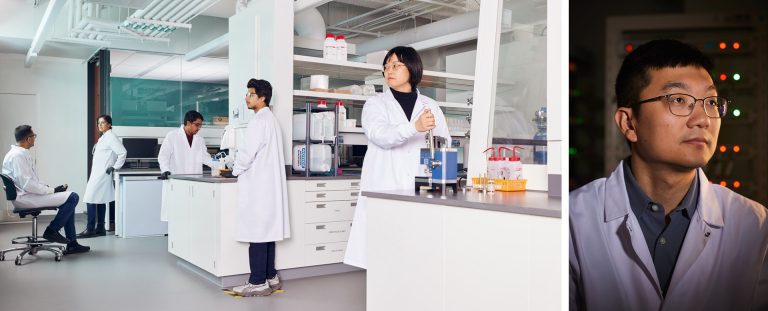
Next-generation batteries promise faster charging, higher energy storage and cleaner energy systems — but technical challenges remain in materials, design and safety. Early career Concordia researchers Xia Li and Sixu Deng are helping Canada chart a path toward a cleaner, electrified future while training the next generation of scientists.
Li, an associate professor in the Department of Chemical and Materials Engineering, and Deng, an assistant professor in the same department, are co-principal investigators on a Volt-Age Impact Project led by principal investigator Karim Zaghib. The project advances two next-generation battery technologies: Ultra-High Energy Density and Fast Charging Lithium Rechargeable Batteries.
One battery is an advanced lithium-ion model designed for cost-effective, fast-charging performance. The technology uses materials sourced within Canada.
The second battery is a next-generation solid-state lithium-metal battery which promises ultra-high energy density, packing more power into a smaller, lighter package. It can recharge in just five minutes and withstand more than 10,000 charge cycles, offering long-lasting performance for vehicles and devices.
“We started thinking about the devices we use daily — our phones, laptops — and how batteries make them work. That same technology can now help power electric vehicles and zero-emission buildings,” Li says.
From lab to market
The project is based at Concordia’s Collaborative Centres on Energy and its Transition (C2ET). In the lab, Li and Deng are guiding a team of over 20 students through experiments on novel materials, interfaces and battery designs. Their research is highly collaborative, with industry and government labs partnering to explore sustainable energy solutions.
“Being an early career researcher comes with a lot of responsibility. You’re building a team, developing your research direction, and keeping pace with a field that’s evolving every day,” Li says.
The team’s work is already producing tangible results, including patents and publications. Examples include Li’s recent research on indigo, a natural pigment most commonly used in blue jean manufacturing.
The study showed that indigo can improve solid-state battery chemistry and support more sustainable energy storage.
An opportunity for international leadership
Canada and Quebec are positioning themselves as global leaders in battery innovation. From mining and processing to cell manufacturing and recycling, projects like these advance every step in battery development — while generating highly qualified personnel and new intellectual property.
Deng says support from Concordia and Volt-Age, including funding, lab resources, mentorship and collaborative networks, have allowed the researchers to grow their group and take on complex projects with confidence.
“Ultimately, our goal is to advance this technology in a way that benefits people and society,” Deng adds.
“We’re not just testing materials in the lab. We’re also thinking about how these batteries will work in vehicles, homes and off-grid systems, and training students to carry this knowledge forward,” he says.
Discover the Concordia Department of Chemical and Materials Engineering.