

Concordia alumni help launch network putting culture at the heart of global diplomacy


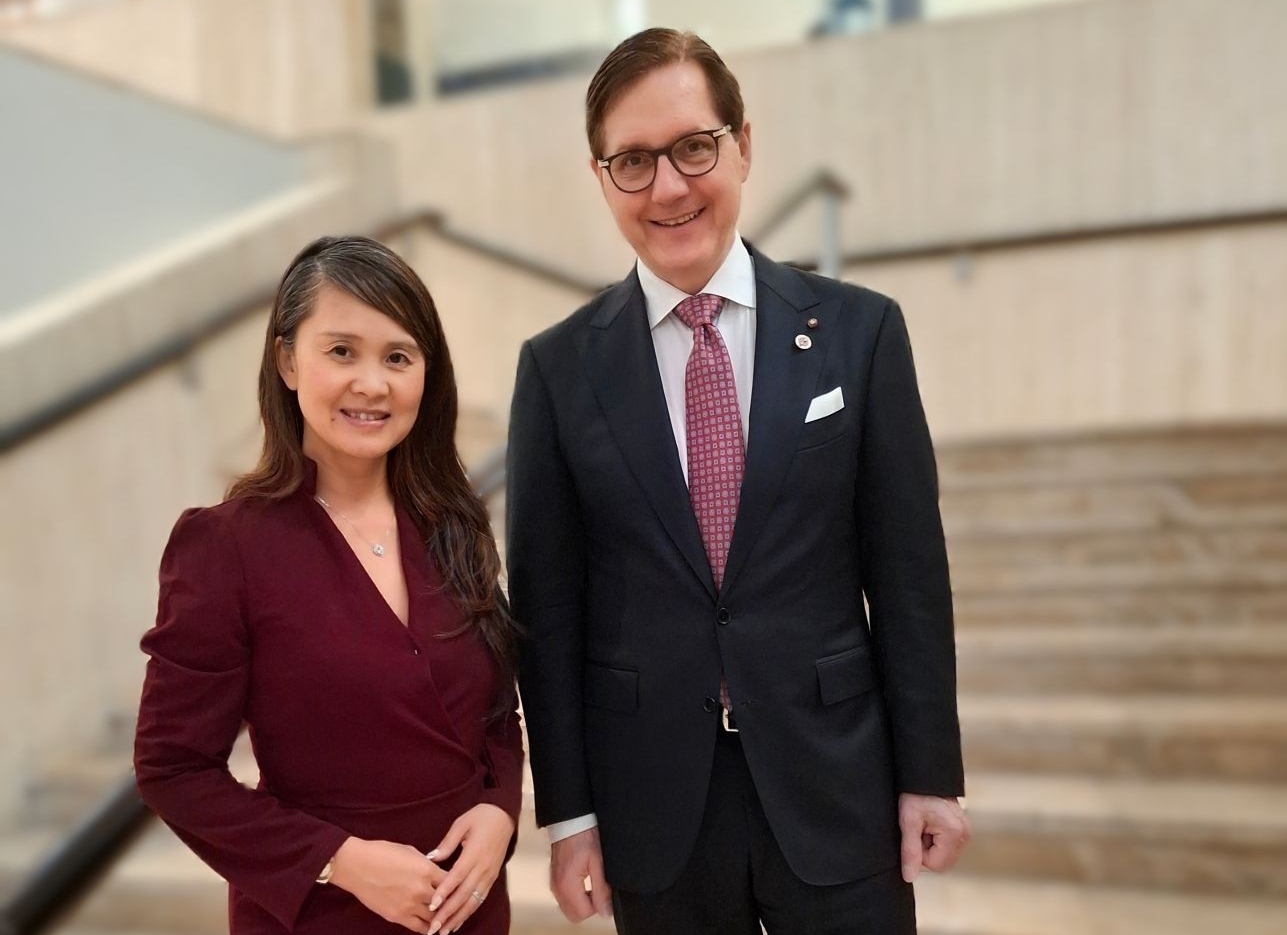 Thi Be Nguyen, BComm 98, and Senator Tony Loffreda, BComm 85
The newly launched International Cultural Diplomacy Network (ICDN) is putting cultural understanding at the centre of how Canada builds relationships abroad — with an eye toward strengthening international trade, diplomacy and co-operation.
The Montreal-based non-profit brings together cultural communities, governments, diplomats, educational institutions and businesses to build the trust that underpins lasting international relationships.
Thi Be Nguyen, BComm 98, is the ICDN’s founding chair. She launched the network with honorary chairs Louis Vachon, LLD 19, former CEO of National Bank of Canada, and Senator Tony Loffreda, BComm 85, a 2024 Great Concordian.
Another Concordian, Claudia Gervais, GrDip 05, president of Grace PR, is a member of the ICDN’s board of directors.
“Cultural diplomacy is about mutual respect,” says Nguyen. “It’s understanding someone’s history, background and values so that we can work together. And that applies to everything — not just the arts or history, but business, education and our everyday interactions.”
The idea for the network partly grew out of Nguyen’s two decades at National Bank, where she became involved in international trade and worked with partners in Southeast Asia. She went on to establish and lead the Canadian office of the Canada-ASEAN Business Council (CABC), working with governments, diplomats, businesses and organizations across Canada and the region.
That work also brought Nguyen back to Concordia. The CABC’s Canadian office was inaugurated at the John Molson School of Business in 2022, creating a hub for advocacy, networking and education between Canada and the ASEAN region.
Concordia also participates in the Canada-ASEAN Scholarships and Educational Exchanges for Development (SEED) program, which supports short-term study and research exchanges between Concordia and participating ASEAN institutions.
Through her work with CABC, Nguyen saw that free-trade agreements alone could not guarantee successful relationships, particularly for small and medium-sized businesses looking to enter unfamiliar markets. Cultural understanding, she says, can be just as important as financing, market knowledge and awareness of trade agreements.
“Trade is important, but it’s also important to understand how we operate, what our values are and how we can build growth together,” she says.
Building trust beyond the negotiating table
For Senator Tony Loffreda, who spent 35 years in finance before being appointed to the Senate in 2019, that understanding starts with listening.
“Cultural diplomacy begins with people learning about one another — their language, their history, their traditions, their creativity and their perspectives,” he says. “We have to listen first, understand who we’re dealing with and approach those relationships with compassion.”
That approach can ultimately create opportunities that extend far beyond cultural exchange, he adds.
“Trust is the currency of every relationship,” Loffreda says. “The same principle should apply between nations. If you don’t trust, you cannot collaborate.”
The ICDN has three central priorities: connecting people and institutions across borders; engaging Canada’s diverse cultural and official-language communities; and working with businesses and trade networks to turn greater understanding into opportunities for co-operation.
The network also draws inspiration from a 2019 report by the Senate’s Foreign Affairs and International Trade Committee, Cultural Diplomacy at the Front Stage of Canada’s Foreign Policy, which called for cultural diplomacy to become a pillar of Canada’s foreign policy.
For Loffreda, the principle is particularly relevant when political or economic relationships are strained. Cultural diplomacy can create the familiarity and confidence needed to keep dialogue open, even when countries disagree.
“If we want Canadian businesses to develop lasting partnerships abroad, understanding the people we hope to work with matters,” he says.
Nguyen sees the network as a natural complement to Canada’s trade relationships — and as something that can begin at home. She hopes the ICDN will eventually support cultural-diplomacy education in Canadian high schools, beginning in Quebec, and showcase leaders who demonstrate its principles.
For Nguyen, the mission is also deeply personal. Her family fled Laos after the Vietnam War and spent nearly a year in refugee camps in Thailand before resettling in Canada. That experience shaped her belief that understanding the past should help people move forward rather than remain defined by it.
“Our history lets us know what happened, but it doesn’t mean we need to be stuck there,” she says. “It’s important to heal, to move forward and to find what unites us.”
That, ultimately, is what she hopes ICDN can help build: relationships grounded not simply in negotiation, but in mutual understanding.
“We want to build together,” Nguyen says. “We want to empower with a positive narrative.”