

From Stingers pioneers to world champions: Concordia grads help Canada punch ticket to LA28


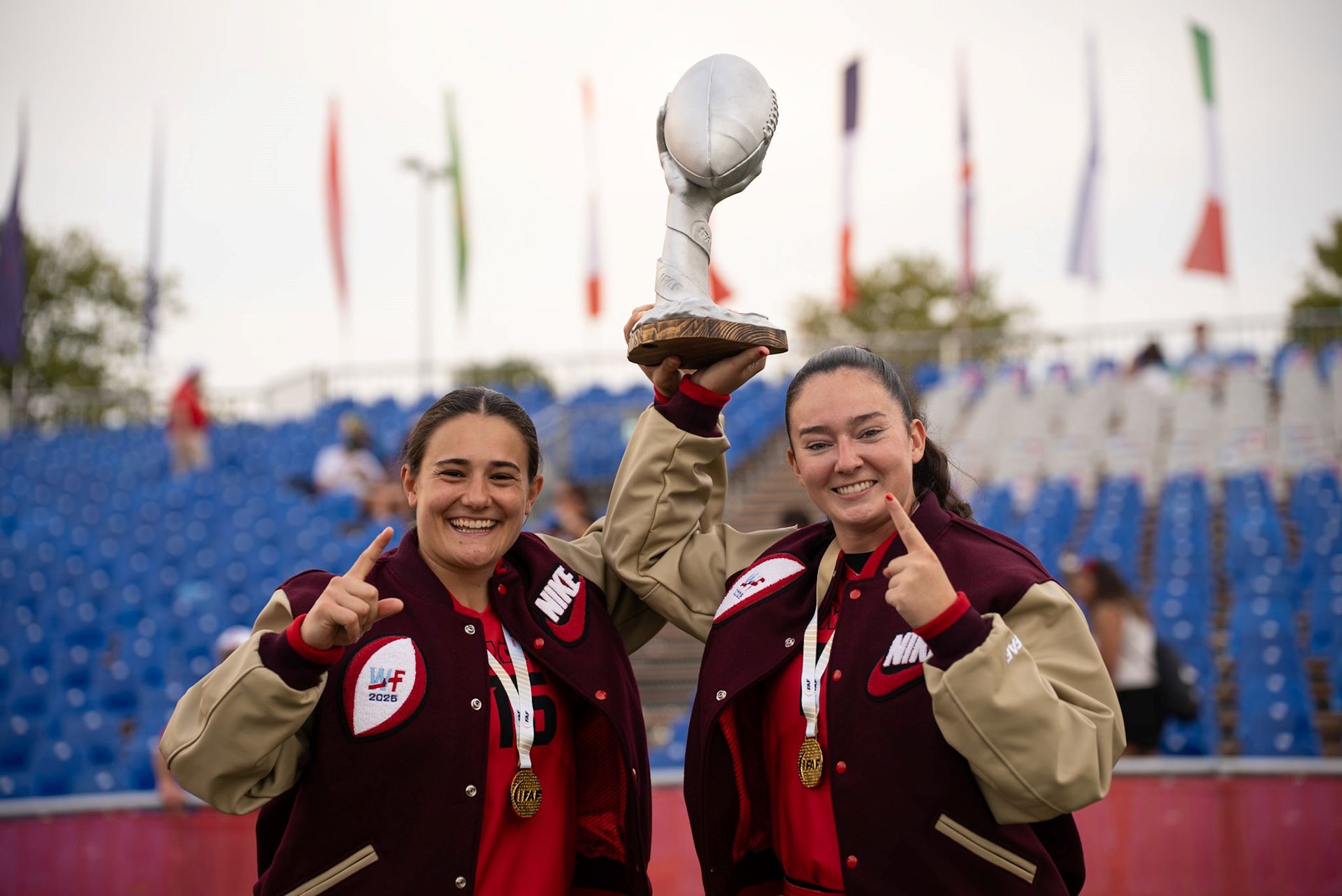 Caroline Moquin-Joubert (left) and Sara Parker
When Sara Parker, BSc 24, and Caroline Moquin-Joubert, BComm 24, first helped establish flag football at Concordia, they were building something that barely existed.
Five years later, the two former Stingers have helped take the sport to its highest level.
Parker and Moquin-Joubert — and current Concordia student and Stinger Laura Molimard — were members of Team Canada’s undefeated squad that captured gold at the 2026 IFAF Flag Football World Championships in Düsseldorf, Germany, in August.
Canada defeated the United States 27-20 in the final, securing a place at LA28, where flag football will make its Olympic debut.
Parker, a graduate of Concordia’s Athletic Therapy program, was named tournament MVP after throwing 23 touchdown passes, while Moquin-Joubert caught nine touchdown passes over the championship run. The former Stingers teammates connected for a touchdown in the gold-medal game.
For Parker, the achievement is the latest chapter in a story that began when she was a student during the COVID-19 pandemic.
She worked with students at other Quebec universities to kick-start a university flag football league, then helped establish Concordia’s team by contacting university administrators and the Concordia Student Union and figuring out how to build a club from the ground up.
The inaugural season was 2021. Parker and her teammates handled much of the work themselves, from budgets and coaches to uniforms, equipment and field bookings.
What began as a student-run club eventually became a Stingers varsity sport in 2025.
Parker played four seasons with the club and one as a Stinger before returning to Concordia to pursue a master’s degree and be part of the flag football team’s coaching staff.
“It’s just incredible to be part of building something at Concordia,” says Parker, who also serves as an athletic therapist at Collège André-Grasset. “I’m always going to be so grateful for the time that I had as a student athlete. It shaped who I am, and Concordia will always feel like home.”
From the Stingers to Team Canada
The growth Parker helped spark at Concordia mirrors the evolution of the sport across the province of Quebec and Canada.
Parker started playing flag at age 13, when it was largely a spring sport after the ringette and basketball seasons. Today, young athletes can progress from youth leagues through high school, CEGEP and university before reaching the national team pipeline.
The progress has been striking. Parker says the young athletes now coming into the Concordia program already have a level of football knowledge, route-running ability and defensive skill that was uncommon when she and her teammates started in 2021.
Moquin-Joubert, a human resource management graduate of the John Molson School of Business, knows that growth from another perspective. A four-year member of Concordia’s women’s hockey team, she won two U SPORTS national championships and three RSEQ titles before graduation.
Today, in addition to her flag football commitments, she works at KPMG Canada in Montreal as she completes her CPA designation.
“I think I’m here today as a member of a world championship team because of my experience at Concordia,” says Moquin-Joubert. “The work ethic I developed as a student athlete has carried over directly onto the flag football field and beyond.”
She credits her years playing under championship coaches and Olympic hockey medalists Julie Chu and Caroline Ouellette, LLD 19, with helping shape her as an athlete and a person.
“That winning mentality, leadership and teamwork — those are lessons I really learned playing for Julie and Caroline at Concordia,” she says.
Those lessons were put to the test in Germany.
‘We knew we were in the right place’
Canada grew more confident with every game. The team defeated Mexico in the semifinal to secure its Olympic berth, then entered the final against the United States with the pressure of qualification already behind them.
“We knew we were in the right place,” recalls Moquin-Joubert. “We knew we had the capability. We were pretty confident.”
Parker describes the championship group as being in a “flow state,” united and on the same page. The final felt like a reward after achieving the Olympic goal.
“Honestly, we knew that we were going to win that game,” Parker says.
For Moquin-Joubert, qualifying for LA28 is only the beginning.
“Having that qualification two years in advance is huge,” she says. “The next two years is going to be building and building, getting our reps in individually and as a group and getting even more cohesion.”
And for the young players now following the pathway that Parker and others helped create at Concordia, the Olympic dream is no longer abstract.
“Now that we have that qualification, it just makes that dream even more concrete and real,” Parker says. “Girls can know that their goals in this sport are achievable because we did it.”