



 “Everything I did during my studies at Concordia was very concrete and very formative.”
When Amazon Prime Video transformed Concordia’s Loyola Campus into a stand-in for an American university on the set of the upcoming film, The Love Hypothesis, Élise de Blois, BFA 90, found herself back on familiar ground.
“It was great to return to Concordia’s campus,” says de Blois, who served as the film's set decorator. “The memories came flooding back. I felt a sense of familiarity.”
More than 40 years after beginning her career in film, de Blois was seeing the university through a different lens.
Since entering the industry in 1983, de Blois has built a career that has taken her through nearly every corner of a film set, from script supervision and props to art direction, set decoration and, ultimately, production design.
Today, she collaborates closely with directors and cinematographers to shape the artistic vision of film and television, making decisions on everything from colour palettes and textures to the overall visual direction.
“The work involves constantly finding creative solutions and bringing the decor to its full potential to serve each scene,” says de Blois. “Every day on the job is different.”
That balance of artistry and logistics has kept her engaged through a career spanning Quebec productions, Hollywood films and acclaimed dramas, including Barney’s Version, The United States vs. Billie Holiday, Immortals and Xavier Dolan’s The Night Logan Woke Up.
Historical productions are among her favourite genres because they demand both deep research and imaginative world-building. For de Blois, the work comes down to the smallest details.
“I often say that the devil is in the details,” she says. “Everything on screen is really important to me.”
Filmmaking ‘from A to Z’ at Concordia
That philosophy was shaped in part by her education at what is now Concordia’s Mel Hoppenheim School of Cinema. As a film production student, de Blois learned every stage of filmmaking, including camera work, editing, colour grading and production design.
“We made a film from A to Z,” she says. “Everything I did during my studies at Concordia was very concrete and very formative.”
Some of her fondest memories centre on the fine arts building and the collaborative environment that extended far beyond the classroom.
“We spent our time, day and night, at Concordia working, editing and reviewing footage,” she says. “We were really like a big family.”
Those long hours gave students more than technical experience. They fostered the collaborative mindset and adaptability that continue to define de Blois’s work today.
She also credits cinematography professor Rodney Gibbons as a lasting influence, describing him as “very pedagogical, technical, effective and fun.”
More than 40 years into her career, de Blois still thrives on the challenge of telling stories through images. Whether she's working on an intimate Quebec production or a major international film, she says the essence of the job remains unchanged.
Last summer, that meant transforming familiar corners of Loyola Campus into Stanford University for The Love Hypothesis. De Blois credits Sonia Ruiz, a technical officer for the Department of Biology, whose welcome and assistance were invaluable.
“We transformed the cafeteria. We created an enormous library, as though it were a section of the library of a university like Stanford.”
It's the kind of imaginative work that has kept her engaged for decades: considering how colour, space and design can shape a story long before a character speaks.
“The work stays the same,” she says. “It's the challenges that are different.”
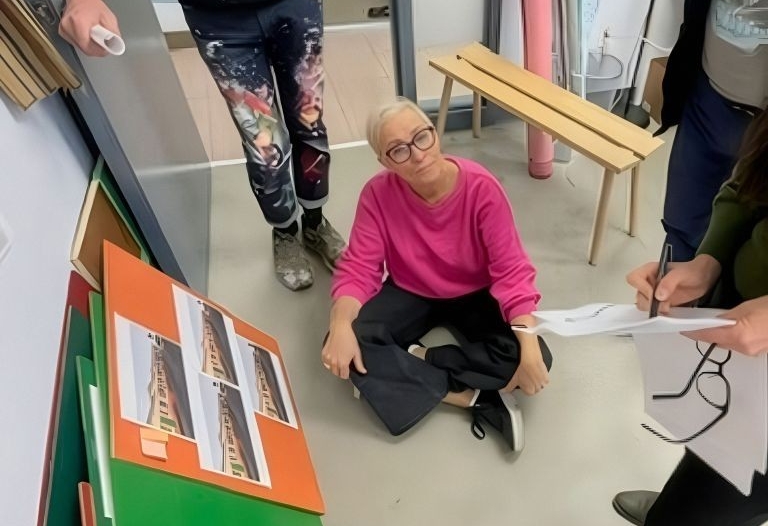 Élise de Blois preparing for the Gucci spring/summer 2025 shoot directed by Xavier Dolan. | Photo: Alex Hercules Desjardins