



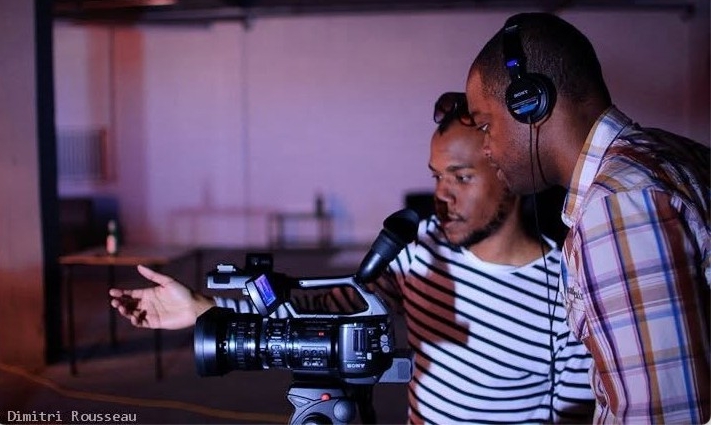
 Éric Lafalaise (right) on set with director CP Simonise. | Credit: Dimitri Rousseau
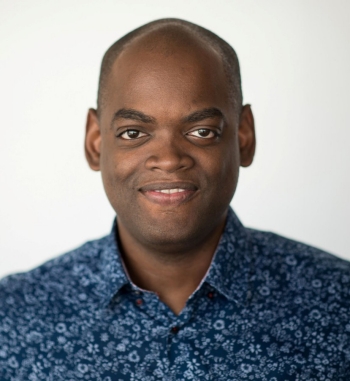 “When I watched a horror film, the chaos of real life made more sense,” says Éric Lafalaise.
“I wanted to talk about film all day and learn how to be a filmmaker,” he says. “And I did just that.”
Soon after graduating, Lafalaise began collaborating with fellow Haitian filmmakers, creating short films that explored the fantastical, spooky and supernatural themes that had fascinated him as a youth.
While growing his creative career, he also gained a behind-the-scenes education in the film industry. He worked as an analyst for Videotron and then managed distribution for Cineflix and D-BOX Technologies, whose motion-enabled seating systems are used in movie theatres around the world.
“To be working with movie theatres in Japan, Brazil and all over the world — it was really eye-opening for me to learn how the theatrical distribution industry works,” he says.
That global perspective started at Concordia. His courses exposed Lafalaise to international cinemas that helped broaden his understanding of storytelling. “Taking courses at on Asian film, European film helped me with that job at D-BOX,” he says.
Today, Red Brand Studios is as a creative home for Lafalaise’s own productions and serves as a platform for emerging filmmakers. Among his latest projects in development is Earthquake Weapon, a feature film about a young Montrealer introducing his friends to the city’s cultural diversity when a bomb suddenly strikes Toronto, leaving him blamed for the attack.
“I would like for Red Brand to help young creators network and facilitate collaboration,” says Lafalaise. “I want to professionalize the creators early.” Mentoring the next generation of filmmakers has become one of the most rewarding aspects of his work.
“To share my experience is important for me,” he says. “Sometimes, we have those difficult conversations filmmakers needs to have, like asking ourselves how we are talking about society in our films, and if we need to do this story right now.”
For Lafalaise, it has always been about more than creating scares. From the late-night horror films that helped him make sense of a turbulent childhood to the stories he now creates, cinema remains a way to explore uncertainty, challenge perspectives and find meaning in chaos.