

Concordia University Press celebrates 10 years of open access publishing


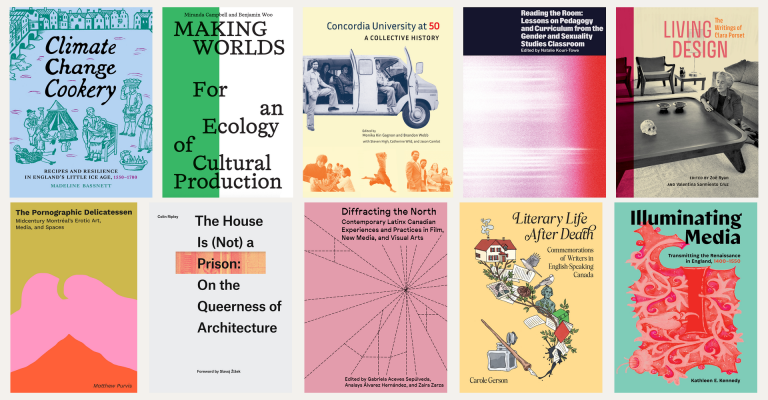
Celebrations are in order for Concordia University Press (CUP).
The publisher of scholarly books is celebrating 10 years since its public launch on October 27, 2016.
Incorporated earlier that month, CUP was founded with a mission to make research more accessible while amplifying voices and perspectives often excluded from scholarly discourse.
This milestone comes as university presses around the world prepare to celebrate University Press Week, the Association of University Presses' annual recognition of scholarly publishing and its impact on society.
Over the past decade, the Press’s catalogue of peer-reviewed books has grown with a focus on disciplines in the humanities, social sciences and fine arts. It continues to centre equity, diversity, inclusion, decolonization, Indigenization and social justice in its work.
As one of Canada's first fully open access university presses, CUP has helped expand access to scholarly works while earning recognition for its exceptional print books and award-winning design.
“Ten years ago, those of us working in open access were advocating to make scholarship as open as possible, to engage communities beyond university campuses, knowing that engaging with trusted scholarship makes for a better world,” says Concordia University Librarian Amy Buckland.
“Concordia University Press, the second in Canada to be fully open access, embodies this engagement with the community. Just ask attendees at any book fair where CUP is present, or CUP authors who speak so highly of the partnership,” she adds.
The value of open access materials became especially clear during the COVID-19 pandemic, when many readers lost access to physical libraries. Because CUP's books were freely available online, people could continue accessing scholarly content regardless of where they were located.
Director of the Press Ryan Van Huijstee recalls that through the pandemic it was reassuring to know readers could continue accessing CUP’s books even as the circulation of physical books was disrupted.
"In our early years, it was so helpful to tell people we were founded as an open-access publisher with the support of Concordia and the Concordia Library,” he says.
“This distinguished the Press from other scholarly publishers and attracted authors who wanted their work to be available to the public for free. There was clearly a groundswell of support for this model of book publishing from the scholars, artists and curators we have since published.”
Global connections
The benefits of open access extend beyond research to teaching and learning. Open access publishing and open educational resources can help reduce costs for students if these materials are used in courses, as some of CUP’s books have been.
The Press continues to strengthen its international profile within the open scholarship movement. In early September, CUP became the first Canadian member of the Open Book Collective, a UK-based organization that helps index open access books to make them more accessible for university libraries and raises funding to support open access book publishing. This new membership will help to strengthen discoverability of open access titles through university library networks.
CUP's commitment to barrier-free scholarship is reflected in its open-access publishing platform on Manifold, where all 24 titles in its catalogue are available as free open-access e-books. All the Press’s titles can also be found in Concordia’s Spectrum repository.
Celebrating print culture and publishing excellence
While digital accessibility is central to CUP's mission, it has also built a strong reputation for beautifully designed print books.
CUP’s commitment to craft was evident from its first title, Everything is Relevant: Writing on Art and Life, 1991-2018 by Canadian artist Ken Lum, which was recognized by the Association of University Presses Design as one of the best examples of scholarly typography in 2021.
In the years since, multiple CUP titles have received similar honours, while several have required reprints. In 2023 alone, three books returned to press, including Alex D. Ketchum's Ingredients for Revolution: A History of American Feminist Restaurants, Cafes, and Coffeehouses, Lauren Beck's Canada's Place Names and How to Change Them, and Arthur Erickson on Learning Systems.
Most recently, two CUP titles were recognized among the best designed books of 2025 in the Association of University Presses annual Book, Jacket and Journal Design Show. Colin Ripley's The House Is (Not) a Prison: On the Queerness of Architecture was selected among only 13 titles in the scholarly typography category, while Matthew Purvis's The Pornographic Delicatessen: Midcentury Montreal's Erotic Art, Media, and Spaces was included among the 48 best book covers of the year.
A decade after its launch, CUP has demonstrated that open access and print publishing can thrive together. By pairing free digital access with thoughtfully crafted print editions, the Press has broadened access to knowledge while building a reputation for publishing excellence.
“Ten years ago, we did not know how open-access publishing might affect the sales of print editions, but our books keep being ordered by bookstores, especially from the independent bookstores that we have seen revive and thrive in this last decade,” notes Van Huijstee.
“I think we have seen that both open-access and print publishing can coexist and mutually support each other, and it is remarkable to see how many more scholars are thinking of barrier-free publishing as a priority for their work."
Visit Concordia University Press to explore all its titles.