

Two Concordia grads bring fresh perspective to safety training


What happens when you give two graduate students the opportunity to rethink how a university learns about safety? Concordia is finding out.
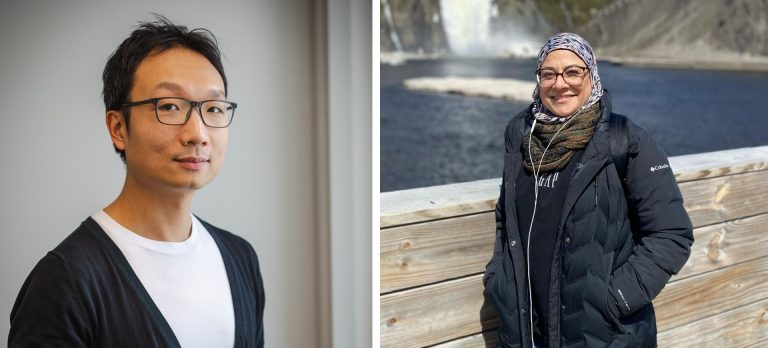
As part of the master’s in educational technology with internship program, Kenny Wee, MA 25, and Hania Al Abiad, MA 25, worked with Concordia’s Environmental Health and Safety (EHS) to redesign a suite of online training modules used across campus.
Their work included updates to Workplace Hazardous Materials Information System (WHMIS) training, as well as those for biosafety and the safe handling of blood. The updated modules are now supporting thousands of learners each year.
“Environmental Health and Safety has so much detailed information, and taking all of that and turning it into something clear for learners was a big responsibility,” Al Abiad says.
“But once I got comfortable with the content, I really enjoyed figuring out how to make it engaging.”
Translating complexity into clarity
Wee and Al Abiad approached the project with different professional backgrounds but a shared commitment to making complex material accessible.
Wee, who previously spent close to 15 years teaching English abroad, says the internship immediately connected his academic learning to real-world needs.
“I enjoyed putting together activities, presentations and anything that made learning more interactive,” he explains. “Knowing there was an internship where I could put everything into practice right away was a huge attraction.”
Both graduates joined EHS through a placement process overseen by Rosa Cerone, internship coordinator in the Department of Education. Once in their roles, Wee and Al Abiad discovered just how much nuance — and collaboration — goes into translating safety protocols into learner-friendly online modules.
“We were essentially our own project managers,” Wee says. “You learn time management and how to collaborate with subject-matter experts very quickly.”
Al Abiad, who joined the program after more than two decades in the banking industry, says the experience expanded her understanding of instructional design in practice.
“Interactivity isn’t just clicking,” she notes. “Sometimes an image works better, sometimes a question helps people reflect and sometimes adding a bit of humour makes information easier to take in.”
Guided by thoughtful mentorship
For Cerone, the EHS project reflects what the master’s in educational technology with internship program is designed to offer: meaningful, hands-on experience with real institutional impact.
She works with a range of host partners, learning about their needs and helping match students with opportunities where they can grow.
“There are lots of opportunities within Concordia, but also outside of Concordia,” Cerone explains. “Our educational technology interns get to work in government, in the corporate sector — companies like Bombardier, CAE, Bell — and in non-profit and educational institutions.”
That broad range of placements is supported by faculty supervisors Florent Michelot, assistant professor in the Department of Education, and Giuliana Cucinelli, associate professor in the Department of Education. Both guide students throughout their placements.
Michelot says the strength of the internship model lies in the responsibility students take on.
“This internship is a very concrete form of experiential learning because the student works on an authentic mandate that has a direct impact on our academic community,” he notes, adding that effective supervision means “being present, but not taking over.”
Cucinelli agrees, emphasizing that the internship model gives students a level of responsibility that deepens their learning.
“It bridges the gap between academic learning and professional experience,” she says. “Students get to apply what they’ve studied in a setting where the outcomes truly matter.”
Looking back, both Wee and Al Abiad say the program gave them a sense of purpose and confidence in their new professional path — one that has since led them to join EHS as staff.
“To have our work recognized by safety experts felt like a real achievement for me,” Al Abiad says. “This experience is something I will always treasure.”
Learn more about the master’s in educational technology.