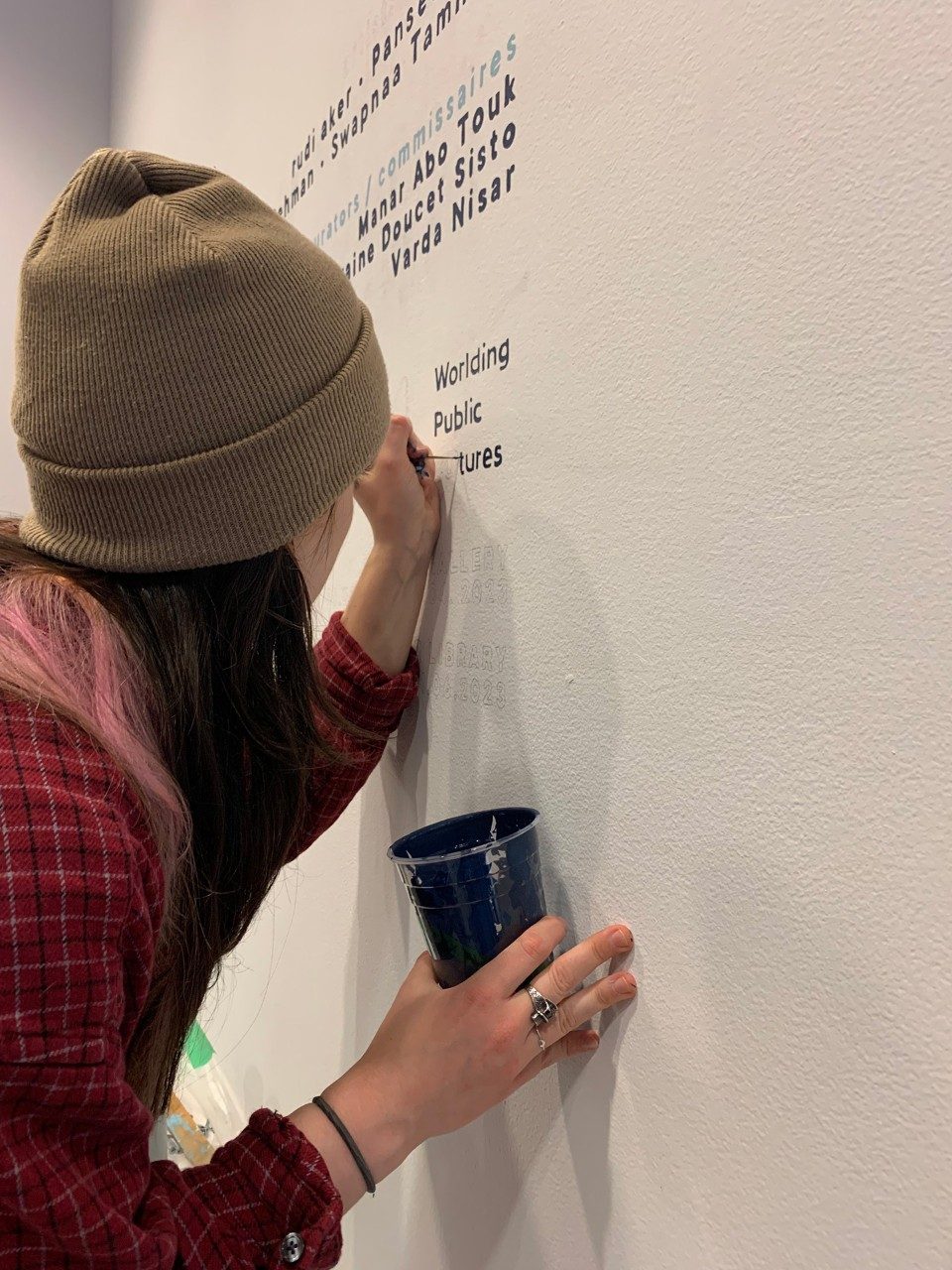




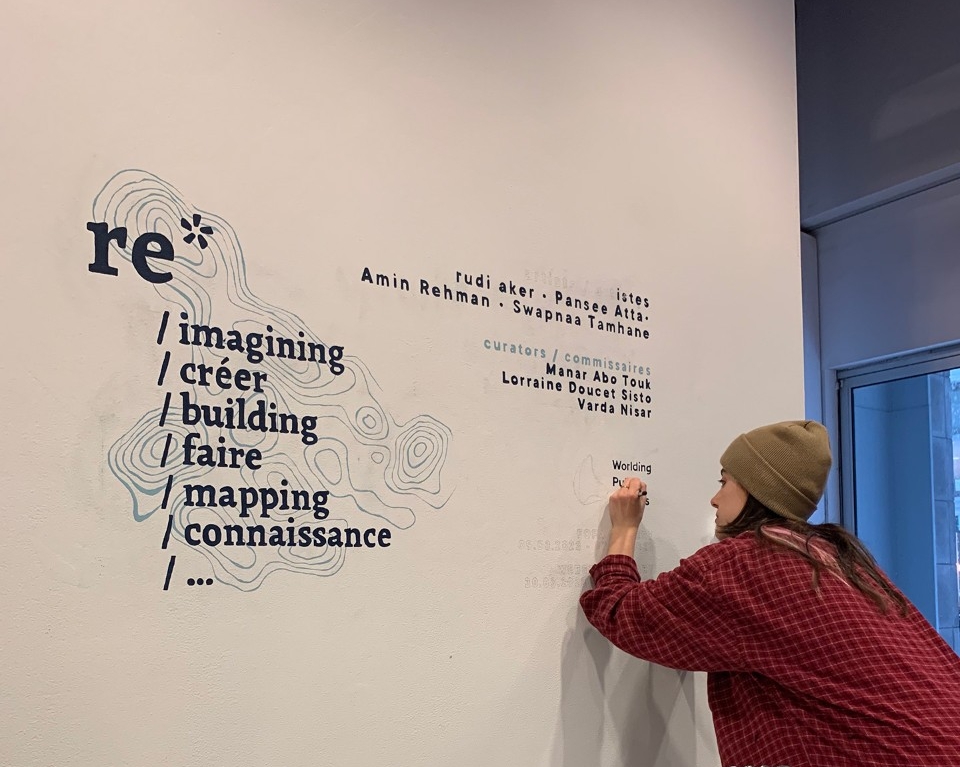
 Demonstration of hand-lettering signage by Lorraine Doucet Sisto for the group exhibition re* by Worlding Public Cultures
 Exhibition signage using paper stencil and crushed rocks glued with rice paste for Jess Slipp's with & of (Becoming Rock)
 Brainstorming board during the Replacing Vinyl Workshop II that took place in March 23, 2023
 Pigment and stencil experimentation during the Replacing Vinyl Workshop II that took place in March 23, 2023
 Workshop facilitator Virginie Fillion-Fecteau demonstrating the technique of stencil transfer "chine collée" during the Replacing Vinyl Workshop II that took place in March 23, 2023
 Experimenting with stencilling and pigments during the Replacing Vinyl Workshop II that took place in March 23, 2023
 Workshop faciitator Virginie Fillion-Fecteau presenting during the Replacing Vinyl Workshop II that took place in March 23, 2023
 Former Curator in Sustainability Jasmine Sihra presenting during the Replacing Vinyl Workshop I that took place in March 22, 2023
 Experimenting with a Vinyl Cutter during the Replacing Vinyl Workshop I that took place in March 22, 2023 in collaboration with 4th Space
 Lecture by Kirsty Robertson on March 13, 2025 in collaboration with the Grantham Foundation

Joé Côté-Rancourt is a multidisciplinary artist and curator working across sculpture, scenography, installation, and performance. As Co-Curator of Sustainability at FOFA Gallery in Tiohtià:ke/Mooniyang/Montréal, he develops approaches to exhibition-making that foreground material responsibility and adaptive reuse. His technical experience in Concordia University’s woodshop, foundry, and digital fabrication lab informs both his artistic and curatorial work, shaping sustainable methods of production and display. His practice examines material histories and the systems that support—or destabilize—them, attending to how structures are built, maintained, and transformed, and who is implicated in these processes. Côté-Rancourt has participated in international residency programs and holds a BFA in Sculpture from Concordia University.
Josh Jensen is a queer artist and emerging curator born in Amiskwacîwâskahikan (Treaty 6 Territory, Edmonton), whose work engages sustainability through material experimentation and process. He is Co-Curator of Sustainability at FOFA Gallery in Tiohtià:ke/Mooniyang/Montréal. Working across analogue photography and installation, his practice incorporates bio-based materials—including kombucha leather and natural dyes—as well as methods of reuse and repair, foregrounding approaches to circularity in artmaking. His work has been presented at the Canadian Museum for Human Rights (Winnipeg), Belfast Exposed (Northern Ireland), and Casa (Lethbridge, Alberta). Recent projects include CORED(2026), a two-person exhibition with Lucy Gill at Produit Rien. Jensen holds a BFA in Photography from Concordia University.
You can contact them at eco.fofagallery@concordia.ca