

Taylor McArthur
If Time Had Listened and Azimuth Nitehi // Cądé Edáha
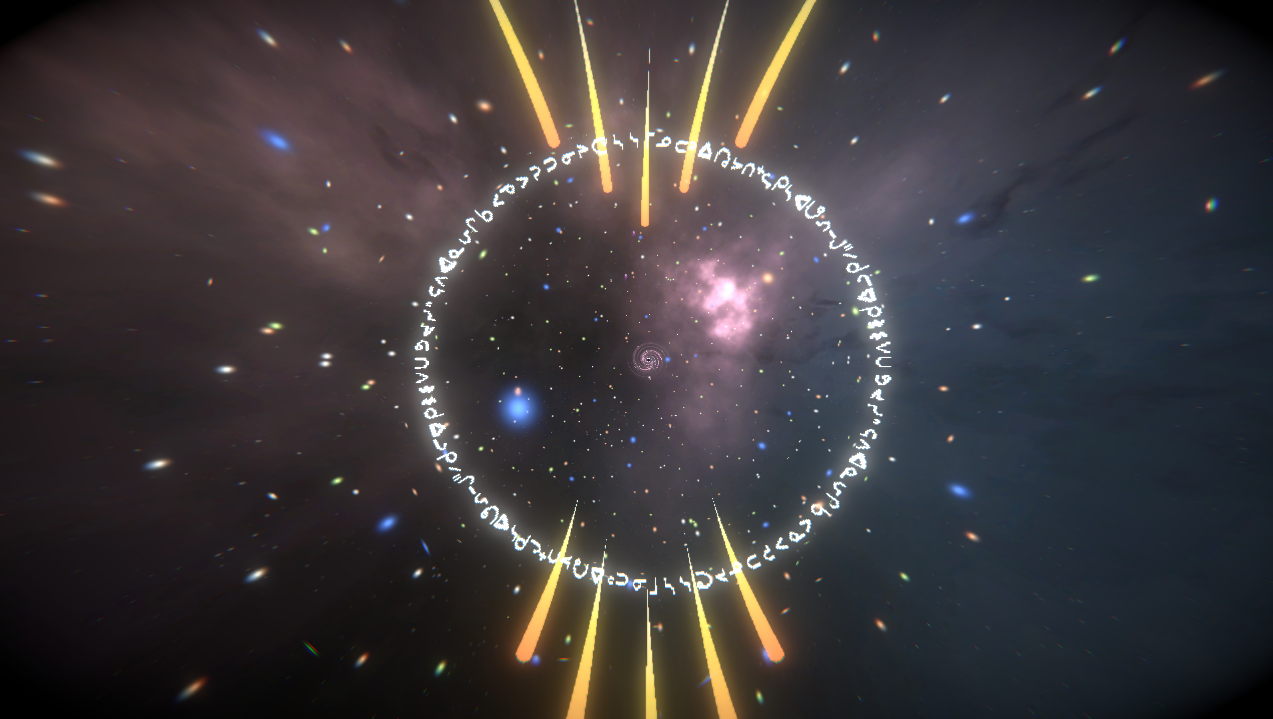 Taylor McArthur and Dallas Flett-Wapash Azimuth Nitehi // Cądé Edáha, 2021. Digital interactive media: two-channel projection, sun catcher.
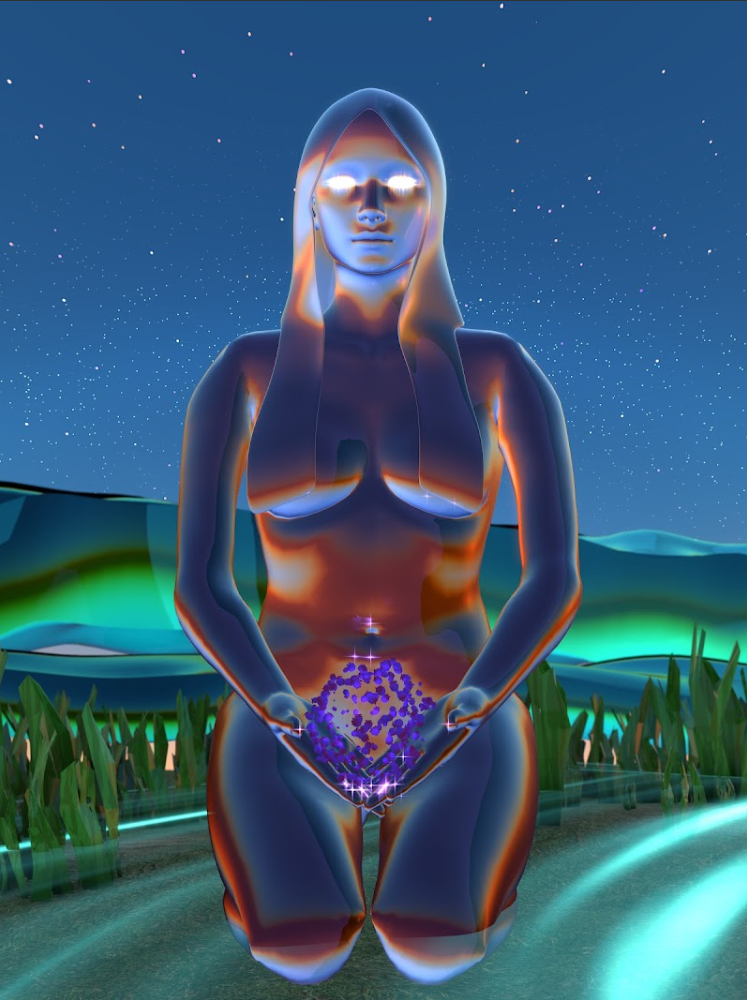
If Time Had Listened, 2025. Unity, Blender, digital print.
About the project
If Time Had Listened draws upon family memory, place, and the artist’s matrilineage to examine inheritance: what is transmitted, what undergoes transformation, and what is relinquished.
The artist constructs a dreamlike digital landscape illuminated by the diffuse light characteristic of early Prairie mornings or evenings. Saskatoon berry and raspberry bushes, native to the region of the artist’s family, occupy the foreground, anchoring the scene in both familial and ecological relationships. Three figures sit together in the grass beside a pond, appearing in communion with each other, their ancestors, and the land.
The central figure depicts the artist, pregnant with her daughter, accompanied by figures representing her mother and kokum (grandmother). Collectively, these figures evoke generations connected through the responsibilities and possibilities of carrying life, knowledge, and memory across time.
Golden lines trace pathways across the central figure’s body, converging at the heart, head, abdomen, veins, and nerves. These points indicate the transmission of knowledge and energy through the body across generations. Circles of energy surround the three figures, as seen in the rings of water that gather them within the landscape.
The work alludes toward the deep temporalities of continuity: even before birth, life is carried through generations, as the eggs from which individuals develop are formed within their grandmothers. This layered connection between generations extends beyond the human body, situating life within the broader relations that sustain it. The work therefore asks us to consider what it means to carry life forward, not only through human generations, but through ongoing relationships with lands, water, and other forms of life that make our futures possible.
In this way, the material body is linked to the earth, connecting the responsibilities of carrying life to the ongoing cycles of renewal, relation, respect, and reciprocity.
This work was originally commissioned for C Magazine, issue 160 (Spring 2025).
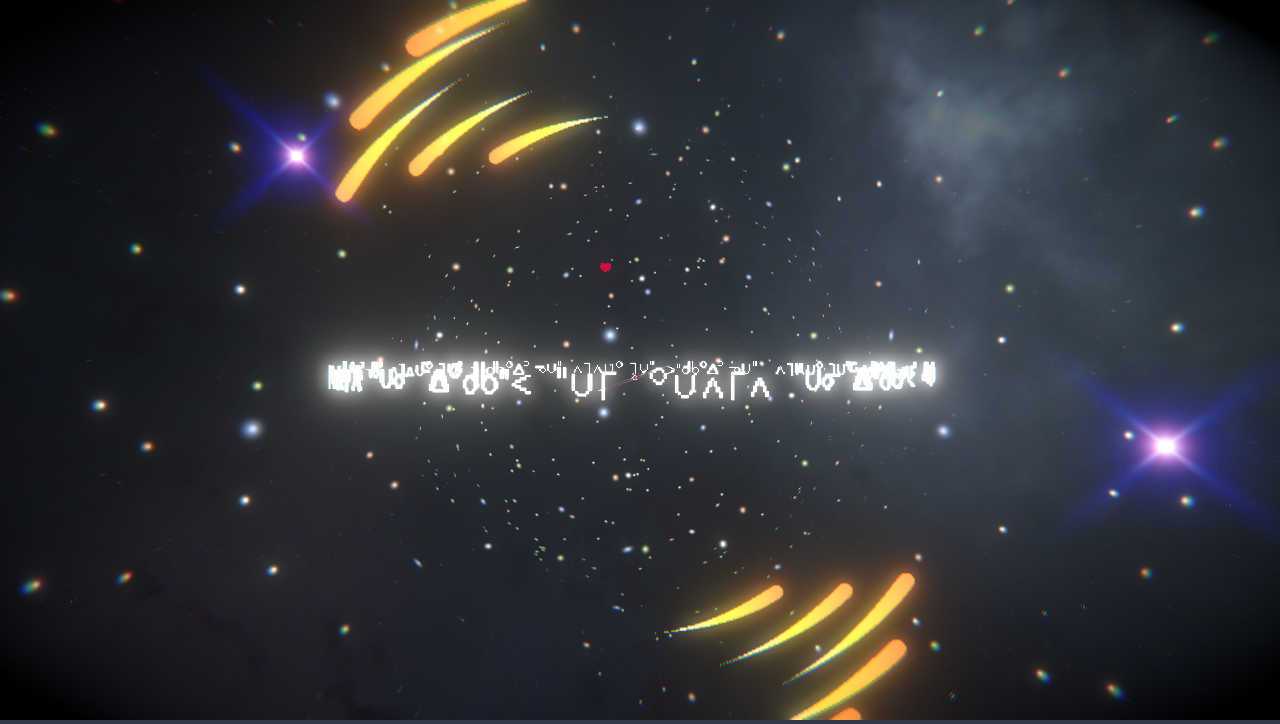 Taylor McArthur and Dallas Flett-Wapash Azimuth Nitehi // Cądé Edáha, 2021. Digital interactive media: two-channel projection, sun catcher.
Azimuth Nitehi / Cądé Edáha is a digital, interactive experience that changes visually in response to the viewer’s heart rate. Created by artists Taylor McArthur and Dallas Flett-Wapash, the work integrates linguistics and conceptual references to movement, direction, and the heart. The term ‘azimuth’ denotes the horizontal direction or angle between a fixed reference point and the direction of an object, while ‘nitehi’ signifies the heart in nēhinawēwin (Swampy Cree). ‘Cądé Edáha’ is a term in Nakota that evokes the idea of “moving hearts.”
The work can be experienced in the gallery’s Black Box and through personal mobile devices. Viewers are invited to participate in the virtual world by scanning a QR code. Following a series of prompts, they measure their heartbeat and enter it into the system. The work is programmed to delete submitted information upon the participant’s exit and emphasizes that the participant’s data remains their own. This deliberate gesture foregrounds issues related to technological data mining, personal information collection, and consent. The participant’s heartbeat serves as a temporary input to activate and animate the digital environment.
Within the virtual environment, participants encounter a digital galaxy reminiscent of a constellation surrounded by floating Cree syllabics. The syllabics move in response to the viewer’s heart rate, creating a sonic relationship between the body and the digital space. The phrase Pahkakowin Niteyeh, meaning “my heart is beating” encircles the participant.
As participants listen to their heartbeat move through the virtual world, the installation connects the body, language, technology, and the cosmos. The stars and constellations of the digital environment intertwine with the participant’s bodily rhythms, emphasizing the relationality and interconnectedness between human and more-than-human worlds.
Biography
Taylor McArthur (Nakota of Pheasant Rump Nakota First Nation, Saskatchewan) is a Canadian multimedia artist working with 3D animation, video game design and video. After having studied Interactive Media Arts in Brandon, Manitoba, McArthur sought to expand her knowledge in digital arts through self-learning. Her first passion being illustration, she gained curiosity in 3D modelling while learning to work in Blender and in Unity. Drawing from her past, McArthur creates digital landscapes of the future, coming full circle in her practice. At times inspired by her own poems, her artworks are contemplative, vibrant and dreamy. Her craft is informed by Indigenous Futurisms and seeks to situate her Indigenous culture within both a modern and potential future vision. Recent exhibitions include Mackenzie Art Gallery, the Art Gallery of Southwestern Manitoba and the Canadian Roots Exchange.