

Concordia prof spotlights Indigenous clean energy leadership through constructive journalism


From solar microgrids to hydroelectric initiatives, renewable energy projects are reshaping northern Indigenous communities in Canada. On December 4, Aphrodite Salas, associate professor in the Department of Journalism and co-leader of Theme 3 at Concordia’s Volt-Age program, premiered her new documentary, ᑰᒃ ᑰᑦᑐᖅ The Flowing River, showcasing these efforts.
The film’s first screening took place in Inukjuak, a village on Hudson Bay in Arctic Quebec. A larger multimedia project will be published by CTV News Montreal in early 2026 with international screenings to follow.
Inspired by truth and reconciliation
ᑰᒃ ᑰᑦᑐᖅ The Flowing River focuses on an Inuit-led hydroelectric project that diverts part of the Innuksuak River through turbines to generate electricity without the environmental footprint of a conventional dam. After years of planning and collaboration, the community has transitioned from diesel-dependent power to nearly 100 per cent renewable energy.
“What inspired me to engage in this work was the Truth and Reconciliation Commission’s (TRC) Call to Action 86, which urges journalism educators to do a better job. Reporters have caused great harm to Indigenous communities for generations through extractive practices and negative stereotypes. I wanted to contribute to a solution changing how journalism is taught at Concordia and by highlighting Indigenous climate leadership,” Salas says.
“For me, the most meaningful part is the process — building relationships, practicing reciprocity, listening, and co-creating work that matters to the communities.”
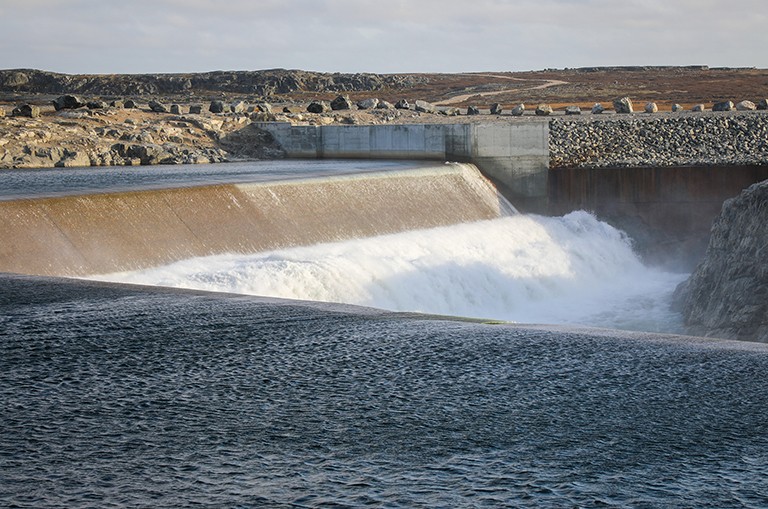 The Innavik Hydro facility on the Innuksuak River, October 2024. The 7.5-megawatt Inuit-owned facility is the largest off-grid hydropower project in Canada. | Photo by Lina Forero
Collaboration, reciprocity and student learning
Salas’ approach brings students into the field to learn collaborative, ethical journalism. For the Inukjuak project, two undergraduate students and five master’s students have documented the evolution of the hydro project since 2019. Students have worked alongside community partners and produced multimedia journalism pieces, including photography, video capsules and text features.
“It’s respect, mutual respect that happens. If we don’t respect each other this would never happen. We need that relationship. And for us to spend time with each other, eat together, celebrate together — that’s what we need, human-to-human interaction,” says Sarah-Lisa Kasudluak, vice president of the Pituvik Landholding Corporation in Inukjuak.
Tommy Palliser, executive director of the Nunavik Marine Region Wildlife Board, adds: “We were the few on the frontlines who put ourselves on the line, not for personal gain, but to keep the project alive, benefit our community, and fight against climate change — trusting our partners and each other to make a lasting impact for generations to come.”
Lina Forero, a Concordia graduate student in the Digital Innovation in Journalism Studies program, says she was equally transformed by the experience.
"Collaborating with Professor Salas, along with our partners and friends in Inukjuak, allowed me to see Indigenous storytelling through an entirely new lens,” she says.
“It challenged me to step back from my traditional journalism background and my current role in communications, bringing me back to the fundamentals of meaningful storytelling — to the roots of true partnership grounded in reciprocity and trust-building."
From seed to impact
Beyond journalism, the relationships fostered through this project have already enabled additional research and funding opportunities.
Notably, these connections contributed to a new Volt-Age Impact Project, “Electrified Transportation, Emergency Power, and Microgrid Design for Indigenous, Remote, and Local Communities.” The initiative explores integrated solutions for sustainable transportation and energy in northern and Indigenous communities.
By addressing transportation, power resilience, and social inclusion together, the new Volt-Age Impact Project will build on Inukjuak and other community teachings. It will also demonstrate how collaborative, equity-centered approaches can drive scalable, real-world solutions to climate challenges in Indigenous, remote, and northern regions.
Explore Concordia’s Department of Journalism.
Learn more about Concordia's Volt-Age electrification research program.