

ARTH 201-B Perspectives of Art History
- Instructor: Davin Luce
This course will introduce the art and architecture of the pre-modern world through a sustained study of the material and visual cultures framed around the Silk Roads. A term coined in the 19th c., the Silk Roads constituted the major trading routes between East Asia and Europe established in the 1st c. BCE. While traditionally discussed as connecting present-day Xi’an, China to Rome, the Silk Roads extended far beyond these two cultures, reaching Anglo-Saxon England, the Iberian Peninsula, and parts of the African continent.
Together, we will look broadly at the peoples living along the areas that would constitute the Silk Roads. Part One of our course will begin circa 3500 BCE to examine the visual and material culture of pre-Silk Roads cultures across three continents (Europe, Africa, and Asia). Part Two will be a sustained focus on the period of the Silk Roads considering many of the important empires and religions in Europe, Africa, and Asia. The final portion of the course will be a thematic examination of textiles, cave temples, and reliquaries. The course will conclude with a discussion of the Mongol empires and the subsequent decline of the Silk Roads in the 14th and 15th centuries.
The course will consider the movement of ideas and goods and the impact such movement had on the art and architecture of Europe, Africa, and Asia. This course will also emphasize the impact of three major religions (Buddhism, Islam, and Christianity), as well as touch upon less dominant religions (e.g., Manicheanism and Zoroastrianism), that thrived in the cultures along the Silk Roads.
The goal of the course is to introduce students to both mainstream visual cultures from Europe, Asia, and Africa as well as important, but less studied cultures, especially those in Central Asia. In doing so, this course will equip students with the tools to critically engage with visual and material cultures from a global perspective.
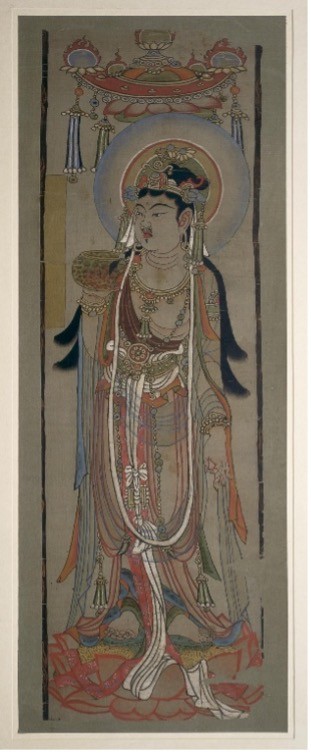 Banner of Bodhisattva, 9th c., painted silk. Found in Mogao Cave 17, China. © The Trustees of the British Museum.