

ARTH 392 Gender Issues in Art and Art History: Women’s Agency within the Harem
- Instructor: Setayesh Nejadi
This course examines the artistic and creative practices that represented and imagined harems across the Islamicate world, including Persian, Ottoman, Egyptian, and broader SWANA contexts. Orientalist discourses have long framed the harem as an exoticized space of female confinement and civilizational backwardness; speculations that reinforce reductive binaries between “West” and “non-West.” In contrast, through analyzing images that documented harems and exploring social, cultural, and political forces that shaped their production, this course reveals the harem as a dynamic, socially constructed institution shaped through women’s artistic and cultural practices.
We begin by studying the spatial and architectural characteristics of harems in order to understand their physical organization as well as the way they function as lived and relational spaces. We then turn to visual representations, from Orientalist paintings to domestic artistic practices, to analyze how harems and the women within them were depicted. These materials allow us to engage broader questions of cultural politics, materiality, sartorial codes, relationality, and women’s agency in image-making and self-representation. Central to the course are scholarly sources, along with selected visual case studies, that help us trace the diverse ways women in harems articulated their own forms of agency through aesthetics.
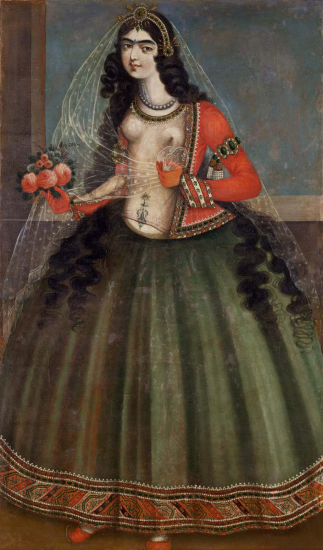 Woman with a Bouquet of Roses. Iran, mid-19th century. The State Hermitage Museum, Iran Collection.