

Jacqueline Hoàng Nguyễn
Wages Due Song
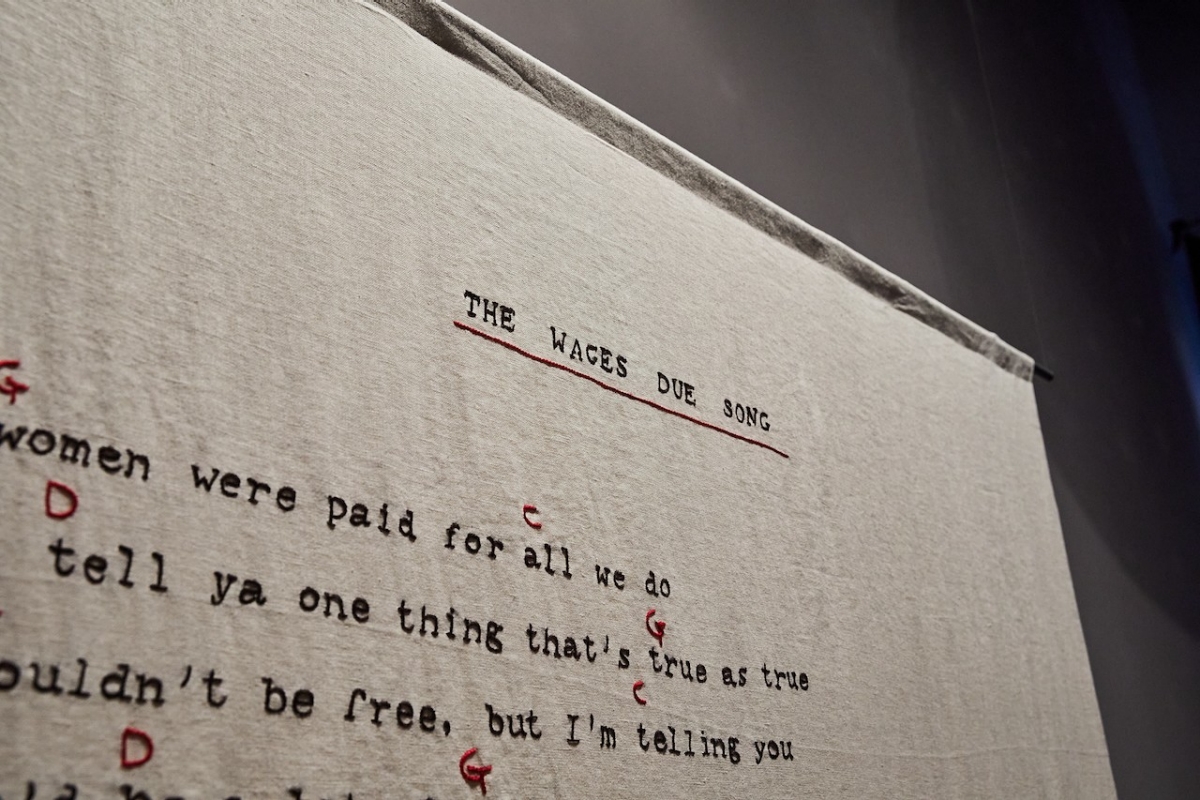 Wages Due Song, 2016-2026. Sound installation comprising stereo audio (3 min. 18 sec.) and hand-embroidered linen banner, 43.3 × 55 in. Photo: Laurence Poirier.
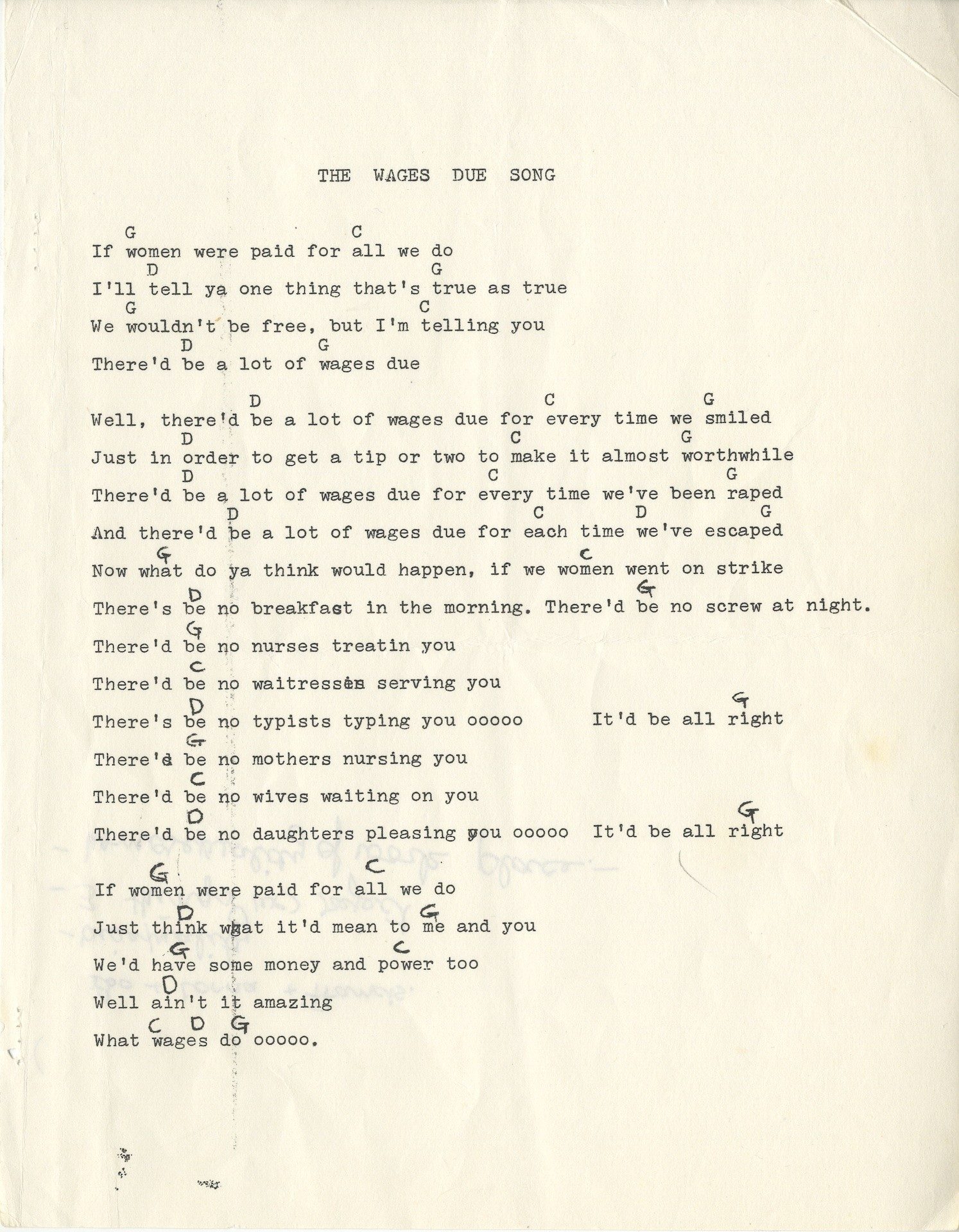
Wages Due Song by Bo Watson. From the 10-027 Wages Due Lesbians Fonds, Archives and Special Collections, University of Ottawa Library.
About the project
Wages Due Song revisits the history of the Wages Due Lesbians, a Canadian feminist collective active within the International Wages for Housework Campaign during the 1970s. Emerging from broader women's liberation movements, the group sought to expose the often-invisible labor of housework, childcare, and care work as the foundation upon which all other forms of social and economic production depend. Their activism extended beyond theoretical critique, taking the form of demonstrations, organizing, publications, and protest songs that transformed political demands into collective acts of expression. Among these songs was The Wages Due Song, written by Boo Watson in 1974. Its refrain, “If women were paid for all they do, there’d be a lot of wages due,” articulated a central demand of the movement: recognition of domestic labor as work. While the campaign called for direct economic compensation, it also sought to reveal the broader structures through which capitalist economies depend upon and exploit the unpaid and underpaid affective labor performed primarily by women. The original musical score, believed to be lost, was recovered in archival holdings. The original audio recording, however, has never been located. This installation reactivates the song through a contemporary sound composition based on the recovered score, developed in collaboration with composer Thunder Tillman. For this edition, the work also includes a newly produced linen banner featuring the song’s lyrics embroidered by hand, extending the themes of labor, care, transmission, and collective memory into the material fabric of the installation. As many of the questions raised by the campaign remain unresolved, the song continues to resonate across generations.
If women were paid for all we do
I’ll tell ya one thing that’s true as true
We wouldn’t be free, but I’m telling you
There’d be a lot of wages due
Well, there’d be a lot of wages due for every time we smiled
Just in order to get a tip or two to make it almost worthwhile
There’d be a lot of wages due for every time we’ve been raped
And there’d be a lot of wages due for each time we’ve escaped
Now what do ya think would happen if we women went on strike
There’d be no breakfast in the morning. There’d be no screw at night
There’d be no nurses treating you
There’d be no waitresses serving you
There’d be no typists typing you ooooo It’d be all right
There’d be no mothers nursing you
There’d be no wives waiting on you
There’d be no daughters pleasing you ooooo It’d be all right
If women were paid for all we do
Just think what it’d mean to me and you
We’d have some money and power too
Well ain’t it amazing
what wages do ooooo
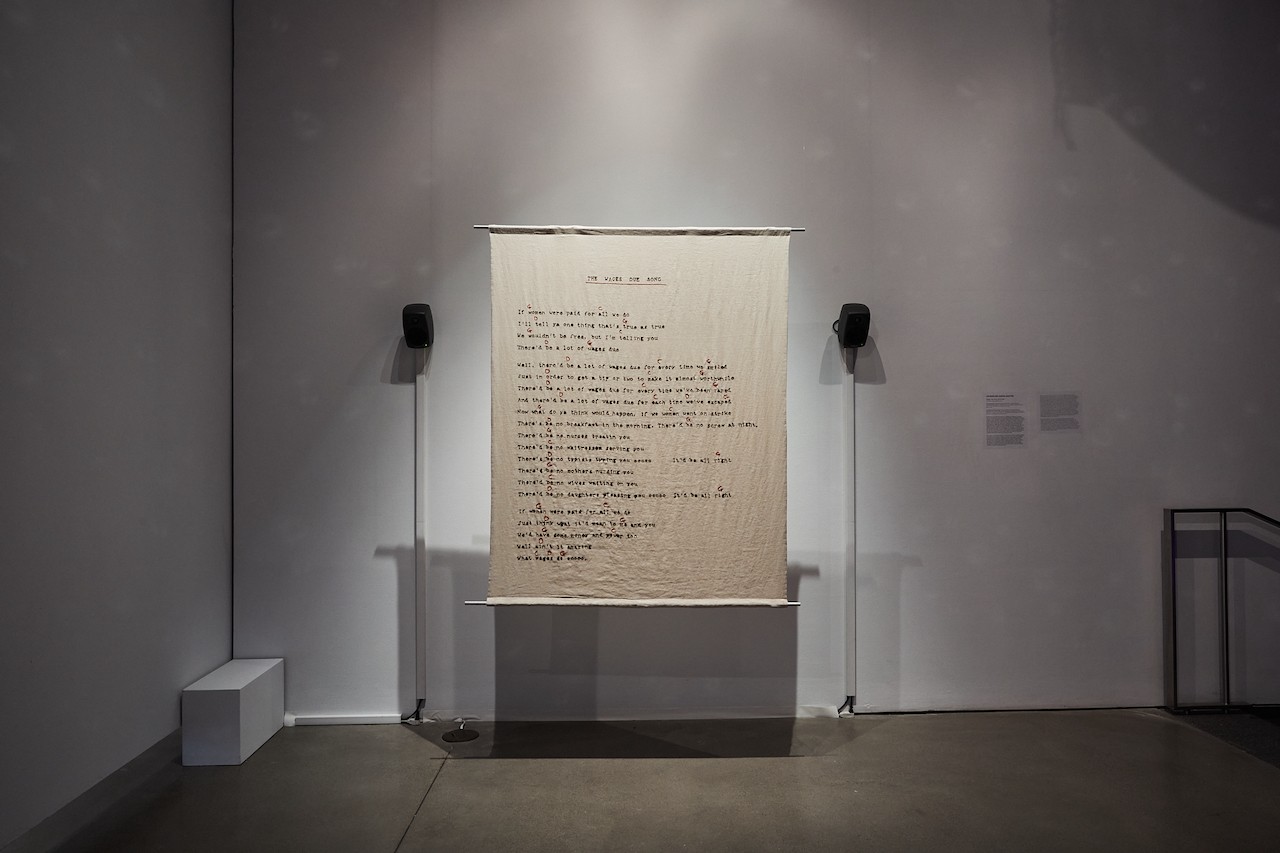 Wages Due Song, 2016-2026. Sound installation comprising stereo audio (3 min. 18 sec.) and hand-embroidered linen banner, 43.3 × 55 in. Photo: Laurence Poirier.
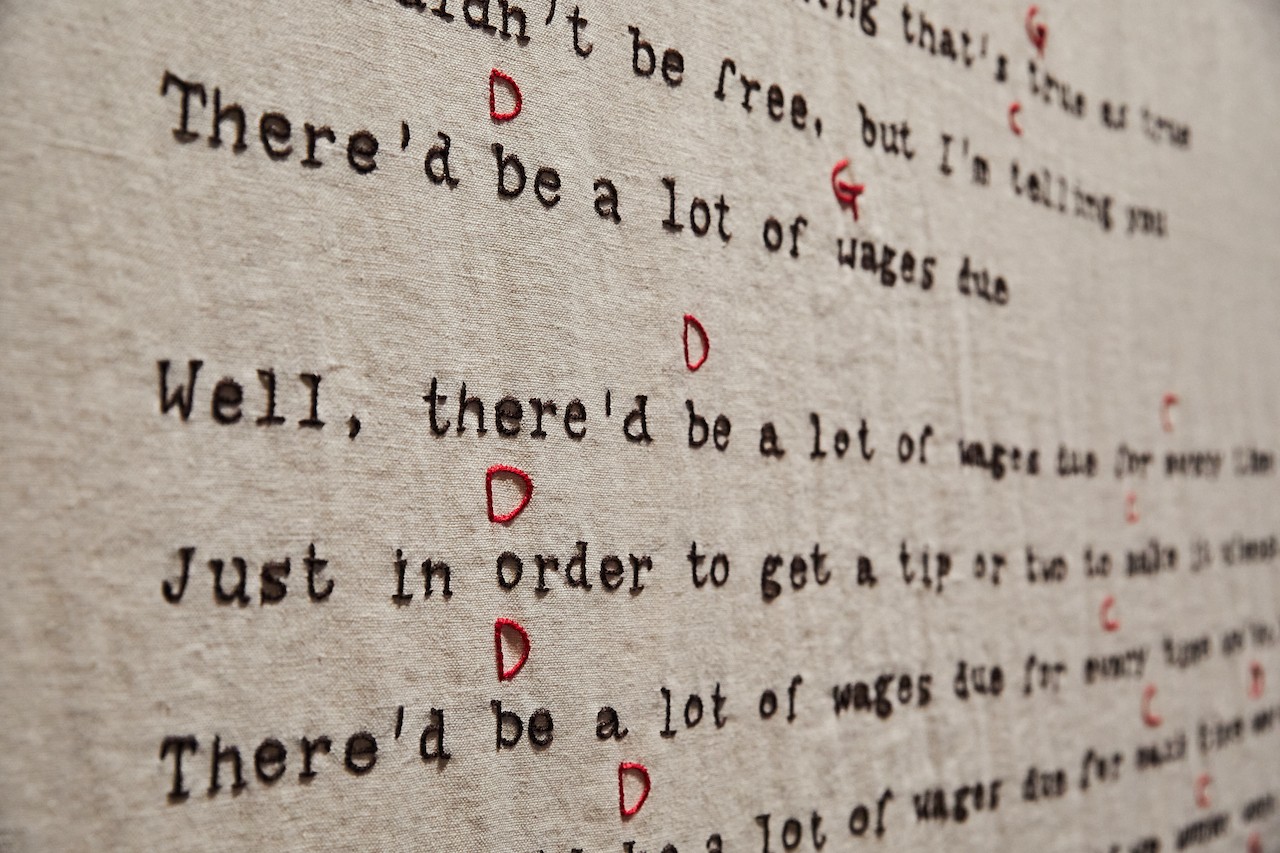 Wages Due Song, 2016-2026. Sound installation comprising stereo audio (3 min. 18 sec.) and hand-embroidered linen banner, 43.3 × 55 in. Photo: Laurence Poirier.
Biography
Jacqueline Hoàng Nguyễn is a visual artist and doctoral candidate in the Art, Technology and Design programme at Konstfack and the Royal Institute of Technology (KTH), Sweden. She completed the Whitney Independent Study Program in New York in 2011, received an MFA and a postgraduate diploma in Critical Studies from the Malmö Art Academy, and a BFA from Concordia University, Montreal. Working across installation, film, sound, photography, and archival research, Nguyễn explores historicity, collectivity, and utopian political imaginaries through feminist and decolonial perspectives. Her work has been exhibited internationally at venues including Mo Art Space and Vin Gallery (Việt Nam), the Musée d’art contemporain de Montréal, Bonniers Konsthall (Stockholm), the MA*GA Museum (Italy), the Vancouver Art Gallery, Mercer Union (Toronto), Braunschweig Kunstverein, The Július Koller Society (Bratislava), the Sharjah Art Foundation, and Apexart (New York). Her ongoing doctoral research, “Perspectives from the Darkroom: Vietnamese Photography and Unprocessed Histories,” examines the social and political history of photography in Việt Nam during the French colonial period and the role of Vietnamese photographers in anti-colonial and nationalist movements.