Kandis Friesen
Where you have not first of all to uproot a whole forest
September 8 – November 20, 2026
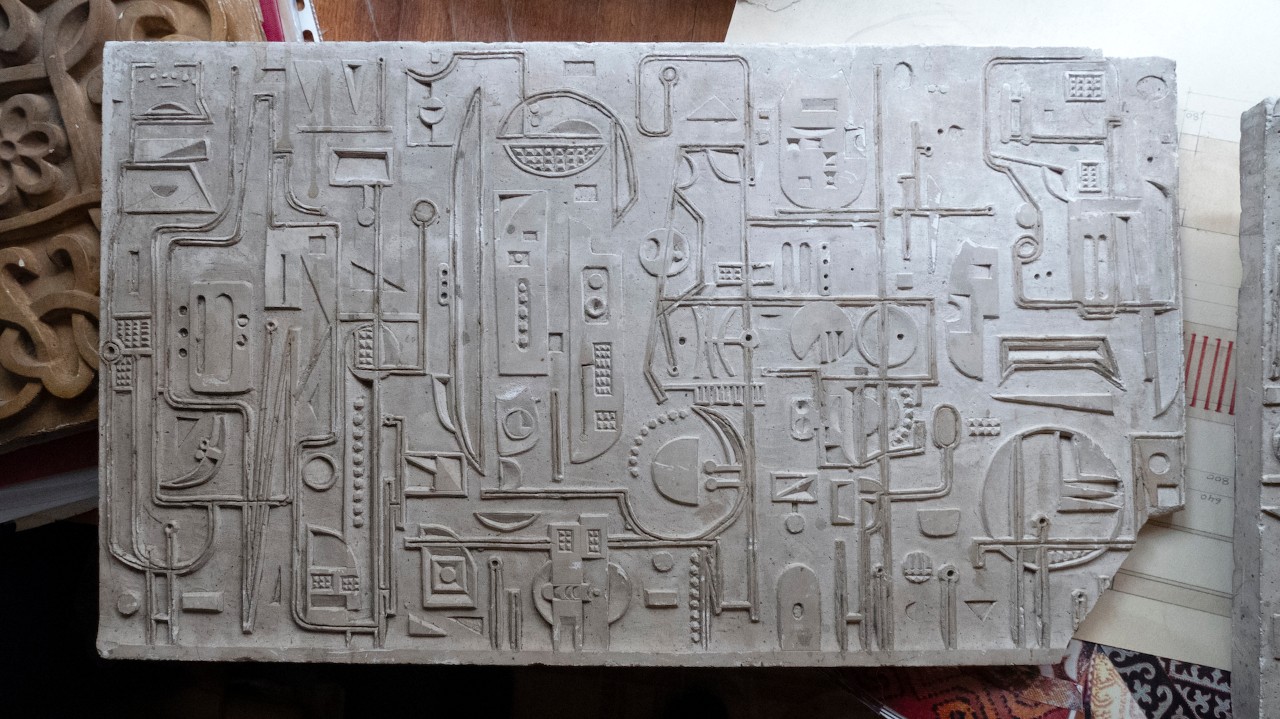 Photograph From The Personal Archive of Saule Bultrikova 2023, digital photograph by the artist.
Events
About the exhibition
Where you have not first of all to uproot a whole forest brings together Kandis Friesen’s recent works in video, photography, and wood carving. The exhibition works through a series of graftings that amplify displaced artistic, architectural, and political histories of Soviet Kazakhstan in the present, emerging from Karaganda, Karaganda, a site-based research project anchored in the slow dissolution of Karlag, a massive former Soviet gulag in Karaganda, Kazakhstan. Grounded in a developing notion of the dispersed monumental, the works trace forms of dislocated historical memory through unofficial archives, oral histories, and self-organized micromuseums; through circulations of coal, song, and shifting ground; through land, architecture, and sound. From Stalin-era repressions to post-war Soviet modernism, Friesen approaches histories of exile, incarceration, and dislocation in the former Karlag gulag region of Karaganda; and in Almaty, Kazakhstan’s former capital.
The Karlag gulag—one of the largest in the Soviet system, holding over a million prisoners from 1931 to 1959 across a territory roughly the size of France—forms the centre of this research. Almost everything in the Karaganda region was built by Karlag prisoners: canals, roads, dams, reservoirs, railroads, agricultural fields, orchards, forests, architectures, mines and processing plants; all realized by forced labourers under brutal conditions. The region’s art history is inherently one of exile, with the first artists—painters, musicians, poets, dissident party members—arriving in the 1930s as prisoners exiled from across the Soviet Union and Soviet Kazakhstan. Artists exiled to Karlag continued to practice, creating fugitive drawings using chunks of coal, insects, and animal blood, while also joining the gulag’s official cultural departments: writing music and performing in plays, making banners and props for official celebrations, and realizing paintings, sgraffito works, sculptures, monuments, and reliefs, both in the gulag and across the city of Karaganda. When Karlag closed in 1959, many of those exiled and incarcerated remained, grafting their lives onto the disintegrating infrastructure of the camp that formerly imprisoned them.
This body of work is a series of new assemblages, built from within the displaced grammars and continuous attenuation that these histories endure—especially the muted narratives of the gulag—attempting to inhabit the impossibilities of direct address and the deferred possibilities of justice and reconciliation.
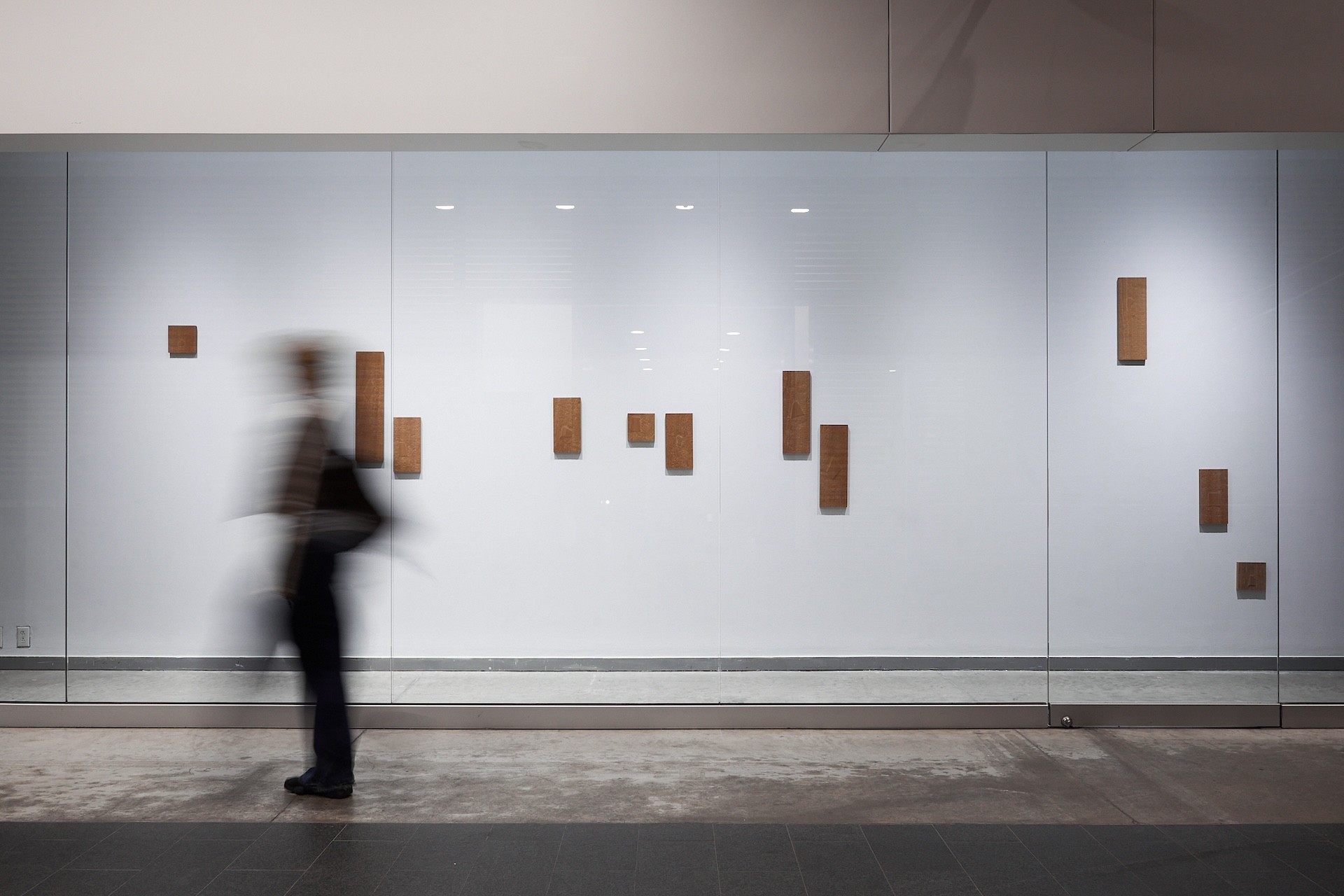
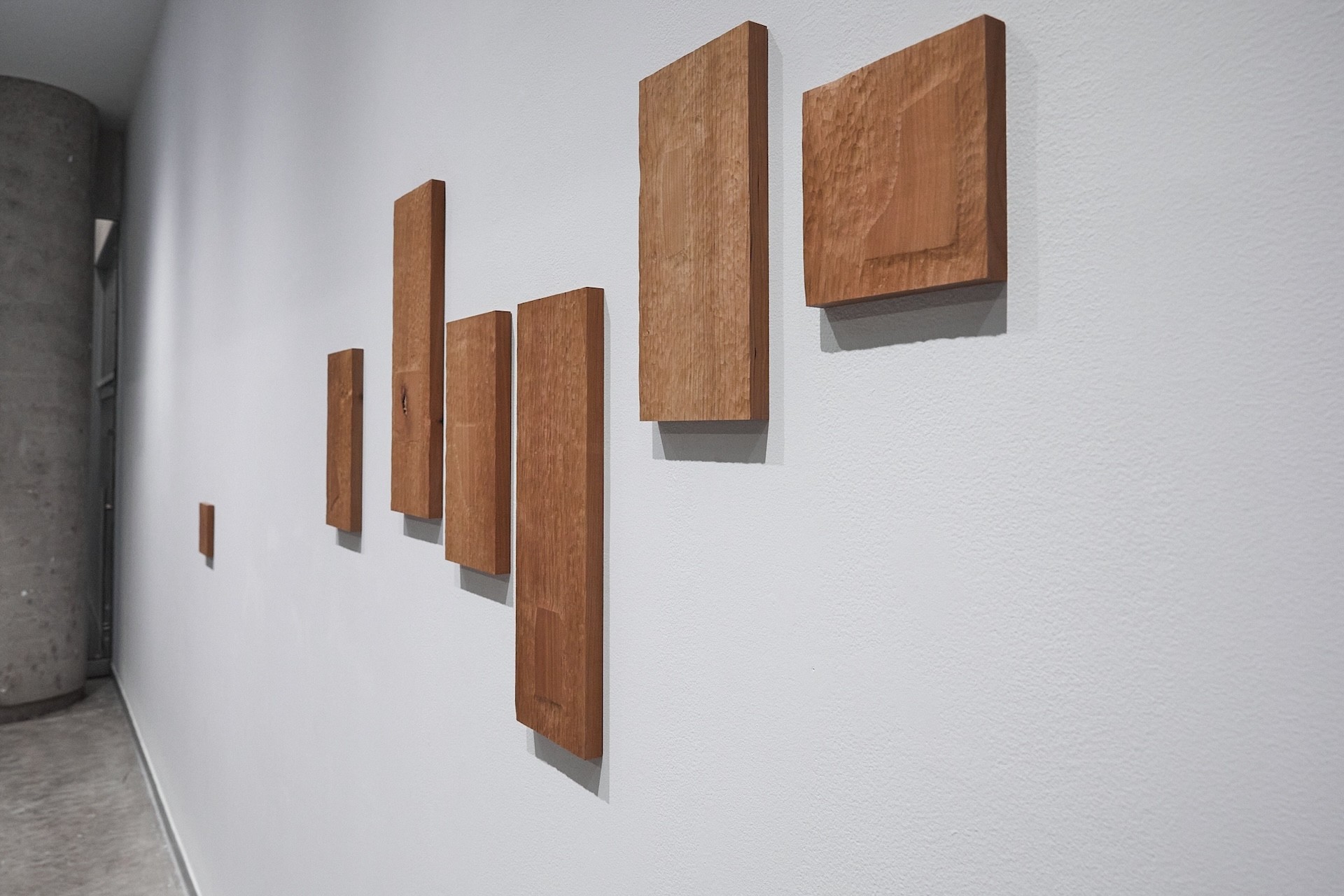
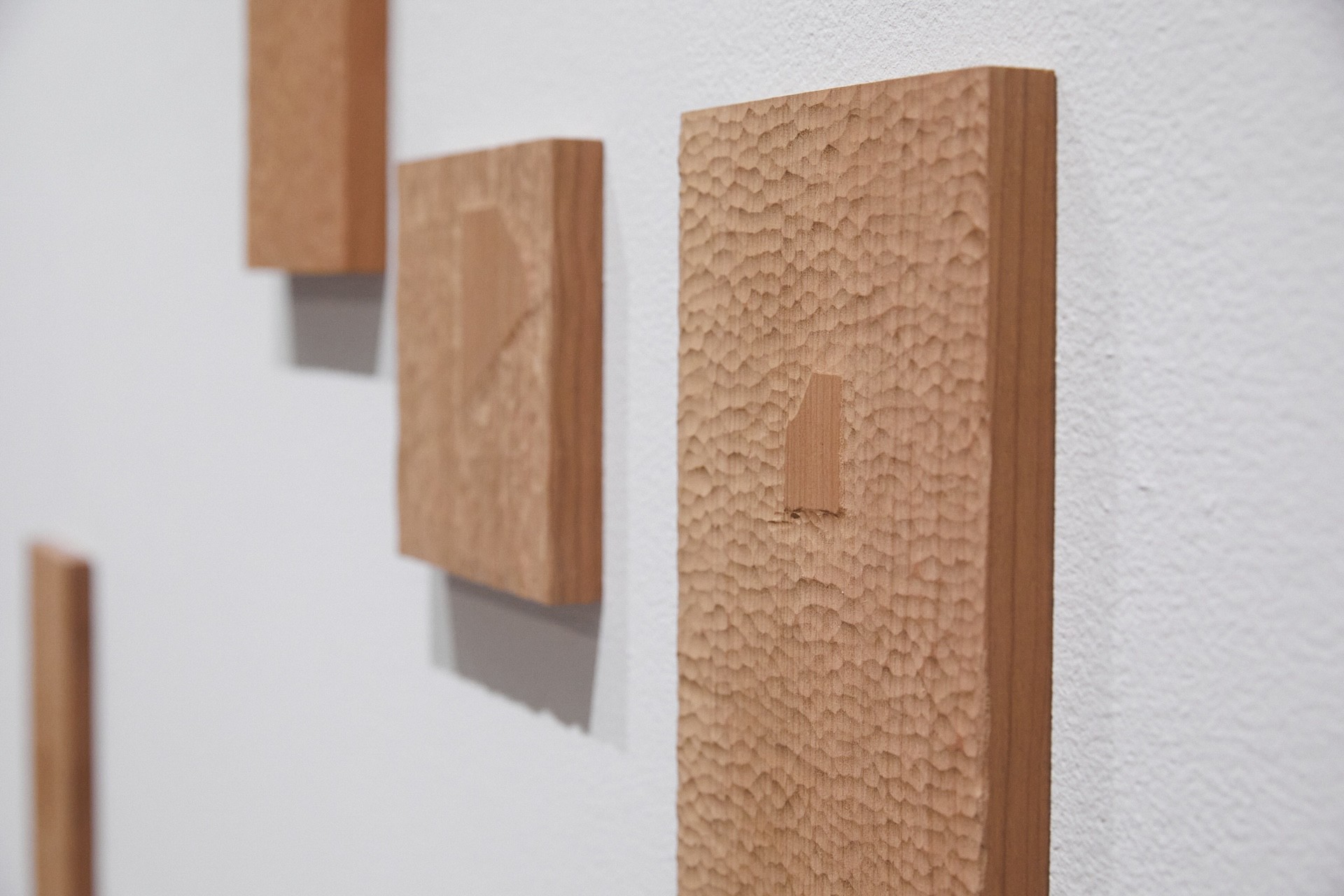
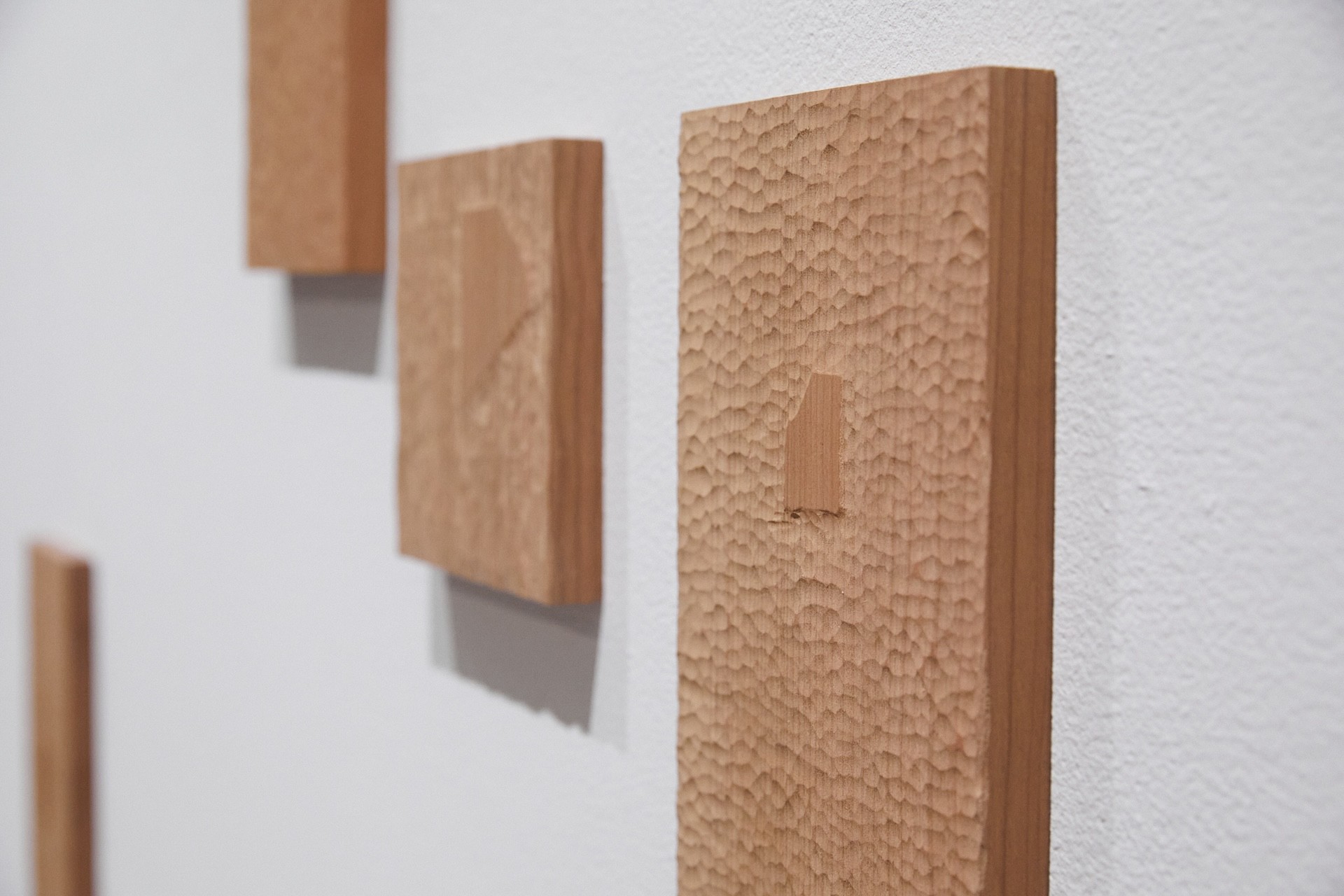 ABTTP, 2026, carved eurasian cherry wood panels, fallen mosaic tiles collected from the 1960s Soviet-era mosaic Art Belongs To The People (author unknown) on Nurken Abdirov Axvenue in Karaganda, Kazakhstan; installation dimensions variable. Photo: Laurence Poirier
ABTTP consists of sixty carved panels — one for each of the fallen tiles I collected from a small rooftop over several years in central Karaganda, Kazakhstan. Rendered as subtle reliefs, the series is a work of transposition: a new composition for the displaced elements of a monumental work by an unknown author. It is both a new image of the original mosaic, and a process of imaging the displacement and disintegration of the Karlag gulag’s art histories.
The panels articulate the outlines of tiles fallen from Art Belongs to the People (circa 1960s), a modernist Soviet mosaic by an unknown artist installed on the side of an apartment building in central Karaganda. In contrast to other monumental Soviet public works in the city, this mosaic is decidedly un-epic in form: made from cheap materials, it depicts weavers, dancers, musicians, and a sun-bird in a style that only loosely conforms to the official state style of socialist realism. The title comes from a rare use of text in the work— an early quote from Lenin’s interview with German socialist Clara Zetkin: “art belongs to the people.” Its author unknown, the mosaic has been left to disintegrate.
Arranged as a kind of abstracted visual score, ABTTP responds to the mosaic’s architectural context. Carved of cherry wood, the panels invoke one of hundreds of thousands of trees planted by forced gulag labourers across the grassland steppe of the Karaganda region, which endured massive climate and ecosystem change due to the gulag agriculture and coal mining industries. Many local gulag histories are sustained through oral stories and provisional graftings, circulating in quiet and dispersed forms that exceed those registered in the official Karlag museum. i
i Much of what we know about these artists comes from the work of art historians Guldana Safarova and Larissa Pletnikova, among others. Among the artists they documented, I discovered Pavel Friesen, a distant cousin from the same village as my grandfather, near Molochansk, Ukraine.
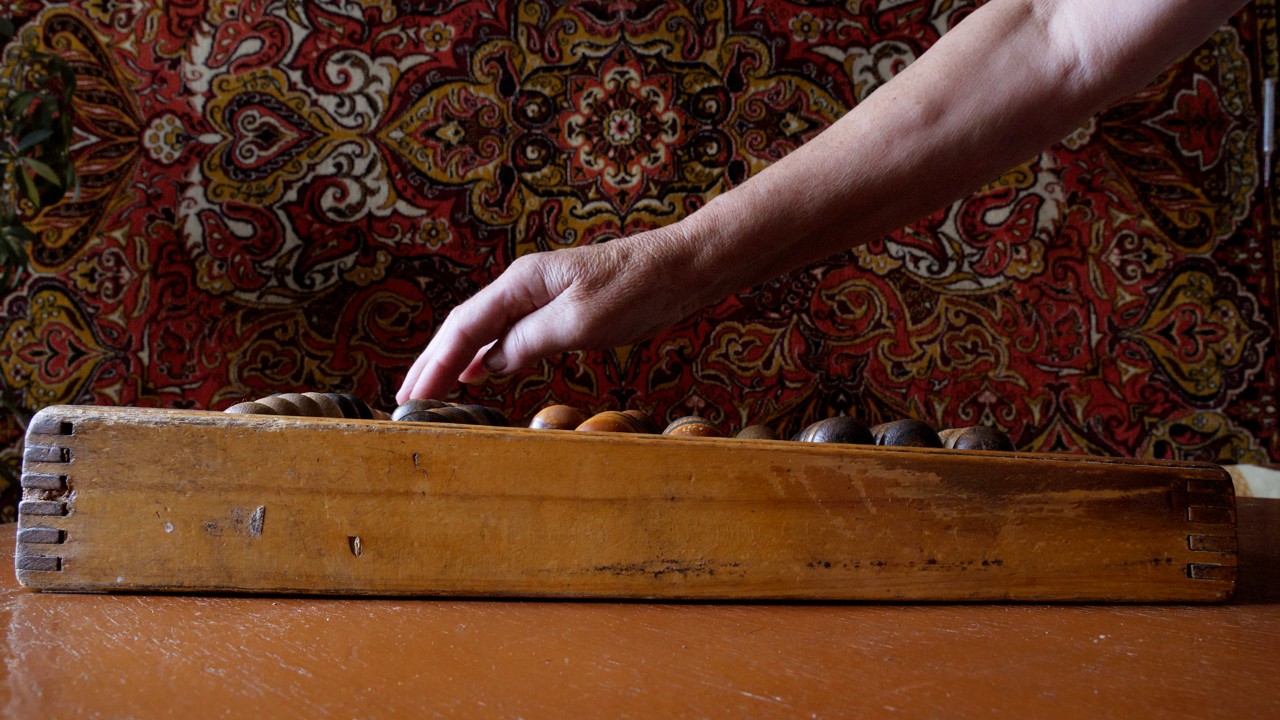 Video still, from the single-channel video installation Dolinka Shyoti (Score for Abacus I), 2026.
I produced Dolinka Shyoti (Score for Abacus I) in the former territory of the Karlag gulag, in and around Dolinka, central Kazakhstan. In the work, Irena — a cashier in Dolinka’s village store, and a gulag descendant — performs a mathematical score on an abacus, composed of statistics drawn from the nearby Karlag museum. Opened in 2011 in the former administrative building of the gulag, the museum sits within a Stalinist imperialist complex whose surrounding structures have been repurposed into homes, stores, workshops, and contemporary prisons. The score is composed of disparate statistics, including the numbers of each exiled ethnic group; the hectares of land the incarcerated farmed; the kilograms of cabbage, sunflowers, and tobacco produced in the first year; the number of bands and choirs the prisoners formed; the amount of livestock camp authorities confiscated from nomadic Kazakh communities during the process of forced sedentarization, a policy that resulted in the Asharshylyk — the famine death of the Kazakh population between 1930-33, estimated to have taken the lives of up to almost half of the population.
In a neighbour's living room, Irena performs this score of abstract addition on her inherited abacus, the traditional calculator she used as a cashier for twenty-five years. The soft click of the wooden beads and her whispered counting produce a steady yet fluctuating flow: an oscillating calendar or clock for an abstracted accounting, tuned into the impossibility of reconciliation or repair. I consider the vital role of statistics in documenting acts of genocide and state violence and what cannot be comprehended through accounting alone, especially when such violence continues in ongoing genocides, wars, and occupations every moment of every day.
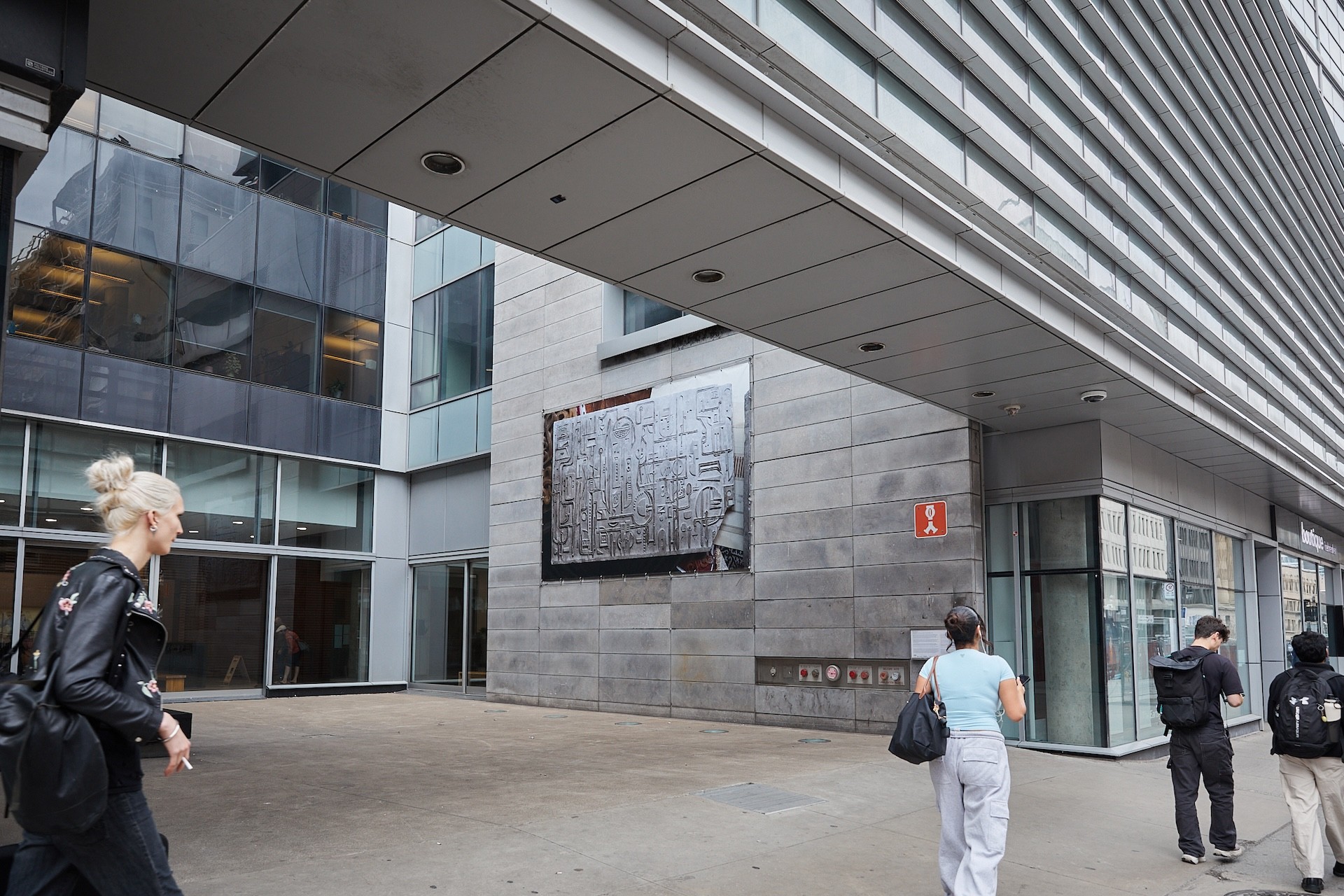
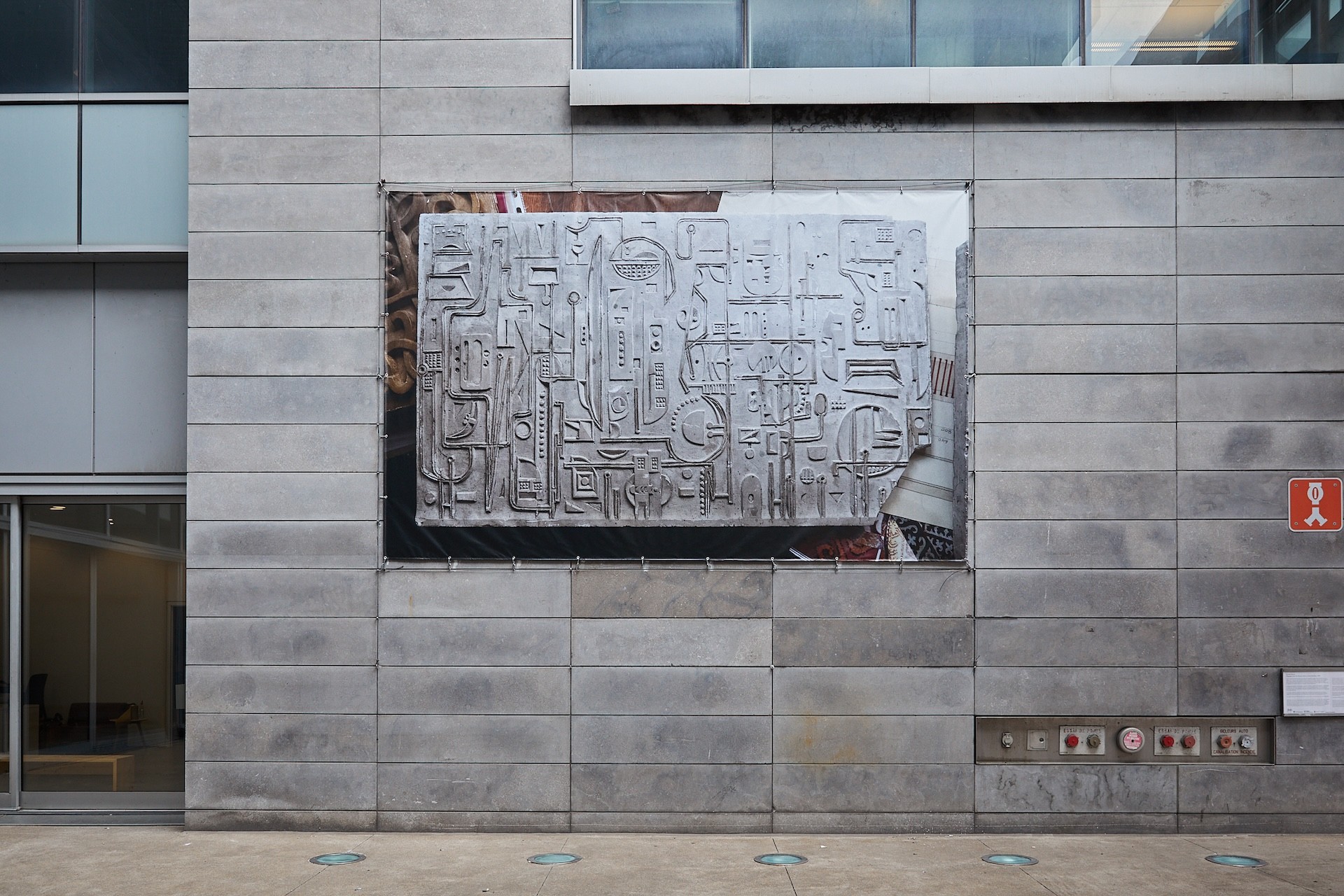 Photograph From The Personal Archive of Saule Bultrikova, 2023. Digital photograph, print on vinyl, 123" × 194". Photo: Laurence Poirier.
In 2023, I visited Saule Bultrikova in her home studio on the mountainous edges of Almaty, Kazakhstan’s former capital, where she gave me a tour of her personal archive. The first female architect to practice in Soviet Kazakhstan, Bultrikova’s extraordinary body of work spans architectural design, interior concrete and plaster reliefs, sgraffito, textiles, collages, paintings, and drawings. All her architectural work is now destroyed, surviving only through photographs and her personal archive of models and drawings. Yet Bultrikova’s archive is fragile, and during our visit she expressed an uncertainty of where her work would be archived and preserved.
Enlarged and displayed here, this photograph re-presents a detail of her model for the Kumyskhana, a café specializing in Kazakh food and drinks that once stood in Almaty’s city centre. Kumyskhana’s interior relief is an abstracted and decorative work, yet it contains traditional symbols and visual language of Kazakh tribes in a covert subversion of Soviet cultural policy, which restricted ethnic and spiritual imagery and enforced socialist realism as the only permissible form of artistic production. ii
The outdoor banner in the FOFA Courtyard will be presented, thanks to Concordia Public Art, until November 2026.
ii I came to know Bultrikova’s practice through Dennis Keen who has been documenting Soviet-era modernist monumental works in Almaty and the surrounding region for over fifteen years. Keen's project Monumental Almaty is intrinsic to the movement for the preservation and restoration of these works: www.monumentalalmaty.com
 Photograph From The Personal Archive of Saule Bultrikova, 2023. Digital photograph, print on vinyl, 123" × 194". Photo: Laurence Poirier.
 ABTTP, 2026, carved eurasian cherry wood panels, fallen mosaic tiles collected from the 1960s Soviet-era mosaic Art Belongs To The People (author unknown) on Nurken Abdirov Axvenue in Karaganda, Kazakhstan; installation dimensions variable. Photo: Laurence Poirier
 ABTTP, 2026, carved eurasian cherry wood panels, fallen mosaic tiles collected from the 1960s Soviet-era mosaic Art Belongs To The People (author unknown) on Nurken Abdirov Axvenue in Karaganda, Kazakhstan; installation dimensions variable. Photo: Laurence Poirier
 ABTTP, 2026, carved eurasian cherry wood panels, fallen mosaic tiles collected from the 1960s Soviet-era mosaic Art Belongs To The People (author unknown) on Nurken Abdirov Axvenue in Karaganda, Kazakhstan; installation dimensions variable. Photo: Laurence Poirier
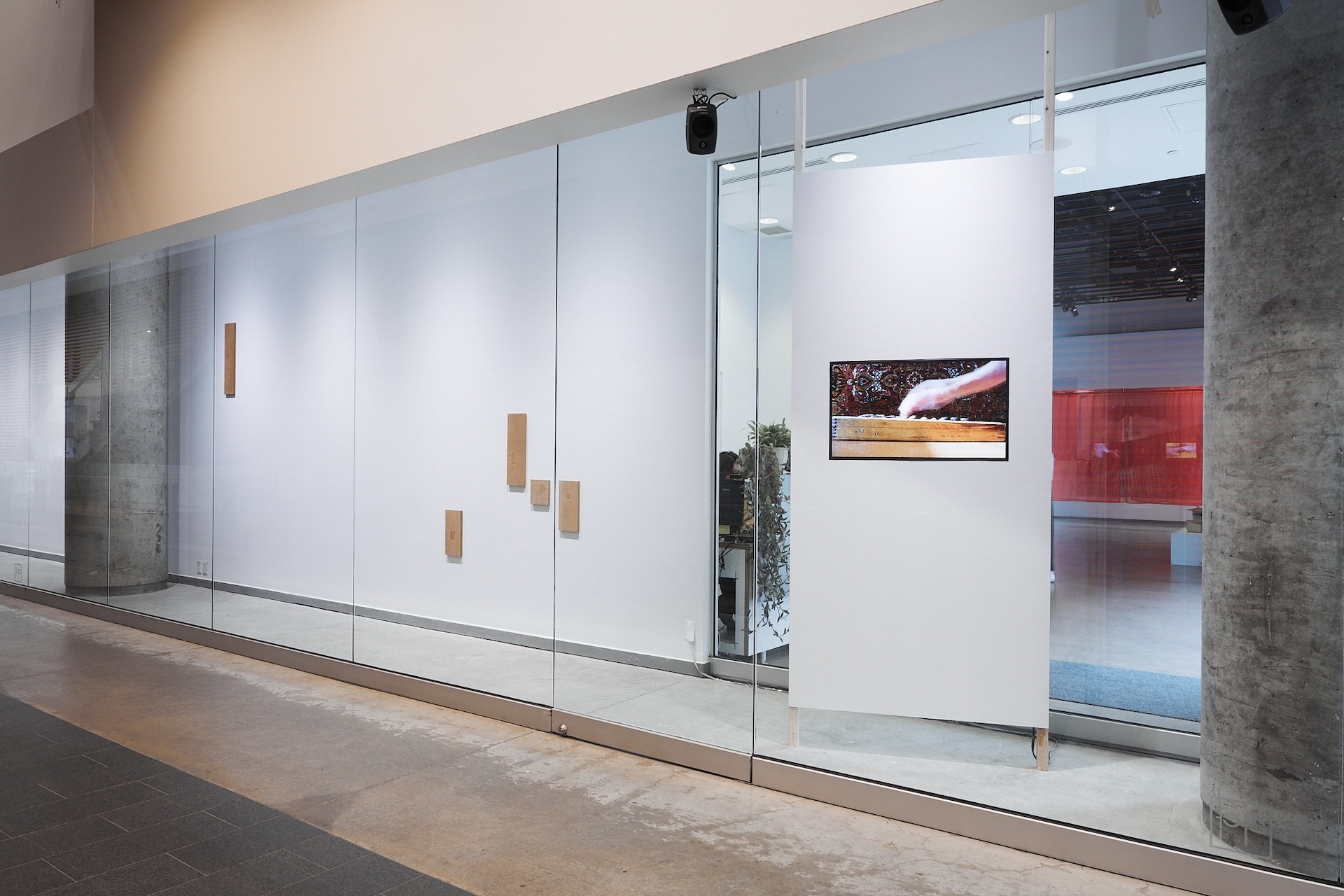 Installation view of ABTTP, 2026, and Dolinka Shyoti (Score for Abacus I), 2026 in the York Vitrines. Photo: Laurence Poirier.
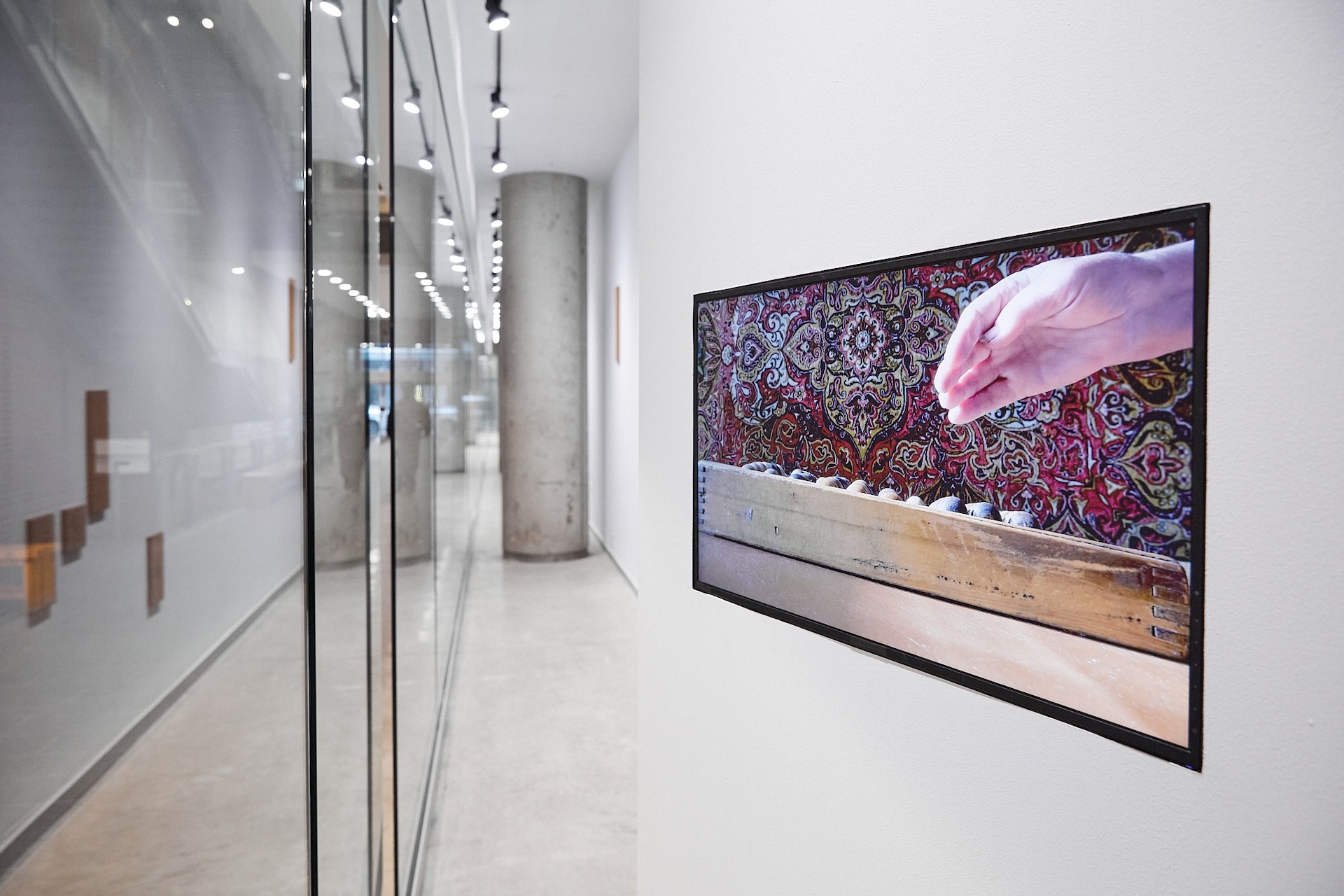 Dolinka Shyoti (Score for Abacus I), 2026. Single channel video / installation, colour, stereo sound, 7’00. Photo: Laurence Poirier.
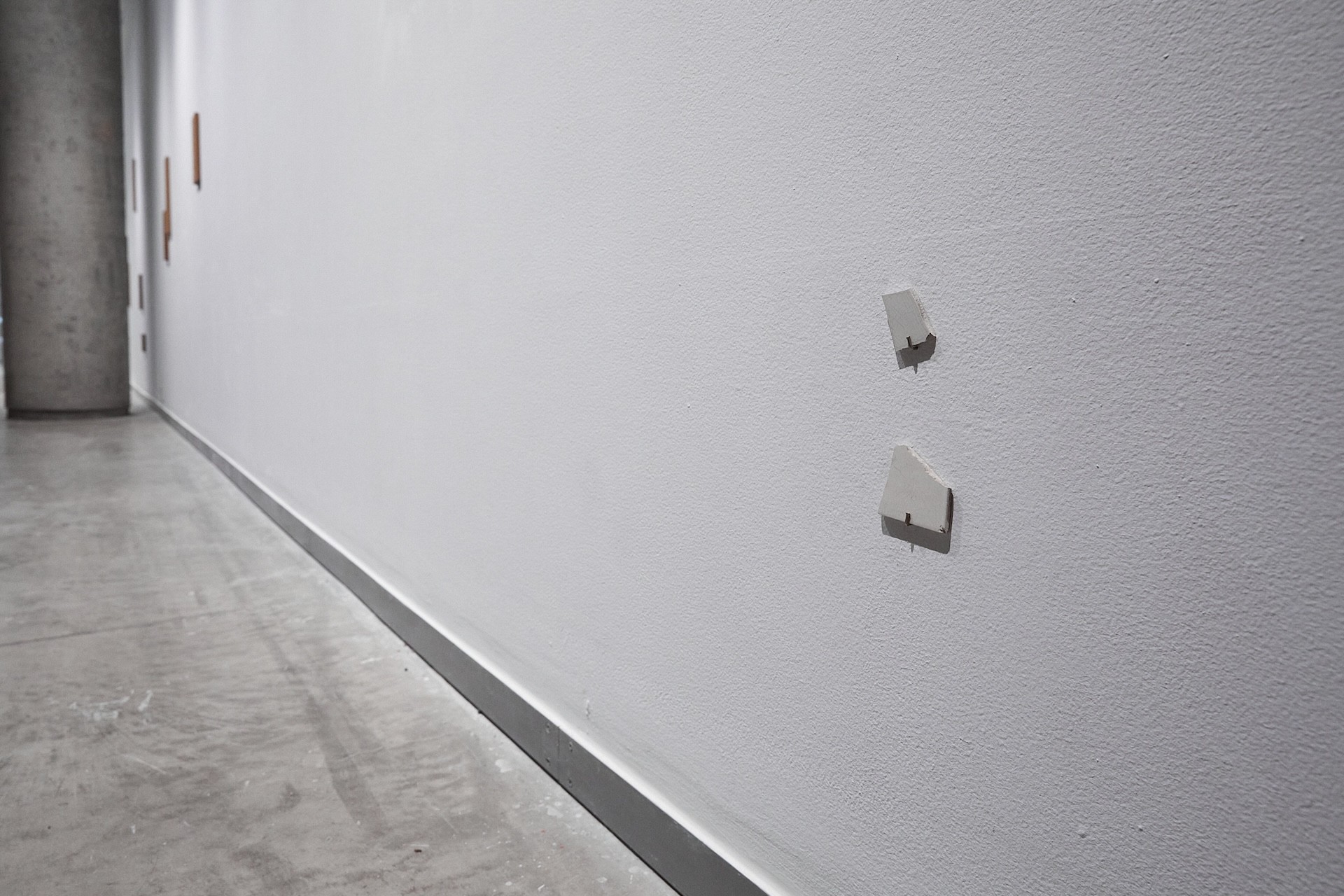 ABTTP, 2026, carved eurasian cherry wood panels, fallen mosaic tiles collected from the 1960s Soviet-era mosaic Art Belongs To The People (author unknown) on Nurken Abdirov Axvenue in Karaganda, Kazakhstan; installation dimensions variable. Photo: Laurence Poirier
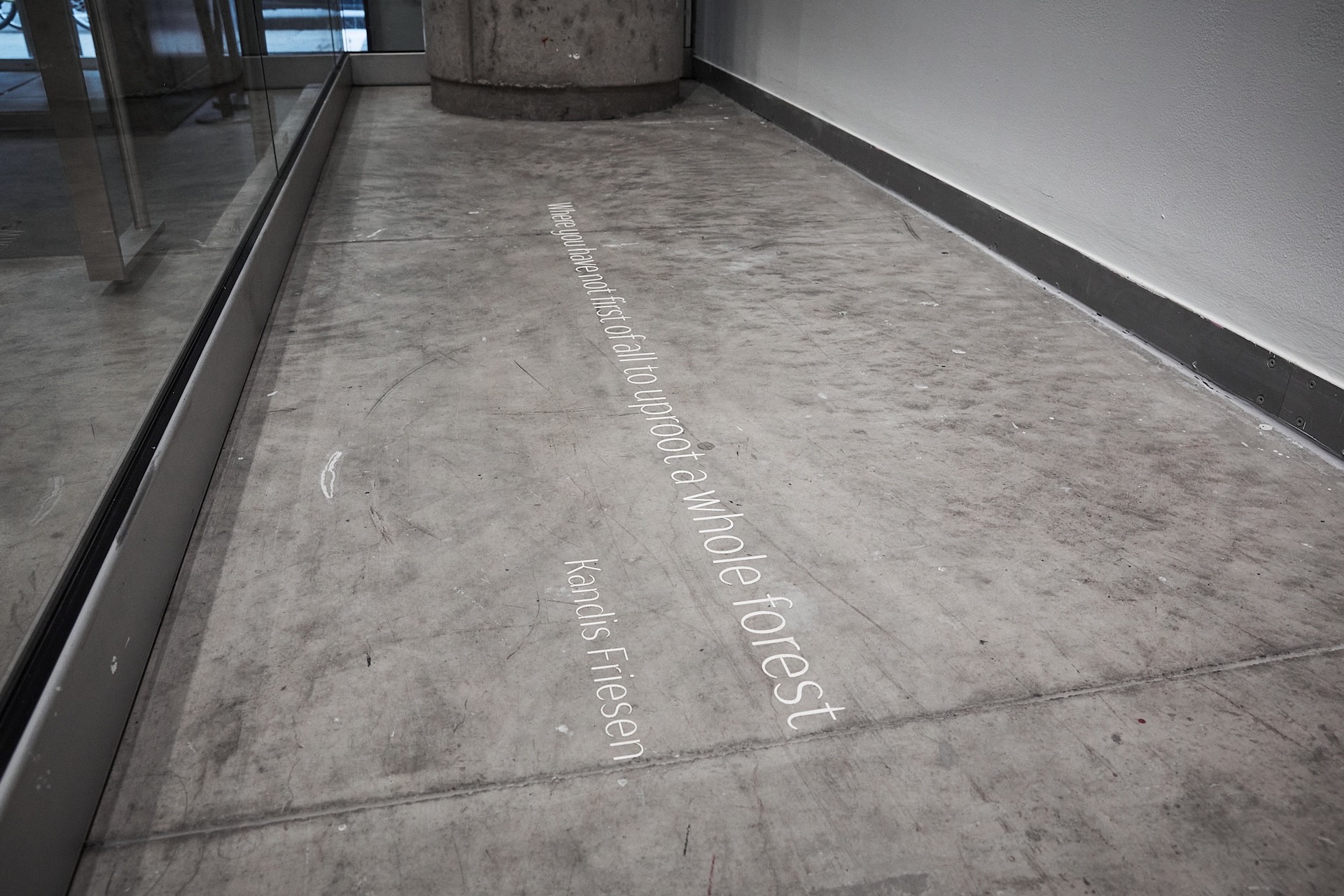 Exhibition signage made by Joé Côté-Rancourt and Hannah Ferguson. Photo: Laurence Poirier
Biography
Kandis Friesen works with the disintegrating and dispersed monumental. In her practice, she often works in modes of grafting and re-publication (making something public, again), making works that amplify site-specific histories and the structures which hold and transmit them. Her recent work uses history as a central material, building provisional structures for historical resonance, repositioning, and disrepair. Her work has been exhibited and screened at Kunstpavillon (Innsbruck), Galerie im Turm (Berlin), Odesa National Fine Arts Museum (Odesa), CAFKA Biennial of Art in Public Space (Waterloo), Plug In ICA (Winnipeg), FIFA (Montréal), Images Festival (Toronto), MIX (NYC), and Jihlava IDFF (Jihlava). She holds an MFA in Art Theory and Practice from Northwestern University and a BFA in Intermedia Arts from Concordia University. Her work has been supported by grants from the CALQ, Canada Council for the Arts, the Graham Foundation, and a 2025-26 Fellowship for Art and Theory at Künstler:innenhaus Büchsenhausen. Friesen lives in Berlin and teaches art at Bergen School of Architecture in Norway.
Visit Kandis Friesen's Instagram

Acknowledgements
The research and production of works in this exhibition have been supported through grants from the Graham Foundation for Advanced Studies in the Fine Arts (2025-26), the Canada Council for the Arts (2025), and the Brucebo Art Foundation’s WB Bruce Travel Scholarship for Artistic Research (2019/2023).
The outdoor banner in the FOFA Courtard is presented thanks to Concordia Public Art.