

New youth-led VR project brings the realities of anti-Black racism into focus


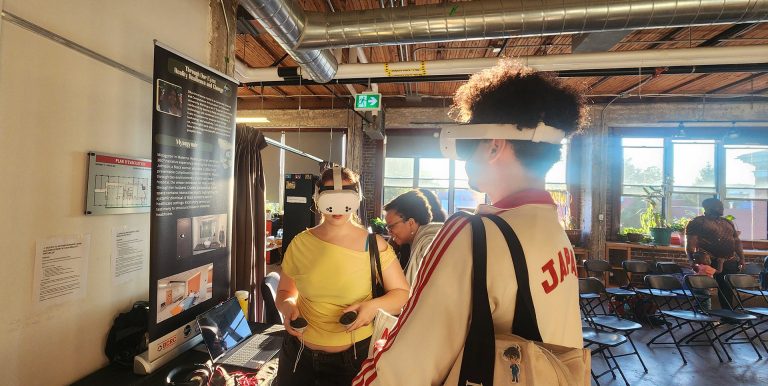
A new virtual reality (VR) project from Montreal's Black Community Resource Centre (BCRC) invites the public to experience the realities of anti-Black racism firsthand.
Through Our Eyes: Reality, Resilience and Change features seven simulations created by Black youth, including Concordia students Eniola Oyinloluwa and Dika Anne Marie Conté, and alumna Misha Bellerive, BFA 21.
The project aims to fight anti-Black racism by using immersive storytelling to build empathy, raise awareness and challenge biases. The participants’ VR simulations, recently showcased at an event on Aug. 21, explore workplace discrimination, racial profiling, microaggressions in education and racism in health care.
A project from the heart
Film Animation student Eniola Oyinloluwa is one of the project's participants. As creative director of his simulation, he explored racial profiling and discrimination in law enforcement, giving users a chance to witness a Black youth wrongfully stopped by police.
As the scenario unfolds, users are given the choice to intervene.
“This project is close to my heart,” says Oyinloluwa. “It became a lot more personal the more I worked on it. I’ve become more confident in my ideas and creative direction.”
While working on Through Our Eyes, Oyinloluwa was also taking Black Studies classes.
“Learning about the past, what it's been like, while also trying to find solutions to the challenges we’re still facing — it definitely affected the way I approached the project,” says Oyinloluwa.
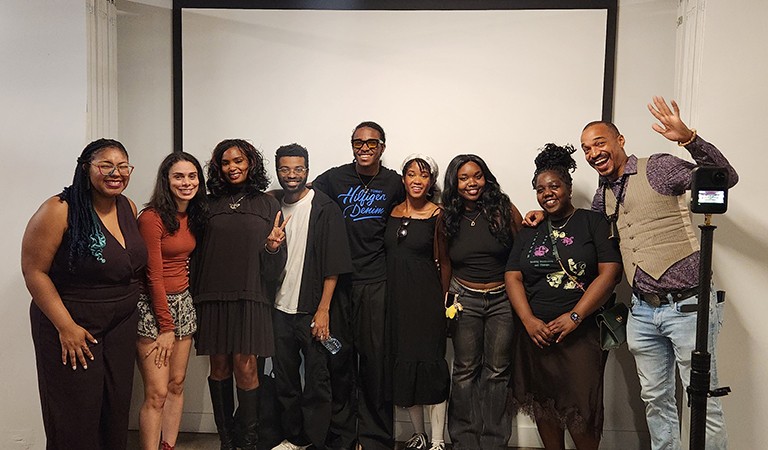 From left: Kayla Lewis-Thelusmon, Daphné Ostiguy, Iyore Edegbe, Fahad Ben Aboubacar, Eniola Oyinloluwa, Misha Bellerive, Dika Anne Marie Conté and Ayana Monuma and Kwame Newman-Bremang.
Exploring lived experiences
Ayana Monuma, BA 26, BCRC project coordinator, says each simulation’s creative director had the freedom to shape their work around their own perspectives and experiences.
“They had complete creative leeway on their simulation, deciding what they wanted to build based on their vision and personal experiences,” she says.
In the simulation “Misogynoir,” Dika Anne Marie Conté, a current Computer Science and Computation Arts student, depicts the systemic dismissal of Black women’s pain in health care.
Her project tells the story of a Black woman who died in 2016 from preventable complications after childbirth.
In “They’re Not Used to Our People,” Misha Bellerive, a Film Animation graduate, highlights the microaggressions often experienced by people of colour in school settings.
Educational toolkits, upcoming public dialogue
For each simulation, there’s an accompanying educational toolkit available on the BCRC website.
“We want to share toolkits with teachers so that they're able to talk about these topics in their classrooms,” Monuma says.
In addition to bringing the project into classrooms, Monuma says the BCRC hopes to share the project with the Montreal police force, which has been invited to attend an upcoming public dialogue later this month alongside other community organizations.
Headsets will be available so attendees can experience the VR projects in person.
“The dialogue is open to everyone,” she says. “It’s a chance to talk about the issues, share comments, ask questions and experience the simulations.”
Learn more about Concordia's Black Studies programs and certificates.
Explore the Through Our Eyes project at the Black Community Resource Centre.