



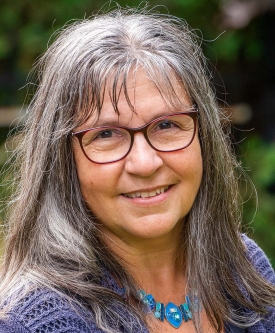
 “It feels good to be able to offer [participants] moments of self-care, peace and pleasure," says Suzanne Caron.
After decades building a career in computer science, business and politics, Suzanne Caron, GrCert 11, never expected that piano lessons would lead her to a new calling: music therapy.
Caron initially returned to the piano to unwind from her busy professional life. She had studied computer science, earned an MBA, developed information systems for large and small businesses, and provided strategic planning and business management counseling services — while raising four children. Her involvement in local schools eventually led her into politics, where she served as a municipal councillor and later as mayor of the Town of Mount Royal.
“My six years in politics were 24/7,” says Caron. “You are expected to resolve a diversity of issues and improve services, while not being in total control of your environment. It was a fascinating time but also stressful and exhausting.”
Seeking a creative outlet, Caron turned to jazz piano for an opportunity to express herself and have fun playing with other musicians. While attending summer jazz camps at the University of Louisville in Kentucky, she discovered their music therapy program.
“I wanted to know: can it really help people?” she recalls.
That question led her to return to school and embark in Concordia’s inaugural cohort of the Graduate Diploma in Music Therapy. During her first internship, Caron saw firsthand how music could really have an impact.
Working with a non-communicative stroke survivor, she helped him reconnect with memories of his late brother, a jazz musician. Gradually, music therapy helped him through his grieving process as he began to open up and socialize with other residents.
The experience confirmed she had found her new path. Caron later asked her professor and mentor, music therapy pioneer Guylaine Vaillancourt, what she hoped for the profession’s future.
“She replied, ‘I’ve always dreamed of having a music therapy centre in Quebec,’” recalls Caron.
Inspired by that vision, Caron drew on her leadership experience and her contacts in the business community to launch the National Music Therapy Institute in 2016, with offices in Côte-des-Neiges since 2018.
“Our model is based on a business-to-business concept,” says Caron. “We work in partnership with organizations whose clientele could benefit from music therapy. It often starts with a pilot project, offering them free services for a limited period.”
Over the years, the institute has worked with a range of clientele, including autistic children and adults, people with aphasia and living with dementia, caregivers, and young adults with developmental and physical disabilities.
One recent initiative began with an unexpected inquiry through the institute’s website.
 Caron pictured with former Concordia chancellor L. Jacques Menard, BComm 67, LLD 06, was among the inaugural cohort of the university’s Graduate Diploma in Music Therapy.
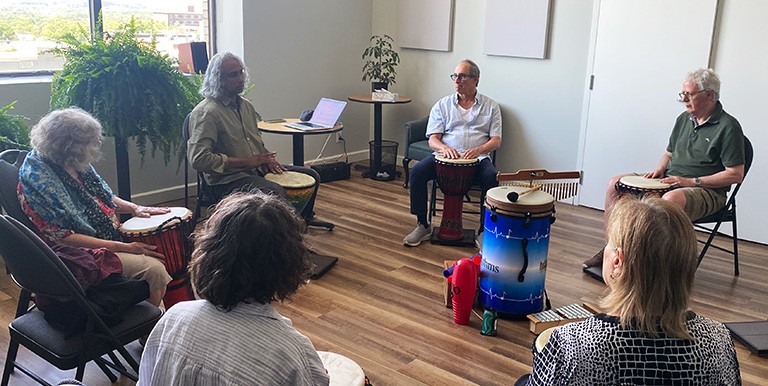 A group music therapy session led by Concordia grad Stephen Venkataragam.