The findings highlight the importance of incorporating visual cues in instructional materials so that children can learn not only a system of places and digits, but also a structured system of related units, the researchers say.
Seeing numbers differently
The researchers worked with 137 students, showing them visual representations of quantities to assess how well they could put numbers together (compose) and break them apart (decompose). Some visuals made the tens within hundreds visible, while others did not. The children were asked either to identify the number of tens or the number of hundreds represented.
The study found that children had more difficulty identifying the total number of tens than the number of hundreds. For example, when asked how many tens are in 235, a child might count only the three tens represented by the digit 3, overlooking the 20 tens contained within the two hundreds.
Making those embedded tens visible, as in Figure 1, helped.
“We think that when children break down a quantity, making the tens visible could act as a support that helps them recognize — or remember — that there are tens embedded within hundreds,” Barilaro says. “When tens are not visible, the relation between tens and hundreds is less obvious, making it harder for children to take the relation into account.”
Beyond memorization
The findings suggest that children may learn how to read and write numbers without developing a flexible understanding of how they work. This may be related to the way place value is typically introduced in school.
Children need to understand not only what each digit represents, but how numbers can be regrouped in different ways. For example, 235 can be represented as two hundreds, three tens and five ones, or as one hundred, 13 tens and five ones. Researchers call this the “structure” of a number.
“Place value instruction typically focuses on syntax at the expense of structure,” Barilaro says. “This would be akin to a child correctly saying she has ‘three dimes and four pennies’ in her pocket but not knowing that a dime is worth 10 pennies.”
The researchers argue that focusing on how numbers are conventionally written can limit children’s understanding of how quantities can be regrouped in different ways (Figure 2).



 Barilaro and Osana's paper showed that children in grades one and two had more difficulty breaking numbers into their component units than putting those units together, but that their performance improved when the tens contained within hundreds were made visible.
 Figure 1: The bars show that two hundreds can also be represented as 20 tens.
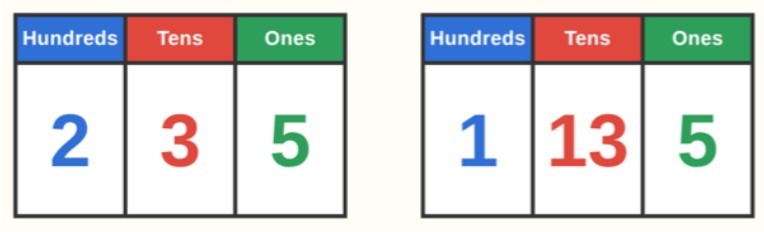 Figure 2: The left panel shows how place-value charts are usually used in the classroom, emphasizing one digit in each place. The right panel shows how the same quantity (235) can be regrouped differently.