Date & time
Thursday, February 26, 2026
7 p.m. – 9 p.m.
7 p.m. – 9 p.m.
Other dates
Thursday, March 12, 2026
Tuesday, April 21, 2026
Thursday, May 7, 2026


Thursday, March 12, 2026
Tuesday, April 21, 2026
Thursday, May 7, 2026
Marlihan Lopez, Gage Karahkwí:io Diabo, Emma Haraké
This event is free.
Librarie Livresse
2671 rue Notre-Dame Ouest, Montréal (Lionel-Groulx metro)
Activism is often associated with protesting, being out in the streets and calls to action. But what about the creative work that accompanies activist movements? Can storytelling and writing bring people together? What can it teach us about the causes we are fighting for?
In this public conversation, we will explore how writing and storytelling informs us and sets the tone for our activism and resistance. We will discuss how they can offer release, a way to find joy, and so much more.
Join us as we discuss: how does writing as a practice invite us to learn more about ourselves and those who came before us? In what ways do writing and storytelling complement activist movements? How do we ground Black and Indigenous activism in storytelling practices?
Accessibility notice: We strive to host inclusive, accessible events that enable everyone to participate fully. This venue is above the ground floor and wheelchair accessible with an access ramp. For inquiries about accessibility, please send an email to communityengagement@concordia.ca at least one week before the event.
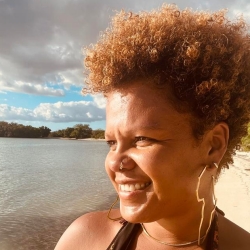
Marlihan Lopez is a Black feminist community organizer tackling issues surrounding anti-blackness, gender-based violence and its intersections. She coordinated the EDI (equity, diversity, inclusion) division of the Quebec Coalition of Rape Crisis Centres, where she did advocacy work and raised awareness on how gender, race, class and ability intersect in the context of sexual violence. She has also organized with movements such as Black Lives Matter around issues such as racial profiling and police brutality. She was co-vice-president of la Fédération des femmes du Québec and is the co-founder of Montreal's Defund the Police. She is also cofounder of Harambec, a Black feminist organization in Montreal that bridges academia, community and the arts.
Today, she dedicates most of her time to Black feminist memory work committed to unearthing, preserving, and honouring the cultural and epistemic productions of Black women and gender-expansive people. Her work is rooted in Black feminist thought and speculative methodologies, as well as an abolitionist and anticolonial praxis. She weaves together oral histories, critical archival research, and storytelling to challenge erasure and create spaces for communion and intergenerational knowledge transmission. Drawing from Afro-Caribbean traditions of ancestral remembrance and knowledge-keeping, Marlihan’s scholarship and creative practice focuses on facilitating Afro-diasporic reparations and pathways to healing from intergenerational trauma stemming from colonialism and white supremacy. She views embodied memory work as a form of maroonage, conjuring the spirits of her foremothers and envisioning liberatory futures.
Currently a PhD student in the Individualized Program in Fine Arts at Concordia University, she’s also the Academic Advisor for the Women’s Studies and Black Studies programs at Concordia University where she contributes to Black feminist programming and curriculum development.
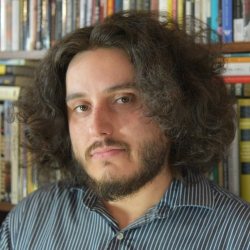
Gage Karahkwí:io Diabo is a Mohawk scholar from Kahnawake, recently hired at Concordia as an Assistant Professor with a cross-appointment in English and First Peoples Studies. Their research concerns the entanglement of land, oral tradition, and political philosophy in Indigenous literature, especially that of the Mohawk nation and the Haudenosaunee Confederacy. Their essays on Beth Brant, Waubgeshig Rice, Tom Porter, Lee Maracle, and Robert Alexie have been published in Canadian Literature, Studies in American Indian Literature, Inter-Asia Cultural Studies, and The Capilano Review. They graduated with a PhD in English Literature from the University of British Columbia in 2023 and recently held the Horizon Postdoctoral Fellowship at Concordia.
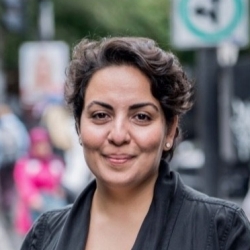
Emma Haraké is an educator, artist, and researcher whose work centres on oral history, memory, and personal narratives, with a strong interest in collaborative and community-based practices. She is the lead of collaborative space and events at SHIFT and is the creator of Mumtalakat, a project that gathers stories from Arabic-speaking immigrants through the objects that have accompanied them on their journey here. She is currently co-creating the graphic novel Not Here, Not There. A longtime lover of storytelling, Emma is interested in how narrative practices shape belonging and inspire collective action.
As a flagship program of Concordia University’s Office of Community Engagement, the public bilingual conversations are free and open to participants of all ages, backgrounds and levels of education. Since its inception in 2003, University of the Streets Café has hosted over 500 bilingual public conversations.
Follow us on our Facebook page or visit us at concordia.ca/univcafe to learn more about our programming and last-minute scheduling updates.