

Gabor Szilasi (1928-2026): ‘His photography shaped our collective imagination’


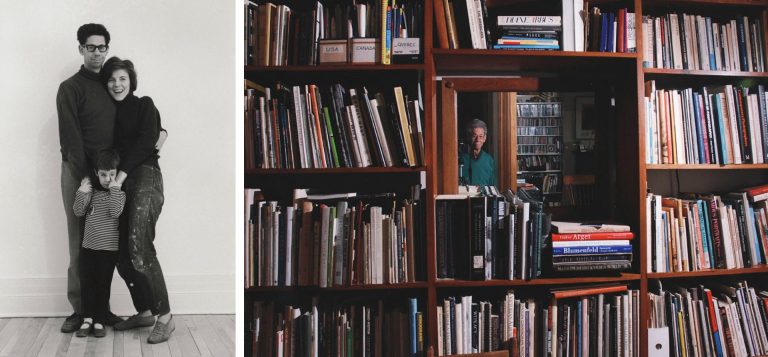
Renowned photographer and Concordia professor emeritus Gabor Szilasi passed away on April 10, aged 98.
Szilasi, who taught at Concordia from 1980 to 1995, was a towering figure in Quebec’s cultural scene. Much-loved for the warmth and clear-eyed curiosity that he brought to his photos, he documented the province’s changing cultural landscapes during the heady days of the Quiet Revolution, from the 1950s up to the present.
“Through his photography he shaped our collective imagination, capturing the poetry of Montreal’s everyday life and architecture,” says Annie Gérin, dean of Concordia’s Faculty of Fine Arts. “A remarkable pedagogue, he influenced generations of artists through both his work and his teaching. He will be dearly missed by our entire community."
Tracing Quebec’s social transformation over the decades, his legacy of over 80,000 photos is now a valuable historical document. It was acquired by Library and Archives Canada in 2021.
By capturing everything from political figures to nuns, regular workers and artsy socialites, Szilasi was heralded by francophone and anglophone audiences alike. As an outsider and an émigré, he was able to look objectively at his new country. He liked what he saw, and the people he met. He stayed in Montreal for the rest of his life.
In the 1970s he joined a group of Montreal artists called the Groupe d’action photographique, which focused on social and humanist issues. “Most of my artist friends are francophone, and I think it’s really important,” he told the National Gallery of Canada in a 2013 interview. “If you really want to enjoy the culture here you must speak the language.”
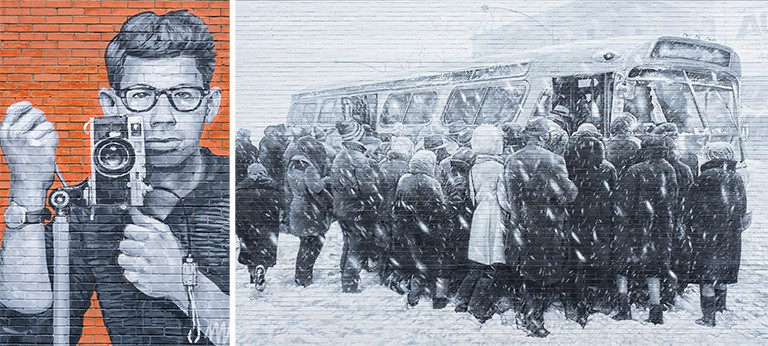 The public artwork honours the career of Gabor Szilasi. | Photo by Olivier Bousquet, courtesy of MU.
A mural in his honour
Montrealers may be familiar with the mural created in 2024 to celebrate Szilasi’s work, located across the street from Concordia’s Henry F. Hall Building, on the corner of De Maisonneuve and Mackay.
It shows a group of people huddling outside a bus during 1971’s Storm of the Century, beneath a bespectacled young Szilasi holding a camera.
The photo recreated for the mural beneath him, "Tempête de neige, février (1971)”, is one of his most famous works.
“Montreal has been a source of inspiration for Gabor since he came here in 1959,” his wife Doreen Lindsay told Concordia at the unveiling of the mural. “His years of teaching invigorated his life and led to friendships with both students and fellow faculty.”
Surviving Europe
Szilasi was born in Budapest, Hungary, in 1928 to an educated, middle-class family. He came from a Jewish family that had converted to Lutheranism, despite describing himself as non-religious. He was forced to wear the yellow star during World War II, and his mother died in a concentration camp.
He bought his first camera after working as a labourer on the Budapest metro, and documented the Hungarian revolution of 1956 before fleeing the country with his father — his second attempt after being caught by the communist authorities the first time in 1949.
He landed in Halifax in 1957, but was quarantined after being diagnosed with tuberculosis. Eventually settling in Montreal, he got a job at the Office du Film du Québec, and started travelling throughout Quebec, documenting rural life in regions like Charlevoix, Abitibi, Lac Saint-Jean and Beauce.
His series of Charlevoix photos in particular resonated with people, and have come to be considered an important Canadian collection. His images “are part of a larger and continuing documentation of rural life in Quebec,” according to Toronto’s Stephen Bulger Gallery. “An exponent of down-to-earth humane realism… Szilasi is pointing out truths that most people recognize only too late.”
 Man on horseback at the Festival Western de Saint-Tite, Mauricie, Quebec. | Image courtesy of the Gabor Szilasi fonds, Library and Archives Canada.
Everything only happens once
Over the course of a long life well-lived, Szilasi was an exponent of seizing the moment.
“You have to take photos today, because everything is always changing,” he told Le Devoir. “Everything happens only once.”
By capturing the fleeting nature of the present, this beloved figure left an indelible mark on his adopted city and country.
“Gabor’s work and legacy have had a lasting impact on photography in Quebec” said photography professors Marisa Portolese, Geneviève Cadieux and Chih-Chien Wang, in a statement released after Szilasi’s passing, on behalf of Concordia’s Photography program.
“He was a key figure in the program. He helped establish a rigorous and humanist approach to the medium. His images remain an important historical record of the communities and places he photographed, bearing witness to our time. His influence continues to resonate in the ways photography is taught and practiced today. He will be missed.”
Throughout his career, Szilasi received many honours, among them the Governor General’s Award in Visual and Media Art, the Paul-Émile Borduas prize, the Knight’s Cross of the Order of Merit of Hungary. He was a Companion of the Arts and Letters of Quebec and a Knight of the Order of Montreal.
His work is held in galleries around the world, including the National Gallery of Canada, the MAC in Montreal, the Stedelijk Museum in Amsterdam and the Fotografiska Museet in Stockholm.