

Negar Sahebalzamani
Double Consciousness I, Double Consciousness II, and Sar-e Sofreh
 Double Consciousness II , 2024, oil on canvas, 24" x 30". Photo: Guy L'Heureux.
Project description
The Double Consciousness series is a continuous exploration of the dissonant nature of identity within the diaspora. It reflects the tension of attempting to live normally while the hum of news from home lingers in the background.
Double Consciousness II is inspired by moments of comfort shared between the artist and her mother while watching films; capturing the coexisting intimacy and quiet avoidance that such rituals can hold.
In Double Consciousness I, although separated by the mirror, the two women are connected in action and held in equal importance, showing connection and solidarity. As the connection to a diasporic home is often rooted in memory and the imaginary, the superimposed realms evoke a dreamlike state.
The use of the explosion creates a contradiction by being physically removed but psychically tethered to a place under threat. The diasporic subject sees, remembers, feels, yet cannot intervene. The women pictured are calm, yet their stillness is heavy, a silent reckoning with fractured belonging and unspoken grief. The superimposition of places recalls the fragmented realities of the diasporic subject where danger is normalized and goes unspoken. The estrangement between the bodies and the bomb resists a neat narrative of war, refusing the expectation of spectacle and the flattening of Middle Eastern lives into victimhood. These pieces become a quiet act of mourning, reckoning, and resistance, reclaiming agency amidst attempts of erasure.
Seeking to explore the dispersal of cultural and familial ties amidst displacement, Sar-e Sofreh stages a dinner scene that exists only in the memory and imagination. A large family inhabits this liminal space, their forms and environment slipping between presence and absence. This work explores the oscillation between fleshy embodiment and diaphanous dissolution, examining how the diasporic identity inhabits states of in-betweenness. The figures personify and live among this liminality through translucent flesh that merges with their surroundings and through the joining of incongruent spatial planes. This work seeks to destabilize the grounds on which the familiar Western model of the nuclear family is constructed and bring to attention alternative modes of being.
The title references the ‘Sofreh,’ a traditional Persian fabric on which we serve food and sit, yet it culturally connotes gathering, sharing, and community. The yarn border evokes this fabric, maintaining rhizomatic ties yet taking on a new, dispersed form. ‘Mehmoonis’ or large gatherings are a foundation within Persian culture, yet in this lived condition, the foundation becomes lost and fragmented in memory. Familiar Persian motifs adorn the wall, yet appear similarly fragmented and decontextualized. This work becomes a portrait of a family that exists dispersed but still entangled, held together by the threads of shared memory, even as they dissolve into the fluidity of distance.
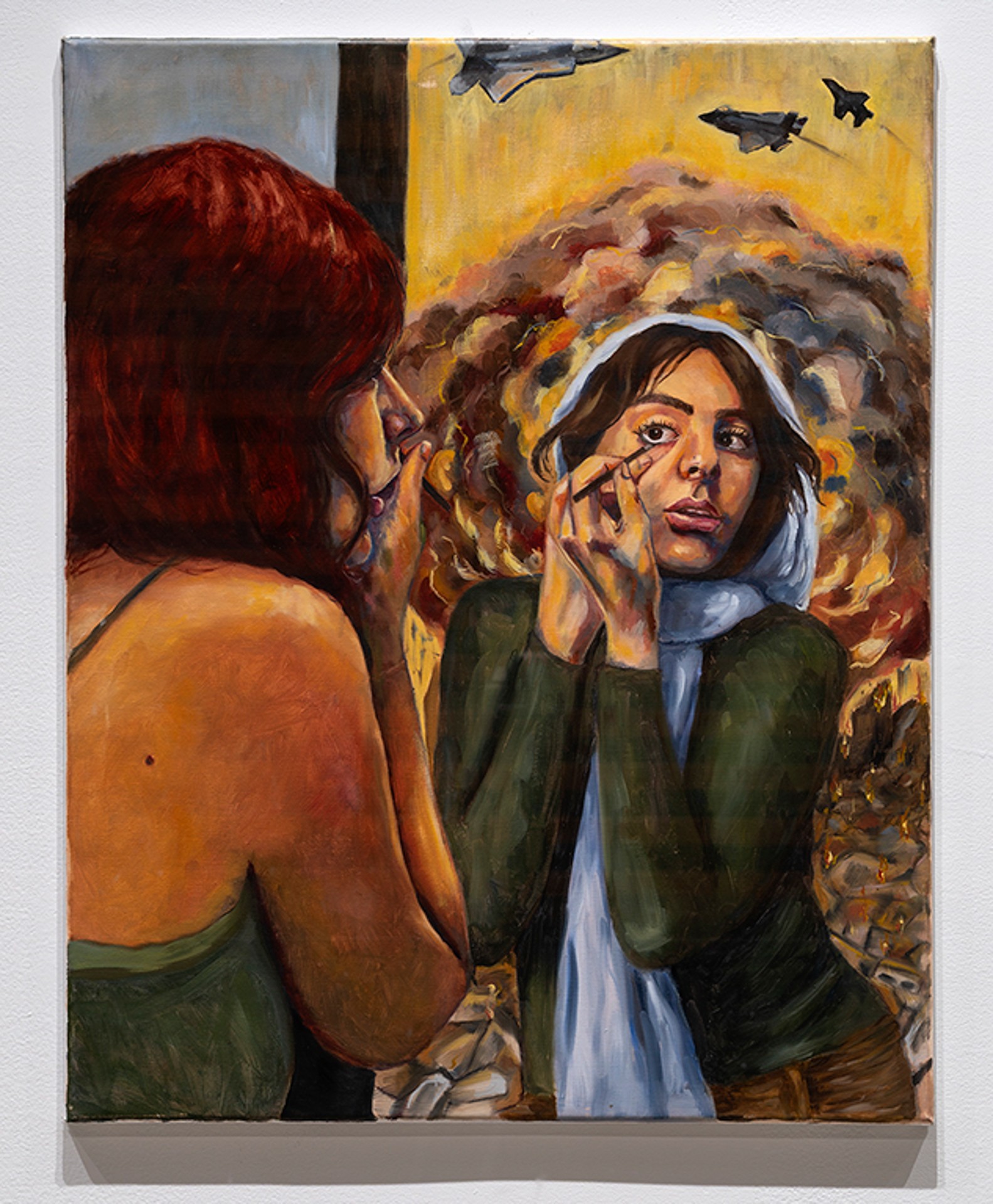 Double Consciousness I , 2025, oil on canvas, 36" x 48". Photo: Guy L'Heureux.
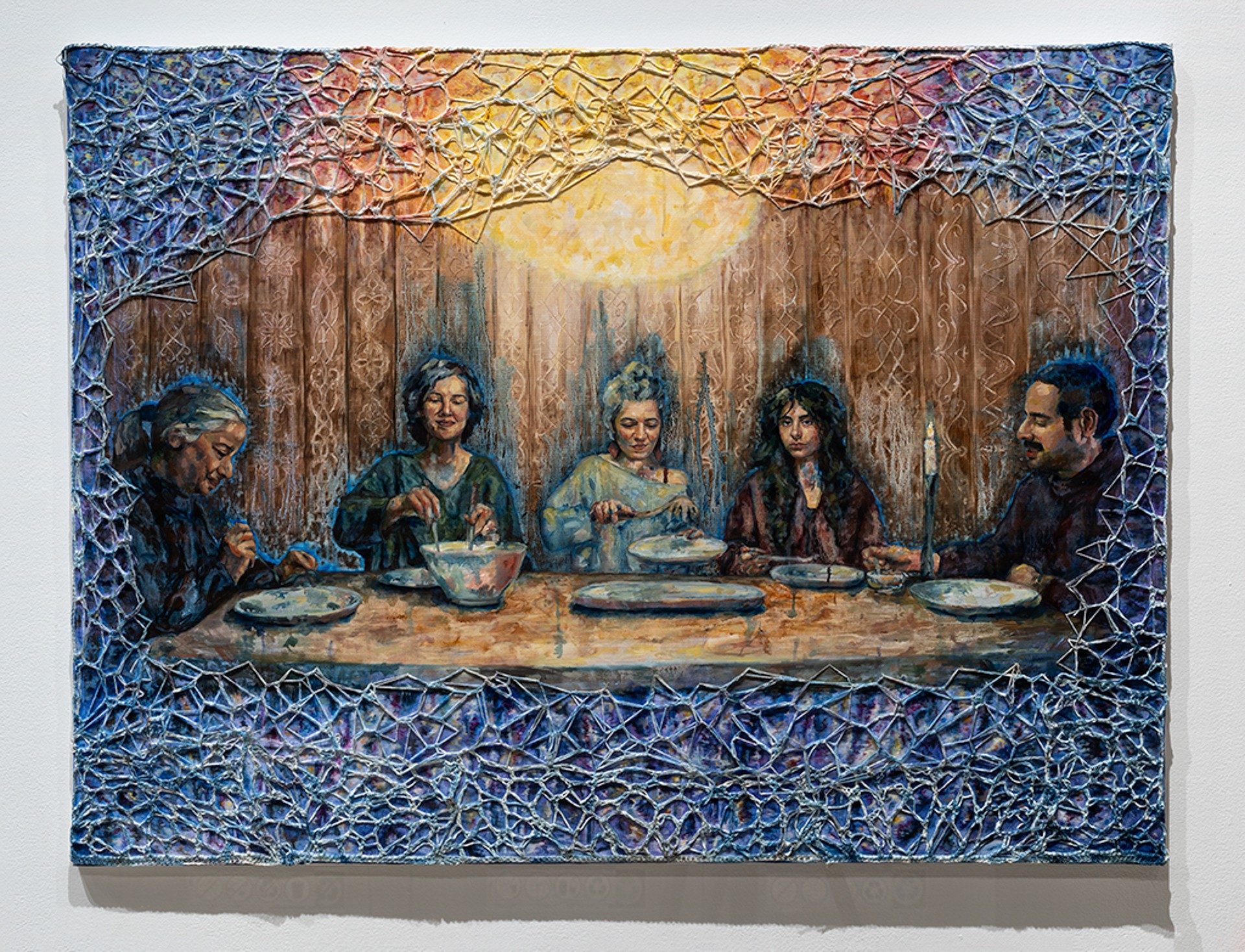 Sar-e Sofreh, 2025, oil, acrylic, yarn on canvas, 36" x 48". Photo: Guy L'Heureux.
Artist’s biography
Negar Sahebalzamani is an Iranian artist who explores the fluid, rhizomatic nature of identity within the diaspora. Drawing from her cultural heritage and lived experience in the West, she creates figurative portraits that center resilience, resistance, and self-reflection. Confronting colonial and phallo-centric gazes, her work challenges hegemonic norms and reclaims narrative agency. Her figures often exist in liminal spaces, caught between memory and displacement, the imaginary and the tangible. Sahebalzamani’s practice is both a personal reckoning and a collective exploration, offering a space where marginalized identities can feel seen, represented, and empowered.
Visit Negar's Instagram!
