

‘Cultural expression didn’t stop’: Artist Dominick Porras on reimagining Indigenous histories


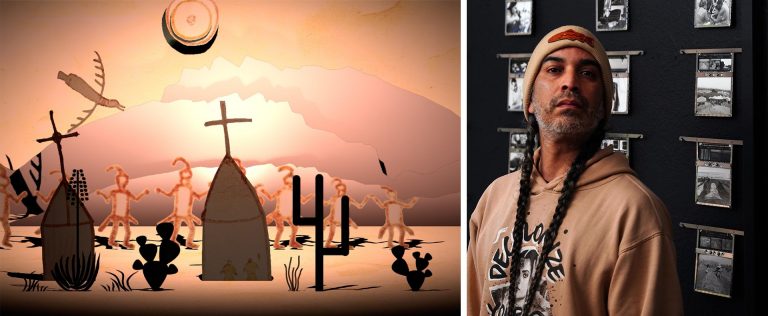
A gun among bows and arrows. A missionary among Indigenous figures. For artist Dominick Porras (Chicano/Coahuiltecan), these details tell a story of a world undergoing profound change.
The images appear in rock paintings in the Pecos region of Texas, some of which were created roughly 400 years ago. Porras, Concordia’s 2026–27 Fulbright Canada Research Chair in Indigenous Knowledges, is studying these works as both historical records and works of Indigenous art.
His project, Animating North America’s Oldest Illustrated Book: The Rock Art & Paintings of the Pecos, looks specifically at paintings created during the period of Spanish missionization in the 16th and 17th centuries. The scenes capture Indigenous communities encountering European weapons, missionaries and new social and cultural pressures.
Working with Concordia’s Indigenous Futures Research Centre at the Milieux Institute, Porras is bringing an artist’s perspective to the paintings. He plans to look beyond the terminology often used to describe the artwork and explore what their imagery might reveal about the people who created them.
Your project focuses on rock paintings from the period of Spanish missionization. What interests you about these works?
Dominick Porras: There are scenes that show Indigenous people and European presence together. You can see things like a gun among bows and arrows, or a missionary represented within the imagery. You’re seeing a negotiation between maintaining traditional ways of life and seeking protection through the missions.
I think it’s important to look at these works beyond the scientific nomenclature that has already been created around them. There are deeper meanings there. Sometimes terms such as “primordial” are used, which can reduce rock painting to a very low standard, when these are, in fact, incredibly fine works of art.
Why is it important to you to approach these paintings as art rather than simply as archaeological evidence?
DP: When you look at something created 400 years ago, there can be an assumption that it belongs entirely to the past, as though the culture itself stopped. But cultural expression didn’t stop.
I’m interested in these as works created by artists who were experiencing a period of tremendous change. I want to look beyond simply identifying what is represented and explore what these images might have meant to the people who created them.
Why use animation and new media to explore this material?
DP: I want to share some of this information through animation and encourage people to look more closely at the works themselves.
I’m hoping to eventually take the project into other platforms, including 3D animation and augmented reality. There’s something interesting about bringing something very old together with a relatively new medium.
I’ve also been visiting electronic and interactive art events here in Montreal. Seeing Indigenous artists working in those spaces has been really inspiring, especially because there are still relatively few Indigenous artists working in digital and electronic art.
What has working with Concordia’s Indigenous Futures Research Centre added to the project?
DP: Here, I’m able to share these stories with people who have experience with these kinds of places. I’m really excited because I’ve already been able to establish connections that I didn’t quite foresee when I arrived.
I’ve also been inspired by the work of Indigenous digital artists like Skawennati, and the way they use digital technologies to push traditional storytelling into new media.
The support I’ve received from the Indigenous Futures Research Centre and Aboriginal Territories in Cyberspace has been really helpful. It gives me an opportunity to develop these ideas with people who have experience in these areas.
What do you hope people will take away from the project?
DP: I’d like to show that this is one way of approaching and investigating works like these. There’s a lot more that can be done with these paintings.
Ultimately, I’m hoping the project can help learners from that region engage more deeply with these narratives and discover different ways of connecting with their history and cultural expression.
Learn more about the Indigenous Futures Research Centre at Concordia.
Explore Concordia’s Milieux Institute.