

Two boxes of these small accessions were sitting on shelves in our vault for some time now and between two projects, I finally decided to give them the proper attention and see how and where they could fit in our collection of holdings. This is a short recount of some of my actions.
Blog post
Making Sense of Small Accessions as Missing Pieces of a Puzzle
July 14, 2026
|


Any archivists will tell you: small accessions can be a bit of a headache.
We often receive small groups of materials from different places, small private donations to be added to different fonds and collections. It’s easy to leave them on the side and let them accumulate to focus on more substantial projects. However, the risk in doing so is to lose some of the context surrounding their arrival.
 True copy of a survey of lot 13 located in ‘Gaspé Bay South’ dated March 18, 1865, I0176 Office of the Vice-President, Administration fonds, Records Management and Archives, Concordia University, Montreal.
 Passenger pigeon, [1881], A0001-02-0191, A0001 Concordia University Alumni and Friends Archives Collection, Records Management and Archives, Concordia University, Montreal.
Former Principal of the Simone de Beauvoir Institute Marianne G. Ainley brought the negative of a photograph of a passenger pigeon to Concordia Archives in April 1991. With it came a handwritten note by J. F. Lillicrap, a wholesale lumber of Lakefield, Ontario and addressed to the editor of the Rod and Gun in Canada magazine: 'Negative of a snapshot of passenger pigeon that I wrote you about some time ago. Yours faithfully.' The negative and Lillicrap’s note had been given to Ainley by passenger pigeons expert Dorothy Mitchell in the 1980’s and the date of the photograph was estimated to be 1881. Shortly after receiving the materials, Concordia Archives had the negative developed. The materials from this small acquisition were added to our Concordia University Alumni and Friends Archives Collection.
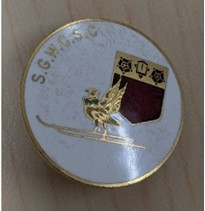 Sir George Williams College Ski Club (S. G. W. C. S. C.) enamelled pin, [1949], A0001-13-0012, A0001 Concordia University Alumni and Friends Archives Collection, Records Management and Archives, Concordia University, Montreal.
Leonard R. Rosenberg graduated from Sir George Williams College in 1949. In December 2002, he decided to give to Concordia Archives different pieces of memorabilia dating from his time as a student: his graduation ring (with his name engraved on the inside), a button pin of The Georgian, as well as an enamelled pin of the Sir George Williams College Ski Club, featuring the dove from the college’s crest on a pair of skis. These precious items were also added to the Concordia University Alumni and Friends Archives Collection.
 Insert for the CD including 4 songs recorded by Tom Swift in the 1960’s and compiled in his memory, A0001 Concordia University Alumni and Friends Archives Collection, Records Management and Archives, Concordia University, Montreal.
Tom Swift was already working as Assistant Director of Admissions at Sir George Williams University when he graduated in 1962. He also had a brief stunt as a singer during his studies, appearing on different variety shows and recording music with Allied Records. He chose the stability of office work over a rock star status and worked at Concordia University for many years, even returning after his retirement in 1995. Swift passed away in 2006, and his close ones put together a compilation CD of the music he recorded in the 1960’s. A copy of the CD as been added to the Concordia University Alumni and Friends Archives Collection. Listen to the four songs below.
Tom Swift: In Memoriam (1939-2006), A0001 Concordia University Alumni and Friends Archives Collection, Records Management and Archives, Concordia University, Montreal.
Adding these three small accessions to the Concordia University Alumni and Friends Archives Collection enriches the collection and adds depth by highlighting the importance of our donors. These records together help build a portrait of the students, faculty, and staff life at Concordia University.
 Stage in preparation, Traitor’s Gate, 1946, P0149-02-0026, P0149 Loyola College Dramatic Society fonds, Records Management and Archives, Concordia University, Montreal.
It is unclear how the 1946 photographs of the Traitor’s Gate production came to be part of our holdings. An error in the accessions numbering system resulted in the loss of their provenance. Nevertheless, it made sense to add the photographs to the Loyola College Dramatic Society fonds – the program for the play was already part of the fonds. The photographs offer a glimpse of the considerable effort devoted to creating the stage sets. They also reflect the social context of the times: Loyola College would not admit women as students until 1959 so the female roles in the production were played by men, recalling the Shakespearian practice of male actors appearing in drag (or ‘dressed as a girl’).
 The cast of Traitor’s Gate, 1946, P0149-02-0032, P0149 Loyola College Dramatic Society fonds, Records Management and Archives, Concordia University, Montreal.
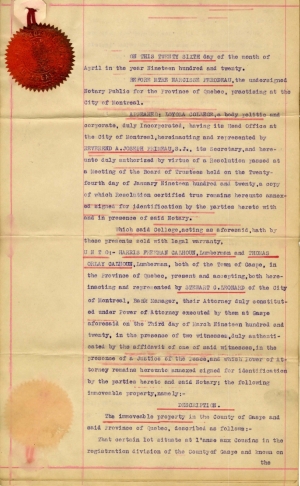 Extract from the deed of sale dated April 6, 1920 signed before public notary Narcisse Perodeau by Reverend A. Joseph Primeau representing Loyola College, of the Gaspé property, I0176 Office of the Vice-President, Administration fonds, Records Management and Archives, Concordia University, Montreal.
The same error in the accession numbering system mentioned above caused the loss of contextual information regarding the acquisition of the Henry John Kavanaugh papers. The collection consists of files including correspondence (going as far back as 1819!) and various legal documents related to a parcel of land (lot 13) located in l’Anse aux cousins, near Gaspé, that Kavanaugh bequeathed to Loyola College in his will. In April 1920, Loyola College sold the property. The records were added to the Office of the Vice-President, Administration of Loyola College (Reverend Joseph Primeau S.J., who represented Loyola College in the transaction was Bursar at the time of the sale).
In the end, I’m very happy that these small accessions have finally found their place in our different fonds and collections. They are now listed in our catalogue of holdings, each with a custodial history and a brief description. Making them discoverable opens up new possibilities: perhaps someone will stumble across this very blog post or a catalogue entry and be able to shed more light on the works of Dorothy Mitchell; perhaps the Kavanaugh papers will spark the interest of a researcher exploring the connections between John Henry Kavanaugh and Loyola College; or perhaps someone will be inspired to donate photographs from the Loyola College Dramatic Society that were left to them by a deceased family member. Small acquisitions can sometimes be like missing pieces of a puzzle, filling gaps in our institutional memory.
If you wish to help us donate materials to us, please visit our website and complete our donation form.
- Eric Côté, Archivist
ChatGPT was used to review some of the syntax of this text.