

As previously discussed in “UX is everything”, to create a great experience for your users/audience you should:
understand their needs and context
create a solution to address their needs
test the solution
repeat
There are various UX methods and activities that can be used at each stage. The Nielsen Norman Group provides a great cheat sheet.
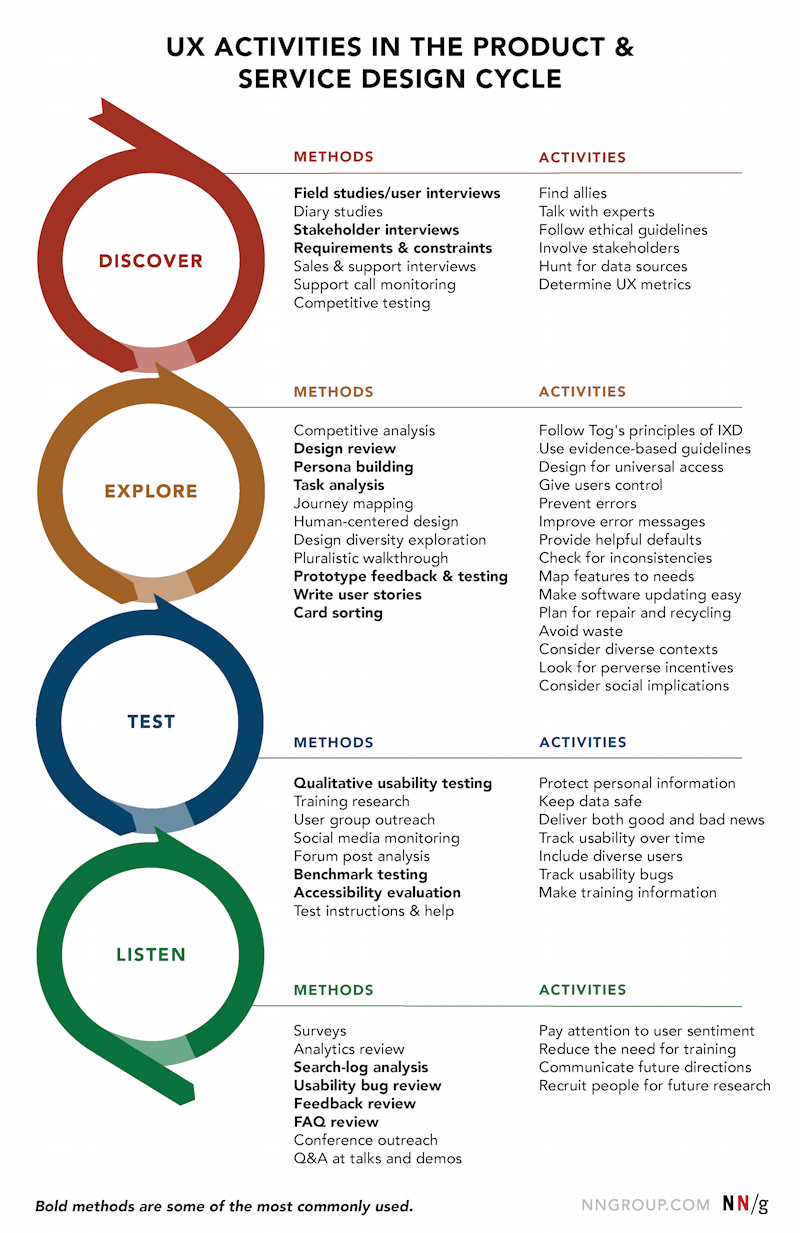 UX activities in the product & service design cycle – nngroup.com
Choosing which methods and activities are best suited for a project will depend on:
- the type of project
- gaps in knowledge about the users and their context
- resource constraints (e.g., time, money, availability of human resources)
Leverage what you already know about your audience and their context and identify any gaps in knowledge. In instances where you may not know much about your audience there are established best practices that can help get you started.
- First Principles of Interaction Design
- Ten Usability Heuristics for Interface Design
- Five Principles of Visual Design in UX
- Web Content Accessibility Guidelines (WCAG) 2.0 – this is an indepth and detailed read but you can read more about accessible content in these Sidekick articles
- Usability Guidelines for Accessible Web
The Nielsen Norman group among others are a great resource for articles about UX research and current standards.
Be mindful that there will always be unknown unknowns; information we are unaware is missing. Doing research (e.g., talking to experts, stakeholders and users) combined with testing will help uncover these gaps in knowledge and reduce the risk they pose.
- Knowns is knolwedge that can be leveraged from past research & experience + Best practices (human cognition and perception + standards)
- Unknowns / Gaps is knowledge that needs to be obtained through research and testing
Questions to help define user requirements
Below are questions to consider when thinking about the audience and where further research may be required.
What is their goal and why?
What are the steps they take to achieve this goal?
Where are they making decisions?
What information do they need to help them decide?
What terminology do they use?
Gaps or unknowns to this audience?
What do we want this audience to learn or do?
Designing a successful solution
Meeting our users’ needs and satisfying the business’ goals does not guarantee a great experience; rather, there are many factors to consider in their overall experience.
Peter Morville, a designer and information architect who has been working in the field since 1994, developed the user experience honeycomb to capture some of the facets of the user experience.
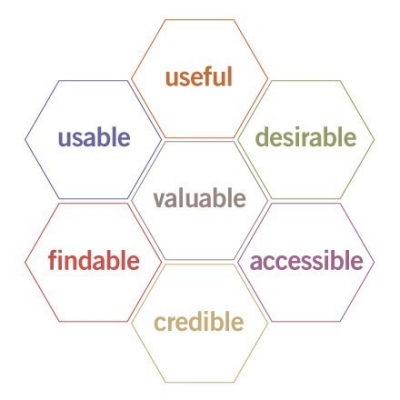 User Experience Honeycomb – semanticstudios.com
A usable and beautifully designed webpage is pretty useless if your audience can’t find it or they don’t think the information is valuable. When conducting research and testing be sure to understand and evaluate these other facets that influence your users’ experience.


