

Jessica Moore wins 2025 Governor General’s Literary Award for translation


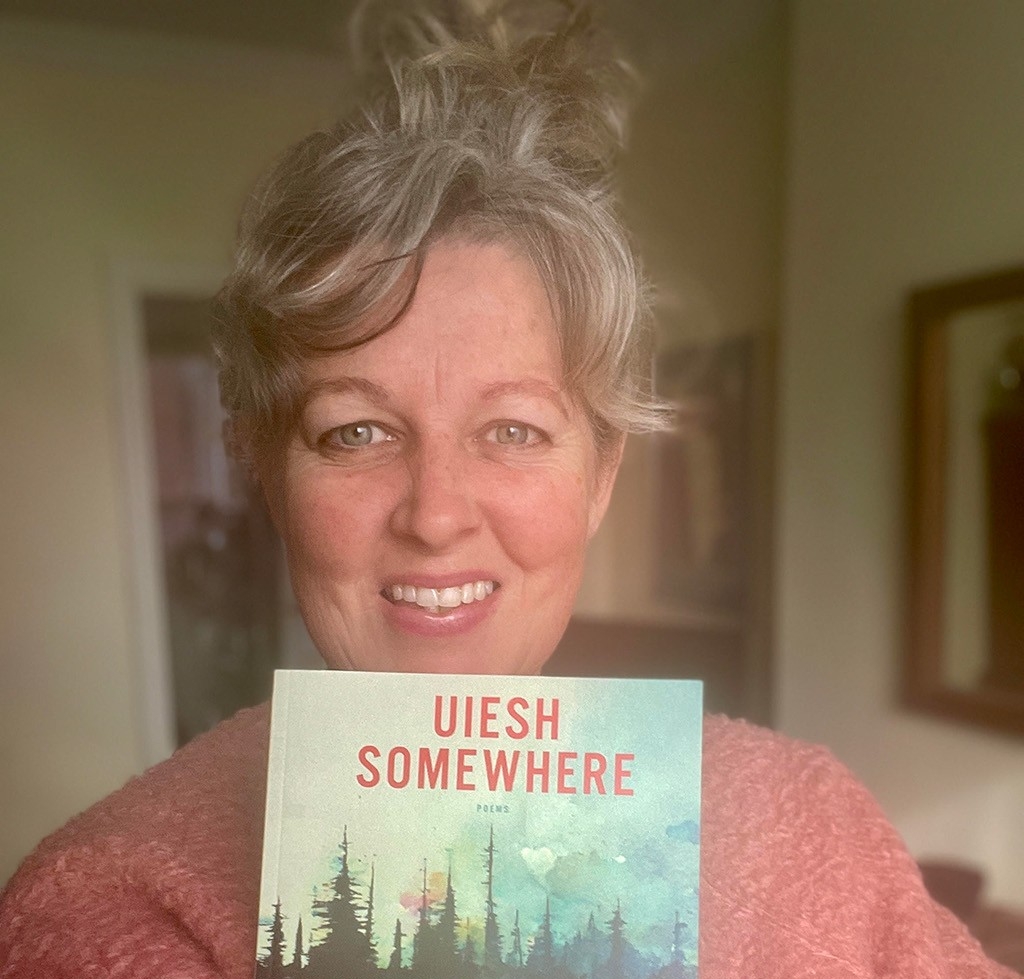 “I assumed there was no way I could win with a book of poetry,” says Jessica Moore.
Translator and writer Jessica Moore, MA 07, has added another major honour to her career. Already longlisted for the prestigious Man Booker International Prize in 2016 for her translation of Maylis de Kerangal’s Mend the Living, and named on the New York Times’ Top Ten Books of 2023 for her translation of De Kerangal’s Eastbound, Moore has now won the 2025 Governor General’s Literary Award for translation for Uiesh/Somewhere.
In the poetry collection, Innu elder Joséphine Bacon — who writes first in French and then self-translates into Innu-Aimun — reflects on her experiences in the northern wilderness of Nitassinan and the bustling city life. Working from the French text and Bacon’s voice, says Moore, meant tuning into the author’s cadence and ensuring it resonated in English.
“It’s a difficult prize to win,” she recalls. “All genres are considered together, and I assumed there was no way I could win with a book of poetry.”
Then came the phone call. “My whole body was tingling, and I really tried to soak it in,” she says.
‘Translation is the rewriting of a work in a new language’
Moore’s path to becoming a French-to-English translator began early. Raised by English-speaking parents, she was encouraged by her grandmother to learn additional languages. She attended a bilingual elementary school, learning in French for half of the day, and eventually did an exchange in Lausanne, Switzerland. Moore then spent a year abroad in Aix-en-Provence, France, where she took her first course in literary translation.
These experiences cemented her decision to pursue translation as a career.
“It requires so much care,” she says. “It’s often in the stage of revision that I see things and make sure to not lose something in translation. I look for creative ways to include the intention and heart of the original.”
Moore’s passion for translation comes from two impulses, she notes: “First, I have always been a writer, and translation is the rewriting of the work in a new language. The second impulse is the deep satisfaction of arranging things in just the right order and delivering words from one language to another.”
Honing her craft
Choosing Concordia’s MA in Translation Studies was “the right choice,” says Moore. “The program allowed me to do an interdisciplinary master’s so I had one foot in Concordia’s English department (creative writing) and another in the translation department.”
It also helped launch her career. Her first literary translation — which started as part of her master’s thesis — was Turkana Boy, a 2012 novel-poem by Jean-François Beauchemin. The book follows a grieving father who grapples with the mysterious disappearance of his son by searching for meaning in the fossilized remains of “Turkana Boy.”
That work helped shape Moore’s own creative practice. In 2012, she published Everything, Now, a hybrid lyric-memoir about navigating grief after the sudden loss of her partner. She uses her own translation of Turkana Boy as a template.
“The two were interwoven,” she explains. “I took phrases from the book as scaffolding for my own pieces — it was a call and response.”
For Moore, her writing and translation remain inseperable.
“I find the greatest strength for translating is that skill and sensibility as a writer,” she says. “I feel very clearly how the writing serves the translation.”