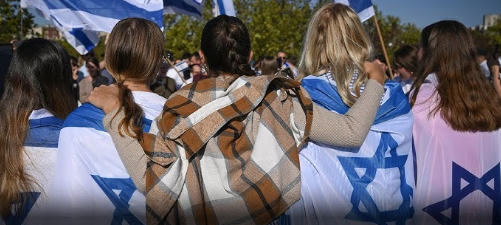
Source: The Independent
The Lionesses of Israel: Hearing from Israelis on International Women's Day
By Randy Pinsky
There is perhaps nothing so iconically Israeli as people keeping the tradition of the Purim celebration in a shelter. In spite of the recent conflict and barrage from Iran and Lebanon, the people of Israel are steadfast in their inner strength and continuity.
How has the average Israeli fared in these challenging and unprecedented times? In honour of International Women’s Day, we interviewed three Israeli women to hear their stories. A religious leader, a teacher - both moms - and the sibling of reservists, they share their experiences with inner strength, humour and determination characteristic of the nation.
The Lionesses of Israel
Moria Ran (MR) is a Rabbanit and Halachic scholar from Petach Tikvah, near Tel Aviv. During the October 7th conflict, she became aware of the need for religious instruction and reassurance, so quickly mobilized groups for communal praying and learning sessions. While others set up food banks, distribution centers, volunteering and farming support, Ran and other religious leaders were involved at a more spiritual level, providing guidance and continuity when the world was swirling in uncertainty.
Lilach Ben Zvi (LBZ) is a lecturer from Haifa teaching in political theory at the Max Stern Yezreel Valley College in the Galilee region and is a researcher at the Kogod Research Center at the Shalom Hartman Institute in Jerusalem. In addition, she mentors students converting to Judaism. As a teacher, Ben Zvi has found that continuity and keeping schedules as regular as possible helps provide hope and security to her students. As the mom of five boys, she also shared how she has helped her kids cope in times of uncertainty, which in turn, helps her and her reservist husband see the light amidst the darkness.
Rachel Schwarz (RS) works as an editor in an international college application firm in Tel Aviv, helping connect students with overseas post-secondary opportunities. She is also the main coordinator at a small synagogue which has been a haven in the upheaval. Both her sister and one brother are in the reserves. She has found that work and community involvement has helped in the anxiety of not knowing their whereabouts or status for days on end. Originally from the States, Schwarz provides a unique perspective on the situation.
What is Your Role (Teacher, Religious Advisor, Reservist)?
MR: I am a Halachic scholar and professor of social history and gender at the Azrieli Center for Israel Studies at Ben-Gurion University, a research associate at the Hadassah Braden Institute, and I teach at the Open University. I’m a social historian focusing on Jewish religious feminism and Halachic ordination for women in Israel and the US, as well as a Rabbanit.
LBZ: I am a lecturer in political theory at Max Stern Yezreel Valley College and a researcher at the Kogod Research Center at the Shalom Hartman Institute in Jerusalem. I am a political theorist focusing on civic consent, modern relations between religion and state, and the role of the public sphere in democracies. In addition, I teach and accompany students who are in the process of converting to Judaism.
RS: By day, I am a content editor, researcher, translator and language teacher, and work as an editor and project manager at an international college application center in Tel Aviv. By night, I teach b’nei mitzvot kids and lead services at my synagogue. Two of my siblings are in the reserves so I know firsthand the situation many are going through.
How Has Your Role Impacted Those Around You?
MR: I feel that many have benefitted from taking part in religious study when things are so uncertain. It provides structure and inner calm. When the conflict started, I invited neighbours and friends to do a study session for Purim, and honestly, I wasn’t sure how they would react. These are strange times and we kept having to run in and out of the shelter. But they were so interested in it and thanked me for leading it, they found meaning and connection they were looking for. I really think it gave the megillah reading that much more impact and helped people to connect in these times.
The war gets us into a ‘war mode’ - we all know what we need to do. We often have to go to the shelter, we do things near the house, not going far away.
And we act like it is normal - but it is not. But this is our reality so we do what we can.
LBZ: Being a teacher, I feel it is important to keep up regular lessons and assignments. Taking a break just makes you focus on the balagan (mess, confusion) around you. I try to maintain as much routine as possible. I find continuing to engage with ideas and with the world, and meeting with my students gives me strength, and I hope it does the same for them. We try to make sure that the war delays us as little as possible, and in that sense continuing with our lives is our form of resilience in the face of those who want to harm us.
RS: There was a lot of uncertainty given concerns about perceptions about Israelis abroad, but we kept going. We reinforced it is their interest and skills that will attract the schools, and that they need to keep applying. Keeping things running helped on many levels.
Could You Describe Your Coping Mechanism?
MR: Just keep going. We act as normal as much as we can. I try to keep busy and that helps. Like most recently, I baked challah and prepared a ton of food for a family whose father was recruited. This will help the family to know that others are thinking of them. It also kept my mind busy and got my kids involved in something tangible. Surround yourself with friends so you are not alone, I really feel that makes such a difference.
I try to also think ahead with making sure we have enough food and supplies, and make sure the path towards the door is always clear in case we have to run to the shelter. At least my kids don’t leave their shoes in the hallway anymore!
I realize less is more too - I don’t have to know details of things. In fact, sometimes it’s better not to.
LBZ: Humour really helps. Israelis, in general, communicate a lot through humor during times of war. I think it gives us strength.
Building a new routine—even if it takes a few days, or sometimes longer, to adjust to the new situation. Being honest when things are difficult and sharing that with the people close to you. Teaching gives me a great deal of strength, which is why I returned to it as quickly as I could. Being there for my family puts me in a position of giving and keeps me going.
Within my family, we also try to create a new routine that makes room for the current situation—sirens and danger, which we are unfortunately quite accustomed to—but does not allow us to sink into it. We also did not give up on celebrating Purim.
RS: For me and my family, checking in on one another and keeping up routine makes all the difference. Finding a normal in not normal times. Keep a limit on the news - that has helped me for when my sister and brother are on the frontlines.
How are Kids and Family Members Coping?
MR: I tell others, try to be a bit more relaxed. The kids are stressed so let them be on their phones if they need it. Don’t try to control too much. I let go, really.
LBZ: I feel kids watch you and pick up on your energy. Even though we are all on edge, if you try to keep calm and not overreact, it will help the whole family. Sometimes they have strange reactions but that’s to be expected. Of course they are not ‘happy’ about it, but this is the way they can cope and make sense of the situation.
I find my children to be strong. Of course it is not easy, and we do not take lightly the disruption of routine, the need to wake up to the sound of sirens, or the fear of missiles.
Some of them are actually more frustrated by the disruption of routine than by the missiles themselves, which is very understandable. We try to talk openly about things, and I find that honesty—saying something like, “I don’t know how long this situation will last, but I believe we will return to normal”—is better than vague answers or promises that I may not be able to keep. We also have a great deal to be grateful for.
RS: My sister works in a search and rescue unit and does not like to talk about feelings. I feel this is her way of coping and keeping strong, forward thinking and focused. It is too easy to get sucked into a spiral of overthinking and anxiety, so she just doesn’t even go there.
I’ve been in Israel for around 7 years now, making aliyah before the pandemic. Of course you never get ‘used’ to the situation, but you do get ‘more’ used to it - you have to.
Can You Give an Example of Israeli Resilience?
MR: Purim was really really strong. The fact that nobody gave up on Purim, nobody thought that if there is a war, we don’t need to do the mitzvot. It made us do it with more attention - and intention, to do it fully. For me, doing the megillah reading was amazing. To get my neighbors to come, people who had never studied Tanach before. For many, it was their first time hearing the megillah and they were surprised at how relevant it was.
LBZ: My eldest son used to work at a falafel place, and in June, a missile struck near where he was and caused a lot of damage. I called him and told him to come home and he said, “No Ima, I have to clean up here first.” I really think this was his way of coping with what happened. We all have to react as we do. He saw his responsibility first and the role he plays in the community. I am very proud of him for that. That showed maturity and inner strength.
My brother-in-law was called up to reserve duty as soon as the war broke out, and my sister is at home with five young children. Like her, there are many women who sustain and create routine on the home front while their husbands are on the front lines.
This has been the reality since October 7, and these are courageous and deeply inspiring people.
RS: Just seeing people insisting on continuing with Purim celebrations whether in the shelters, at bases or online, showed courage and resilience. It also had double the message and meaning of strength in opposing modern day villains with fierceness and bravery.
In Ten Years Time, What Do You Wish You Could Tell Yourself Today?
MR: You can handle this. Although it is not over, there is already a lot behind us. We are not the same people we used to be, and are growing from it.
LBZ: Wow, I don’t know. I hope that in ten years, Israel’s security situation will be much better, so that we will be able to look back at this time as a difficult period that eventually passed and feel proud of how we got through it. And if there are other challenges ahead, G-d willing, we will face those as well.
RS: I often think of the Yiddish expression, “s’vet ibergeyin”; “this too shall pass.” And it’s true - we got through this as we have for 3,000 years of ups and downs. For every down, there is an up. I think you have to think like that to get through life in Israel, believing that something better will come out of this and that there will be a ‘day after.’
Has Purim Taken on a Different Significance for You This Year? If So, How/Why?
MR: Absolutely. It was really powerful, to think about what the Jewish people had gone through in the megillah. It has reinforced for us why we are doing what we are doing, how our ancestors also went through very challenging times but persevered. You might not know this, but the megillah did not happen in a couple of days as we often think - it took place over ten years. So you see that some things will take time but you do get through it.
LBZ: There are of course a lot of parallels and hidden meanings and significance of timings. We make doubly sure to read the megillah together as a family and to do all the mitzvot - visiting family, giving tzedakah (charity) and baskets of food. We have been doing this for 3,000 years - and we will continue doing it for another 3,000 more.
RS: I was just impressed how people found ways and found symbolism in it. I had more people who were interested in learning how to leyn (read from the Torah or in this case, the megillah (Scroll of Esther)). They felt they needed to do it and be part of keeping the tradition alive. Honestly, it made us all stronger and reinforced the messaging.
When it became clear that in-person gatherings for Purim wouldn't be possible out of safety concerns, I coordinated moving my synagogue's megillah reading to Zoom. This not only enabled readers who had been preparing their megillah sections for weeks to ‘perform,’ it brought our community together to laugh and boo the villains in a raucous antidote to the anxiety and isolation so many of us have been experiencing.
Have You Learned Anything About Yourself in These Times?
MR: I really find I get so much meaning and inner peace from studying and religious instruction for others. It has reinforced that I'm in the right field. That I can step up when it is needed. Also, that I can do a lot, much more than I think.
LBZ: Perhaps that I am stronger than I think I am, and that my connection to my people is powerful and natural. That if I am strong for others and can find humour in things, we can manage anything.
RS: We all contribute in these times in different ways; my siblings are frontline, but I provide very needed spiritual and community guidance as well as stability at work. I help the students reinforce that yes they need to apply and that they have so much to offer. I think that message helps keep us together and stronger.
Above all, staying yourself is important when nothing around you is normal. And know that we will get through this.