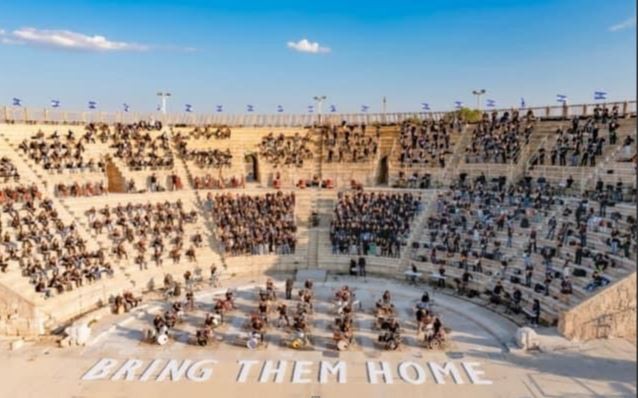
From the production and recording of 'Homeland Concert,' created in support of the Hamas hostages taken captive on October 7, 2023 (Courtesy - Source)
Habayta (‘Home’): Israel’s Unofficial National Anthem
By Randy Pinsky
Israel’s national anthem is Hatikvah (‘Hope’), but since October 7, there is another single-word title song that has become a contender in unifying the country. ‘Habayta’ (‘Home’) has been the rallying cry for the hostages and an end to the conflict, bringing the country together in a unified voice of determination and focus.
The Power of Music
In times of crisis, countries can fall apart - or come together, even stronger than before. After the October 7 attack, Israelis across the political spectrum united in a fervent need to be present, show support, and lobby for the return of all the hostages.
And one formidable means for joining individuals is through the power of music.
Wherever one would go, be it the Hostages Square in Tel Aviv, at the shuks (marketplaces), in taxis or at cafés, a certain ubiquitous song was constantly being played; Habayta’ (‘home’). A haunting piece which lingers in impact, it has been the theme song of constant hope and longing during the past two years.
Fittingly, it has also become the unofficial anthem of the Hostage Family Forum, an organization started by relatives and friends of those taken hostage by Hamas. Providing strength to continue when hope seems lost, it has buoyed families in especially dark times.
Same Message, Different Context
Contrary to popular belief, Habyata was not written for the most recent conflict, though its fit cannot be contested.
The time was 1983 and it was the First Lebanon War. Popular Israeli entertainer Yardena Arazi was performing for soldiers stationed in Lebanon and felt strongly that the war needed to end. Upon her return to Israel, she partnered with songwriter Ehud Manor to compose a piece that would “express this sense of urgency, danger and the desire to ‘go home.”
They based the song on a tune by Yair Klinger for a song called ‘Manana’, and “Habayta” became an overnight sensation.[1]
It rose in popularity again twenty years later in the fight for the return of hostages Gilad Shalit and the late Ehud Goldwasser and Eldad Regev, the captures of which led to the Second Lebanon War. The powerful longing is evoked and reinforces that no one is alone, be they the hostages or the soldiers, all yearning to be home safe and with their families.
One Word, One Thousand Voices
In December 2023, 1,000 Israeli musicians of all ages and levels of professionalism packed the two centuries-old Caesarea Amphitheatre in Sdot Yam, and sang Habayta in a collective wish for the return of all the hostages. From the dozens of percussionists, every instrument imaginable, and family members all singing with tears streaming down their faces, this emotional performance ended with an aerial shot of meter-high letters spelling, “Bring Them Home.”
The level of power evidenced in the Homeland Concert was believed to transcend all levels of land and space, for the hostages to somehow hear it and know that all possible was being done to secure their return.
In fact, one radio presenter “declared that the song should be played on every program until the last hostage…had been returned - granting the families a measure of closure.”
Beyond the haunting tune, the song has chilling lyrics that hit every fibre of one’s being:
“Home/Home/
It is the time to return/
From the mountains/From foreign fields/
The day fades and there is no sign
“Until the break of dawn/I pray for your wellbeing/
Caught in the handcuffs of fears/I hear steps/
Home, home/
Because we still haven’t gotten/What was promised to us so long ago.”
Old Songs Have New Meaning
Music has ephemeral power that moves and connects in a way when nothing else can. This idea was perhaps best said by Jewish Telegraphic Agency writer, Ronnie Perelis; “Old songs have new meanings after October 7- and new music helps the heartbroken like me.”
He reflected, "from the very beginning of this war, music has been a lifeline for me and many others.” Songs unite when words fail, collectively embracing everyone who hears them with an unspoken, ‘I understand.’
Perelis observed that even the most mundane songs assume additional significance given the stressful context of war. “Silly pop songs take on deep meaning when requested by someone from the front lines,” he related, “or by their girlfriend or boyfriend back home, or their kids who love to sing that song with them.”
The pull of nostalgia and connection.
The longing for something or someone.
In an eerie instance, singer Sivan Talmor related how when once performing, her husband on the frontlines in Gaza was somehow able to pick up a signal on his transistor radio and hear the song she wrote for him.
“And for that moment, they were together again.”
The Same…But for One Letter
It is ironic that the two powerful anthems for Israel are both one-word titles (‘Hope’ and ‘Home’) and differ by a single letter. Both national prayers unite over time and perspectives and are haunting in their own way.
In fact, strands of Hatikvah are even played in the background of the filmed Homeland Concert, powerfully uniting and making a statement of connection and continuity. It evokes that in times of prayer for the return of family members home, one must always have hope; the “quintessentially Israeli expression of…resilience.”
More than just the return of the hostages and soldiers, Habayta is also about a yearning for peace in the homeland, and for national unity and strength.
Standing Out
According to Dr Avi Bar Eitan, scholar of Israeli popular music, patriotic songs created in the conflict such as “Am Yisrael Chai” (the Israeli Nation Lives) by popular Israeli singer Eyal Golan, "serve a very important function in strengthening Israeli identity, social cohesion and general morale.”
In fact, in comparing the current songs of reaction to music composed in previous wars, author Yossi Klein Halevi observed, “the most striking difference [evident] is [that of] rage. This is something we haven’t experienced before in Israeli music generally.”
The senior fellow at the Shalom Harmony Institute in Jerusalem noted that the current music evokes a heightened level of authenticity and raw emotion, an urgency and resilience, as opposed to reflection.
Music Plays a Role
After two agonizing years of turmoil and loss, the last living hostages were finally released back to Israel in October 2025.
While many place due thanks for their return to tireless diplomatic negotiations and top-secret meetings, others would not be wrong to believe that it was the power of music -
That brought them Habayta.
[1] She however received significant backlash by those who believed the war against Hezbollah was necessary.