

Limiting urban sprawl requires establishing clear targets and limits to expansion, new Concordia study proposes


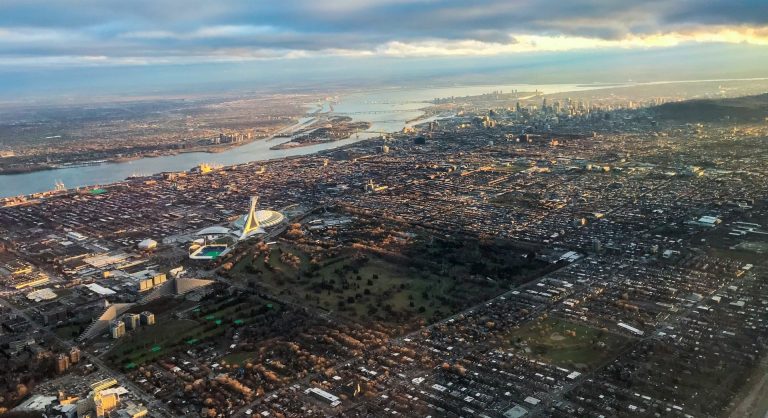
Cities need clear limits and targets on urban sprawl to understand whether planning tools like greenbelts and denser development are working, according to new Concordia research. Applying such metrics in urban planning as rigorously as in other fields that work to limit environmental degradation is essential to achieving a sustainable future in the decades ahead, the study says.
Writing in the journal Environmental Management, researchers from Concordia’s Department of Geography, Planning and Environment created seven urban development scenarios based on Montreal’s rapid growth of built-up areas between 1986 and 2016. They then modelled these scenarios through to 2070, ranging from a “business as usual” approach — where current development trends remain unchanged — to a scenario with no further urban expansion and no new built-up areas permitted.
The five scenarios in between projected slower land use growth per person, increased densification and more moderated sprawl, allowing land consumption to increase in some areas while restricting it in others.
Only the “no expansion” scenario was considered fully sustainable.
The researchers also noted that while greenbelts are an important part of this approach, they must be combined with additional policies to achieve sustainability-oriented targets and limits.
“The political discussion about greenbelts for Montreal has slowed down significantly. That is the opposite of what we need, given current sprawl growth rates, which are still very high,” says Jochen Jaeger, associate professor and the paper’s corresponding author. “Urban sprawl is the opposite of sustainability, and we urgently need to transition away from it for many reasons.”
Jaeger also points out that the 2025 Montreal Urban Agglomeration Land Use and Development Plan does not include a greenbelt, which he says should be added as soon as possible.
 Jochen Jaeger: “The political discussion about greenbelts for Montreal has slowed down significantly. That is the opposite of what we need, given current sprawl growth rates, which are still very high.”
Building up, not out
The researchers evaluated their scenario outcomes using a metric called Weighted Urban Proliferation (WUP), co-developed by Jaeger more than 15 years ago to study urban sprawl in Europe. The metric relies on three elements to determine a city’s level of urban sprawl: how much land is built up, how tightly clustered those built-up areas are, and how much land each person uses on average. Higher values indicate more dispersed, land-intensive growth.
In this study, the researchers applied WUP along with detailed maps, past and predicted population changes and job growth to the greater Montreal area. They found that the pace of sprawl has been accelerating in recent decades: between 1986 and 2016, land use almost doubled, while the city’s population only grew by 25 per cent. This figure reflects a growing shift towards larger, single-family homes on sizeable suburban and exurban lots.
The researchers also compared four greenbelt scenarios, including options that would strengthen existing protections for agricultural land, greenspaces and parks around Montreal, to adding new protections for the farmland near Varennes and forested areas around Gore and St-Colomban.
The most ambitious scenario would extend protections across all these areas. But greenbelts alone would not halt urban sprawl sufficiently without additional policies that encourage densification in existing built-up areas, the researchers note.
“This does not mean building in city parks,” Jaeger says. “Those greenspaces must be protected as well.”
“When we say densification, we can point to a desirable neighbourhood like the Plateau Mont-Royal as an example, which is dominated by triplexes, not high rises. But the model of the suburban, single-family home is outdated. We need to share the spaces that we have already transformed into built-up areas and make better use of them,” he says.
The researchers propose that cities implement targets and limits similar to the measures used to curb noise- and air pollution.
 Sepideh Mosharafian: “These values help urban planners evaluate the success of the plans and strategies used to prevent or reduce urban sprawl.”
“These values help urban planners evaluate the success of the plans and strategies used to prevent or reduce urban sprawl,” says the study’s primary author, Master’s student Sepideh Mosharafian.
She adds that this framework is easily transferrable to other cities looking to limit urban sprawl and achieve more sustainable forms of urban development. However, she notes that in Montreal at least, time is quickly running ou
Mosharafian calculates that if current urban development trends continue in Montreal, the remaining open areas surrounded by the proposed greenbelt may all be developed in as few as 12 years.
Read the cited paper: “Proposing Targets and Limits to Urban Sprawl: How Likely are Current Greenbelt Scenarios for Montreal to Achieve Proposed Reference Values by 2070?”