

Blog post
The Henry Beissel Archives: the 1968 Cultural Congress in Havana audio tapes and other documentation


The archives arrive at RMA
In 2023, Records Management and Archives acquired the archival fonds of writer, poet, playwright, translator, and editor Henry Beissel. Henry joined the Department of English at Sir George Williams in 1966. A professor of English Literature, Henry developed the Creative Writing program and inspired the creation of the Liberal Arts College in 1978.
While processing the Beissel archives many fascinating narratives emerged over the course of his life and career. Today Boxes and Bitstreams does a deep dive into one of these archival narratives that our department found compelling with the hope of connecting these primary source materials to the research community. The topic: Henry Beissel’s attendance at the January 1968 Cultural Congress held in Havana and the recording of a series of audio interviews. His attendance, along with two other Sir George faculty members, was documented in a 1968 article in The Georgian.
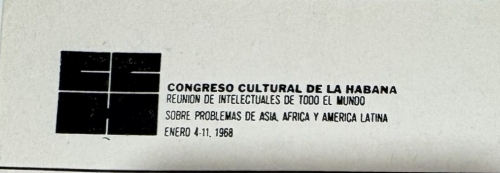 Header from a notepad produced for the Congreso Cultural de La Habana (Cultural Congress of Havana), January 1968. P0287 Henry Beissel fonds, Records Management and Archives, Concordia University, Montreal.
From January 4th to 11th an international Cultural Congress was held in Havana with five hundred intellectuals, artists and scholars from over seventy countries in attendance. Sir George Williams University was probably the most represented institution there with Professors [Andre] Gunter Frank of Economics, Henry Beissel of English, and Leandre Bergeron of French Departments as delegates. - "Cultural Congress of Havana,"
The Georgian, January 19, 1968, p. 5. Available via the Internet Archive
The three delegates from SGW at the Congress occurred during a dynamic period in the history of the University. The event took place between Montreal's Expo ‘67 and the 1969 Sir George Williams University Student protest.
Rescuing legacy audio and digital preservation of the Havana tapes
While processing the records during the summer of 2023 something interesting stood out within the box of audio-visual material. RMA staff came across ten tapes which account for roughly 6.5 hours of interviews and reflections Henry recorded while at the 1968 Cultural Congress. These fragile tapes were in a precarious condition when we started inventorying material; Our department quickly prioritized these tapes for digitization which took place in early 2024 with the support of an external vendor. Upon receiving the digitized audio back we were very pleased that the quality of the audio was generally in excellent shape!
Upon receiving the digitized audio files, staff ingested the files into Concordia’s digital preservation system, Archivematica. The recordings are now managed within the University's digital preservation program, ensuring their long-term active preservation and accessibility for future researchers.
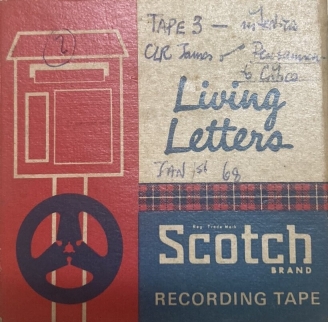 Tape box annotated for interview with C.L.R. James and Pensamiento Crítico recorded during the Congreso Cultural de La Habana (Cultural Congress of Havana), January 1968. P0287 Henry Beissel fonds, Item [P0287-11-0003], Records Management and Archives, Concordia University, Montreal.
Listening to the interviews
The surviving recordings include interviews and discussions involving figures such as C.L.R. James, John La Rose, Rodolfo Walsh, Susan Sherman, and Hans Magnus Enzensberger. Other recordings reference the influential Cuban journal Pensamiento Crítico, as well as a discussion with university students in Havana.
Henry starts every recording introducing the interviewee, as well as, descriptively reflecting on Havana, Cuba and the Congress. Recurring themes on the tapes include: The role of intellectuals, writers, and artists in society; the relationship between culture and revolution; and broader discussions surrounding social change and international solidarity. The interviews are recorded in English except for the discussion with Pensamiento Crítico and C.L.R. James in which parts of the discussion take place in Spanish.
Continuing to dig through the records, a notebook emerged that evidenced Henry keeping notes in the lead up to Cuba and during his time in Havana. Upon opening the notebook RMA staff discovered a page that documented a log of recordings Henry was keeping track of. It should be worth noting that not all of these names appear in what RMA has now.
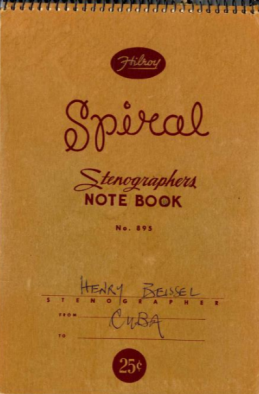 Cover of Henry Beissel's personal notebook from the Congreso Cultural de La Habana (Cultural Congress of Havana), January 1968. P0287 Henry Beissel fonds, Records Management and Archives, Concordia University, Montréal. Digital surrogate available via the Internet Archive: https://archive.org/details/p0287-notebook-cuba-1968.
Continuing to dig through the records is a series of personal correspondence that Henry had with Bertha Serguera immediately after the Cultural Congress. These letters reveal that conversations and relationships established in Cuba continued, while providing insight into the intellectual networks that emerged from the Congress. When viewed alongside the audio recordings and Beissel's notebook, the correspondence adds another layer of context to the archival record.
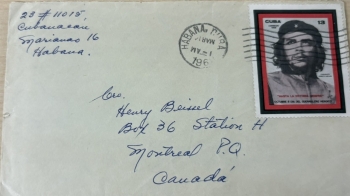 Envelope addressed to Henry Beissel from Havana, Cuba, bearing a Che Guevara postage stamp, 1968. P0287 Henry Beissel fonds, Records Management and Archives, Concordia University, Montreal.
Evolving archival context
Throughout this process of archival processing, describing, and digitizing; There has been a continued interaction with the tapes and Beissel fonds, RMA has been able to actively continue interpreting and updating the archival description records in our archival catalog to provide further context to the records.
This experience demonstrates that archival collections continue to evolve after acquisition. New connections, contextual information, and research opportunities can emerge through ongoing processing, description, digitization, and researcher engagement. We are hoping to further process the numerous boxes of correspondence during the fall of 2026, which we hope will lead to further connections and context building opportunities.
Archival research from further afield
To be clear, this blog post does not represent exhaustive research on either Henry Beissel or the Cultural Congress of Havana. There are certainly further research avenues to follow both within the Beissel fonds as well as other collecting institutions.
For those that might be interested in doing further research there are several other collecting institutions that might hold records relating to the Cultural Congress of Havana. These include the George Padmore Institute, where they hold the “Papers from the Cultural Congress of Havana, 1967-1968”. RMA can also recommend exploring the “Andre Gunder Frank Papers” housed at the International Institute of Social History (IISH). Within these records there may be further answers to the SGW presence at the Congress.
While this post focuses on a slice of Beissel's life, the Cultural Congress recordings and related documentation it represents only a small portion of a richer fonds documenting his literary, academic, and international activities.
Henry Beissel Interviewing John La Rose, P0287 Henry Beissel fonds, Records Management and Archives, Concordia University, Montreal.
For further information regarding the Henry Beissel fonds please feel free to browse the descriptive record in the RMA archives catalog here: https://concordia.accesstomemory.org/p0287-henry-beissel-fonds
To access the Henry Beissel fonds you can contact Concordia’s Records Management and Archives at archives@concordia.ca
RMA would like to acknowledge the work of VideoMedia Digital in the digitization of the Cultural Congress of Havana audio recordings.
Special thanks to Eric Côté for their research insight, digitization and editing.
- John Richan, Digital Archivist