

article
When to use an ampersand (&) instead of ‘and’

They're quick but are they correct?
We’ve all done it before: typed “&” when we should have written “and.” And why not? The ampersand is fast and easy to use in a hurry — but is it correct? Here are some guidelines to help you know when it’s okay to use an ampersand and when to avoid it.
When ampersands are acceptable
Where space is limited
In general, you may use ampersands in AEM Title field names, web page titles, headers (all levels, i.e., H2 to H6) and buttons — wherever space is limited.
In certain abbreviations
What's more, certain words and expressions, such as "Bed and Breakfast" can be abbreviated* with an ampersand to "B&B" because they are so commonly used and therefore readily understood.
*Hint: For the proper Canadian spelling and abbreviation of words the Canadian Oxford Dictionary and The Canadian Press stylebook are considered the definitive reference resources.
But beware! There are exceptions to these guidelines.
In names found in the AEM "Title" field
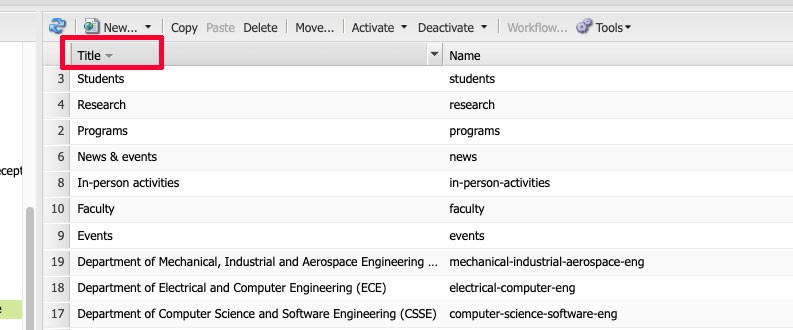
The AEM "Title" field circled in red above allows for ampersands under certain conditions.
Why?
Because when used in names in this field, the ampersand allows visitors to recognize word forms more easily. That’s why the use of ampersands is encouraged whenever the category name is not a legal entity name.
- Examples of category names where “&” is fine to use are:
- Administration & governance
- Graduation & convocation
- Alumni & friends
- News & events
When ampersands must be avoided
In formal writing
In certain circumstances you should never use an “&” to replace “and.” That includes in the body text of business writing and emails, unless it's part of the legal entity name (e.g., Procter & Gamble), in which case ampersands are permitted.
What are some other situations?
Unit names
Institutions like Concordia take great care coming up with official names of departments and units. That’s why the ampersand should not be used in a unit name unless it’s part of the legal name.
Most Concordia unit names are commonly written with “and” and must be spelled that way.
If you’re unsure about the correct spelling of a unit name, check the Terminology Bank, which is maintained by Translation Services. (Simply select ‘Public Access’ to begin your search.)
- Examples of unit names with “and” include:
- Faculty of Arts and Science
- Gina Cody School of Engineering and Computer Science
- Office of Advancement and Alumni Relations
In file paths found in the AEM "Name" field

The AEM "Name" field circled in red above does not allow for words or strings of words containing an ampersand.
That's because the ampersand is classified as a symbol and symbols are not permitted in file paths. What’s more, the word “and” should not be used either because it affects the ability of search engines to effectively find content.
In practice, “and” is the only word that should be systematically removed from file paths. In addition, neither an ampersand or the word "and" should be used in file names for DAM assets. Other words, such as conjunctions (e.g., for, nor, but, or, yet, so) and prepositions (e.g., after, at, by, to, with, under) may be kept.
- Examples are:
- administration-governance
- tuition-fees-break-down
- when-to-use-or-avoid-an-ampersand
Exception: For news stories, articles and event names, best practice dictates that all words should be kept in the file paths.
- Examples are:
- family-life-and-living-with-an-eating-disorder-one-caregivers-journey-from-awareness-to-action
- concordia-law-and-society-program-students-get-an-up-close-look-at-the-justice-system
French content
The ampersand must never be used in French unless it's part of a legal entity name. The word "et" should be used instead.
- Example:
- Diplomés et amis
Summary
To recap, the word “and” and the ampersand symbol “&” should not be used interchangeably for content on the web, although both have the same meaning.
Understanding the rules for using “and” and “&” consistently is key to creating content that is always clear and easy for the reader to follow.
Want to know even more about ampersands?


