

article
Problems and Proposals for Canada’s Military Rearmament
This article was originally published in Real Clear Defense.
Canadian Prime Minister Mark Carney’s Liberal-Party government has now released its long anticipated 2025 Defense Budget. It is Canada’s largest post-Cold War reinvestment in military equipment and infrastructure, as well as readjustment of pay and benefits to align with the realities of market value and the generational shortage of manpower. Its Can$84bn budget (approx. U.S.$61bn) contains few procurement commitments and mostly focuses on personnel and promises to participate in the U.S. Golden Dome ballistic missile defense shield. No mention is made of contract awards, which is consistent with Canada’s traditional political breaks on the procurement process, taking for example the decades long delay on obtaining the F-35. Canada’s Armed Forces currently have an authorized strength of 71,500 active duty and 30,000 reservist personnel, and 5,000 Arctic Rangers.
The budget and force size are wholly inadequate not only for Canada’s commitments to NATO and the UN, but for defending Canada. While Ottawa is under pressure from our allies to respond to the hazards of a rapidly arming China and wartime Russia, most Canadians free ride on de facto U.S. defense of North America. Steve Chase in a recent article recounted interviewing Perrin Beatty the former Defence Minister. "He recalls then vice-admiral Chuck Thomas, who commanded the navy in the late 1980s, would tell him “You can have as much sovereignty as you’re prepared to pay for.” “This was a central issue then and a central issue now,” the former minister said. “We have to decide if we mean what we say when we claim to be a sovereign nation.”
Canada has some critical advantages, according to IMF, as having the second lowest net debt to GDP in the G7 at the end of 2024 sitting at 52%. Only Germany has a lower percentage. The United States stands at 102.69%. Politico Europe is reporting that Germany has proposed a €377 billion military hardware shopping list to again become the "strongest conventional army in Europe." It is important for Canada to play a larger part in NATO not only to defend the outer rim of vulnerable democracies against authoritarian efforts at roll-back, but to secure European allies to offset U.S. influence in North America.
We propose a goal of an active Canadian Armed Force of 110,500 by 2031, which is still smaller than it was in 1962. This comprises an army of 52,500 personnel, capable of deploying 65 fully manned battalions, including 6 Ranger, and one amphibious, when mobilized, with balanced armoured and mechanized components. If Canada wants to protect the global trading regime, it needs a flotilla able to operate with the U.S., NATO, Pacific allies, and independently if need be.
We propose a balanced fleet for the Navy, expanded to 22,500 active and 10,000 reserve personnel, and comprising the rebirth of a carrier navy cold be built around buying two Italian Cavour Class ships and the necessary F-35B's to equip their air wings. This would require more destroyers, frigates and corvettes, amphibious warfare ships sufficient to lift an amphibious battalion, mine counter-measures, unmanned systems, and replenishment ships. The plan also calls for 6 of the 12 submarines required to be Barracuda Class nuclear attack submarines, to accompany the carrier groups, and also patrol under the Arctic for extended periods.
The Coast Guard, now considered part of the defense establishment, needs dozens of new armed patrol ships as well as an assumption of all of the DeWolf Class vessels, with a complement of 10,000 active personnel supplemented with 2,500 reservists. We also advocate for the government providing loan guarantees to help create a Canadian built and manned Merchant Marine Defense Reserve fleet, like the U.S. MARAD, available as supplemental sealift in wartime, and to preserve Canada’s atrophied shipbuilding industry.
A final requirement is that the air force be grown to 32,500, and composed of a substantial fleet of modern air defense interceptors and strike aircraft, plus the surveillance, aerial tankers and airlift assets to fully meet Canadian operational requirements now, independent of American support. This also means building our own ballistic missile and air defense network, co-operating with America in NORAD, but also fully independent of their control.
The current strategic environment also requires Ottawa to be politically willing again to house nuclear weapons on Canadian soil. Acquiring the French ASMP-A(r) is the optimal missile to give Canada a say in shaping NATO policy and contributing to building a credible alliance deterrent in the face of an unreliable American commitment to distant democratic allies in Europe and Asia. It is neither a first strike counter-force weapon, being described by the French as a warning weapon, or a cause of deterrent instability, as it can be quickly dispersed. Integrated within NATO’s nuclear planning committee, or Washington’s strategic retaliatory arsenal, it would never operate independently.
Canada could purchase 18 Rafale or Typhoon FGA and lease 12-15 ASMP-A(r) along with the TNA warheads from France. The ASMP-A(r) is a good weapon to accomplish these goals, with a 300kt warhead and 600+ km range on a hi-hi-lo profile, high supersonic speed and quickly disperse-able at Canadian, NATO European or littoral Asian airfields in a contingency over Taiwan. Deployed in Sweden or Sicily, it would multiply the deterrent value of Canada’s brigade in Latvia. A squadron of ASMP-equipped fighters launching from Goose Bay and crossing the Arctic with tanker support, could strike Pskov or Murmansk in approximately the same time frame as a B-52 from Minot AFB, 7 or 8 hours from launch.
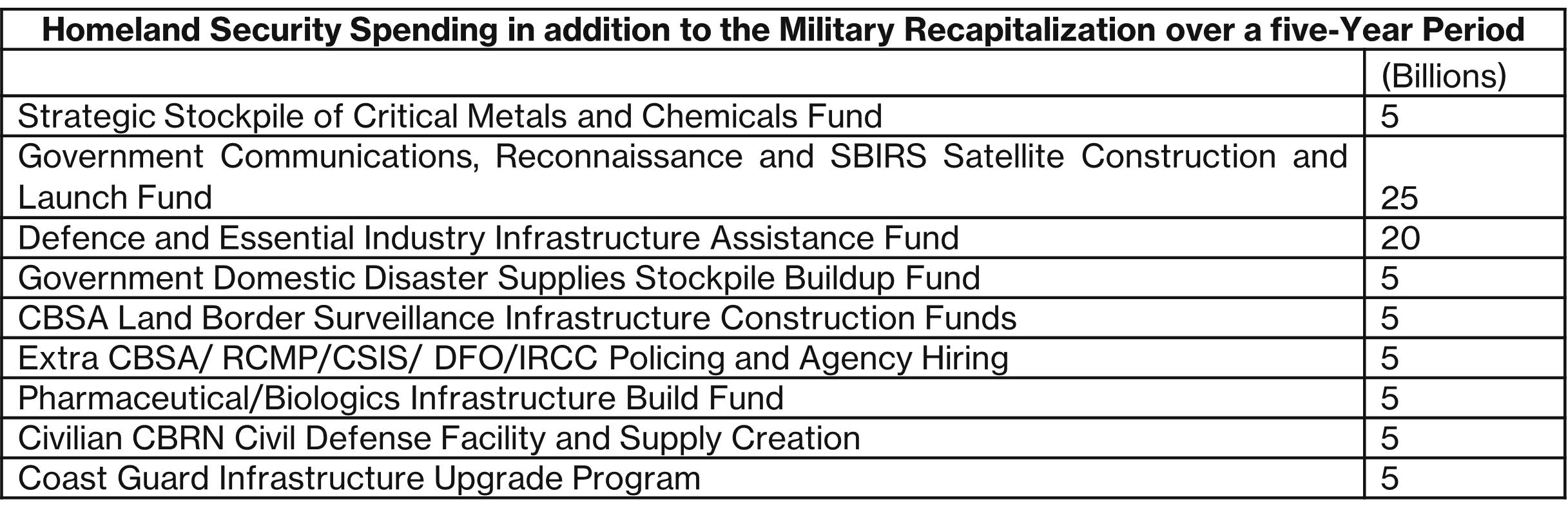
We estimate that our proposed force structure would require an upfront outlay of Can$650 billion, achieving economies of scale and sustainment. Corporations, like Leonardo, Rheinmetall, BAE, Embraer and Saab, will commit to invest in manufacturing and R&D when there is a demonstration of sustained demand. Our proposed 2026 defense budget of $92.4 billion (3% of 2024 GDP) includes enhanced funds for all aspects of the forces, including debt repayment and set asides for planned upgrading of hardware and infrastructure every decade to keep them relevant. Below we propose a breakdown of the 2026 defense budget by forces, by operations, and a five-year Can$80bn investment in domestic security.

Budget 2026: Regular Peacetime Operations and Training Budget Amount for DND ($CAD)
$92,400,000,000.00 (2026) DND Annual Operational Base Budget Total (3.00% of 2024 GDP ($3.08t Canadian))
$33,650,000,000.00 DND Annual payment on $650,000,000,000.00 borrowed @ 35yrs @ 3.8% (Repayment)
$6,500,000,000.00 DND Weapons Systems Upgrade Funding, Fixed amount set aside annually for 10 years (Banked)
$1,300,000,000.00 DND Base Infrastructure Renewal Funding, Fixed amount set aside annually for 10 years (Banked)
$1,000,000,000.00 DND Wartime Ordnance Stockpile Sustainment, Funding Set aside annually for 10 years (Banked)
$26,500,000,000.00 DND Personnel Compensation, Civilian and Military Employees (Salaries and benefits) (Current) $6,400,000,000.00 DND Weapons Systems, IT, Equipment Maintenance and Contractor Services (Current)
$6,100,000,000.00 DND General and Administrative Expenses: food & beverages, medical, cleaning and office supplies, fuels and lubricants (POL), utilities and municipal expenses, official travel and miscellaneous expenses. (Current)
$3,000,000,000.00 DND Training Consumables & Ordnance, Drones, Clothing and Equipment Spares Purchases (Current)
$1,700,000,000.00 DND Defense Research and Development and Military Space Satellite Funding (Current)
$1,300,000,000.00 DND Federal Compensation for Territorial Army personnel costs (Salaries and Benefits) (Current)
$1,000,000,000.00 DND Nuclear Deterrent Infrastructure and Maintenance Funding (Current)
$850,000,000.00 DND Purchases of Supplemental Wartime Ordnance and Supplier base Sustainment (Current)
$750,000,000.00 DND Facility Infrastructure and Contractor Maintenance Services (Current)
$700,000,000.00 DND Contingency Funds for Canadian Forces Regular Peacetime Operations (Bankable) (Current)
$500,000,000.00 DND Contributions to CPP Pension Fund for wounded and disabled Veterans Benefits (Current)
$500,000,000.00 DND Peacetime Training Deployment relocation Funding and CDRF Fleet Subsidy (Current)
$350,000,000.00 DND Royal Canadian Air, Sea and Army Cadet Funding (Current)
$300,000,000.00 DND Canadian Forces Mobilization Assets and Spares, Storage and Maintenance Funding (Current)
Budgeted amounts on current items are adjusted annually at GOC COLA rate. All banked component funding remains fixed and invested, earning interest and released for hardware and facility upgrades every 10 years. From 2026 forward the Department of Veterans Affairs ($8 billion), CSIS ($2 Billion) and the Coast Guard budget ($5.4 Billion), while separate departments are included in costing of directly related spending to meet the 3.5% of GDP target for NATO spending.(2024GDP=$2.241t USD)
Raymond Floreani (BA Econ) had a 30-year management career in the private sector and is currently studying graduate level law.
Dr. Julian Spencer-Churchill is associate professor of international relations at Concordia University, and author of Militarization and War (2007) and of Strategic Nuclear Sharing (2014). He has published extensively on Pakistan security issues and arms control and completed research contracts at the Office of Treaty Verification at the Office of the Secretary of the Navy, and the then Ballistic Missile Defense Office (BMDO). He has also conducted fieldwork in Bangladesh, India, Indonesia, Egypt, and Taiwan, and is a consultant. He is a former Operations Officer, 3 Field Engineer Regiment, from the latter end of the Cold War to shortly after 9/11. He is currently collaborating with the Combat Modelling group at the Trevor Dupuy Institute.


