

AI and entrepreneurship panel: Moving from possibility to practice


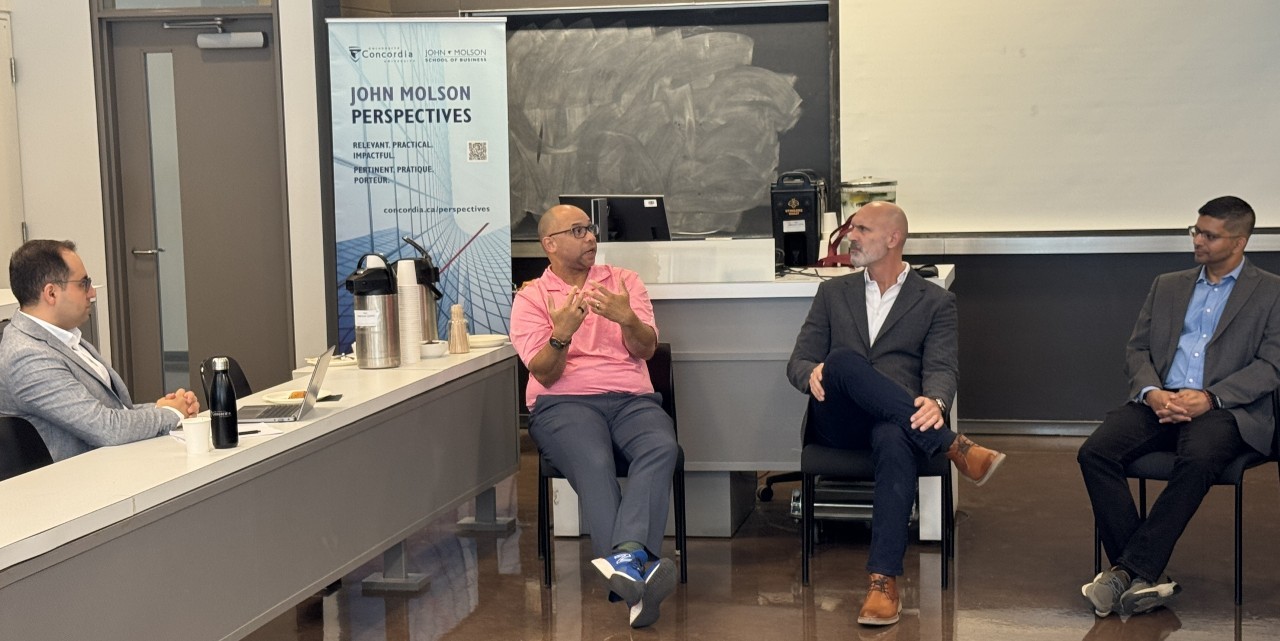 L to R: Arman Sadreddin, Chris Wynder, Riccardo Badalone and Suchit Ahuja.
How is artificial intelligence changing entrepreneurship, and what does it take to turn rapidly evolving AI capabilities into sustainable businesses?
These questions were at the centre of the latest John Molson Perspectives event, AI and Entrepreneurship: What’s Changing, What’s Working, and What’s Next, held on September 25 at Concordia University’s John Molson School of Business.
The panel brought together Chris Wynder, executive director of Western Research Parks; Riccardo Badalone, High-Tech Stream Lead at District3; and Suchit Ahuja, associate professor at John Molson and co-director of Concordia’s Applied AI Institute. The discussion was moderated by Arman Sadreddin, director of John Molson Perspectives.
A recurring theme throughout the conversation was that AI may be accelerating entrepreneurship, but technology alone does not create a viable business. Founders still need to identify a meaningful problem, articulate a clear value proposition, understand who will pay for the solution, and validate that value with real customers. With AI tools making prototypes faster and less expensive to develop, the challenge increasingly shifts from whether something can be built to whether it should be built and whether it solves a problem customers actually value.
The panelists also discussed how the pace of AI development is shaping traditional ideas about competitive advantage. Technologies and capabilities can now be replicated or surpassed quickly, making the ability to learn, adapt, commercialize, and pivot increasingly important. For university researchers and entrepreneurs, this places greater emphasis on creating stronger pathways between research, commercialization, and the broader innovation ecosystem.
At the same time, moving quickly does not eliminate the need for responsible implementation. The conversation explored data privacy, AI reliability, human oversight, and the growing importance of trust, particularly when AI applications operate in highly regulated or high-stakes industries. Panelists stressed that entrepreneurs need to think about these issues early, rather than treating governance and compliance only after a product has been built.
Questions from the audience extended the discussion to data sovereignty, synthetic data, and the environmental footprint of AI. The conversation highlighted the need to match AI infrastructure to the actual business problem while considering the regulatory, social, and environmental consequences of the technology being deployed.
The session ultimately reflected both the opportunities and challenges facing today’s AI-driven entrepreneurship. AI is dramatically expanding what small teams, researchers, and founders can accomplish. But turning those capabilities into lasting ventures still requires many of the fundamentals of entrepreneurship: understanding customers, testing assumptions, building trust, adapting quickly, and creating measurable value.
The event was part of the John Molson Perspectives Seminar Series, which connects researchers, practitioners, and members of the business community around emerging issues shaping organizations and society.