



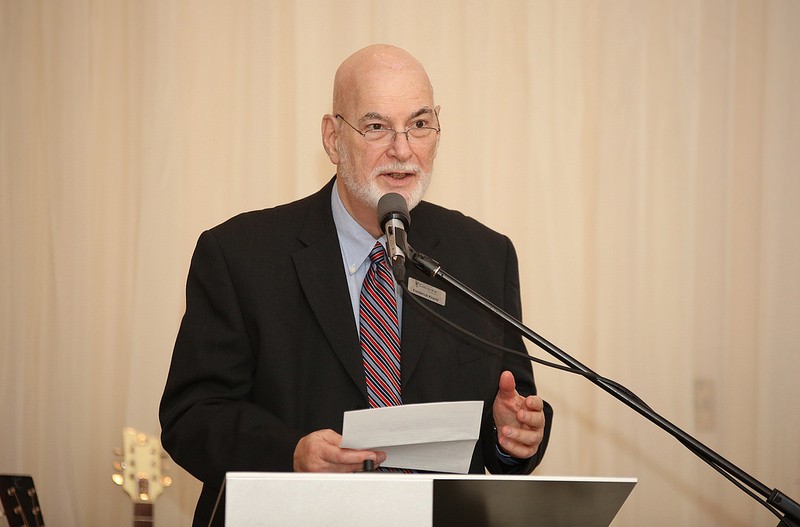
Concordia’s Liberal Arts College (LAC) mourns the passing of Frederick H. Krantz, who passed away on May 3, 2026 at the age of 85. Fred was one of the LAC’s longest serving professors; he was also its cofounder. Shortly after the merger of Loyola and Sir George Williams into Concordia University, Fred and his best friend, the late Harvey Shulman, founded the LAC. Their legacy to Concordia lives on as the college nears its 50th anniversary.
Before coming to Concordia, Fred pursued his passion for history at Columbia University in New York City, where he earned his BA. He then went on to complete his PhD at Cornell University in Ithaca, where he also met his wife of 64 years, Lenore, with whom he would raise four children: Lise, Ian, Stefan, and Adam.
Fred was a scholar of the Italian Renaissance, and had a deep knowledge of modern history, including the twentieth century and especially the Second World War. His seminar classes inspired generations of students to plumb the depths of primary texts from antiquity to the modern age, and to rigorously examine and interrogate historical sources.
Since the news spread of Fred’s passing, former colleagues and students have shared many fond memories of his teaching, mentorship, and friendship through his many decades of service.
‘You never know what you don’t know.’
LAC Alumna Julie Amblard, who studied in the first LAC class from 1979-82, recalls meeting Fred on a hot August morning in 1979, when she arrived for her interview at the LAC. “My conversation with Professor Fred Krantz confirmed something essential: you never know what you don’t know. The LAC would become the beginning of a lifelong journey — one that teaches you to unravel the mysteries of humanity, and to understand that learning is never finished. Fred was the soul, the spirit, and the founder of the LAC. His conviction about education was absolute. He believed deeply in the importance of knowing the roots of Western Civilization in the broadest and richest sense. His drive and dedication to the College and its students went far beyond duty. His mission was simple and profound: to shape us into well rounded, thoughtful, and responsible individuals — his way of making the world a better place.”
An extraordinary legacy
Professor Ariela Freedman remembers the classroom experience and the legendary days of founding the program. “Before he was my colleague, Fred was my professor. I have fond memories of his warmth and erudition in the classroom. I remember his story of driving down to the United States with Harvey Shulman and filling a van with books for our first library. Together they built the LAC with their shared vision of a place animated by the love of learning, and that is an extraordinary legacy.”
The constant and funny NYC trip guide
As a native of the Bronx, Fred helped institute the long LAC tradition of annual student trips to New York City. Professor Mark R. Russell remembers Fred as the NYC trip guide: “I can attest to how much Fred enjoyed the New York trip over the many years that we shared that experience. He was always so enthusiastic and, whether it was over the bus microphone or touring on foot, was a constant and often very funny guide and commentator. He loved to share his extensive knowledge of the city. In the MET, he took students straight to the Egyptian collection, which was his passion, and he loved lunch in Chinatown. I think these things are what I most fondly remember about Fred.”
A vast knowledge and interests that have no bound
To many colleagues and students, Fred’s vast knowledge and interests seemed to have no bounds. Professor Geoff Fidler (retired) recalls discovering shared musical interests with Fred. “As a former Fellow of the LAC, I was Fred's colleague, fellow historian, and teacher for several decades at the college. A devoted teacher and scholar of Renaissance Italy, he never failed to impress, and often enlighten us all, by the range and depth of his learning and reading. Something I didn't know, though, until he once told me: Fred loved opera. I recall his saying in a confiding sort of sotto voce way, that his favourite — suitably Italian — was Puccini's Madama Butterfly. He'd recently been captivated, left speechless almost (not Fred's habitual state), by the film version of that opera made in 1995 (directed by Frédéric Mitterand, nephew of the former French president). It had marked the start of an international career for the then twenty-seven-year-old Chinese lyric soprano Ying Huang in the lead role. The event no doubt reinforced Fred's wish, as I like to think, that students might likewise experience the beauty of great opera, and its ability to move us, sometimes even transform our lives.”
