

Source: JewishPrideAlways
notice
International Conference: Conceptions of Jewish Indigeneity in Zionist Thought and Politics


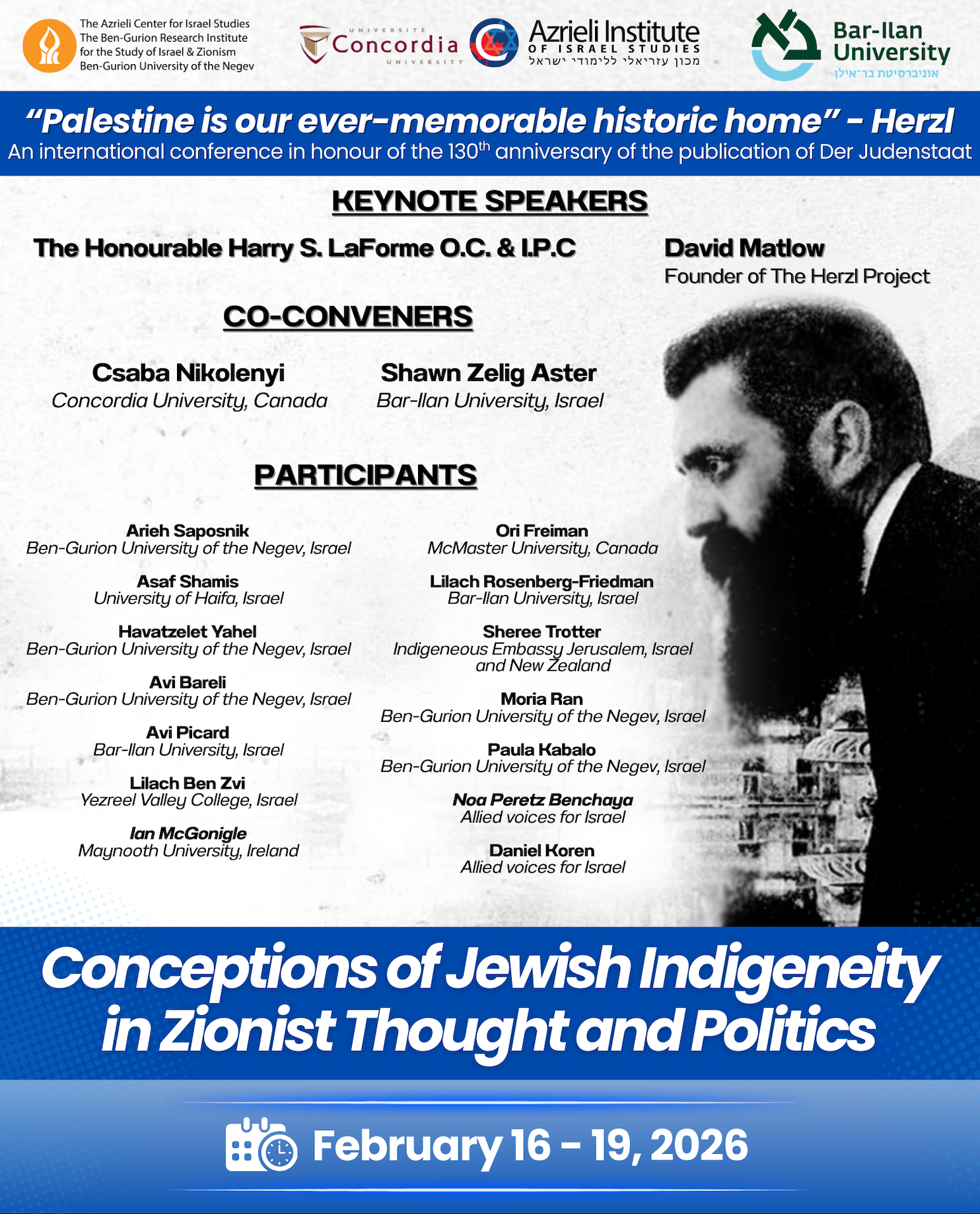
In recent times, there have been increasing attempts at historical revisionism to deny the indigeneity of the Jewish people to Israel. As a result, it is ever more crucial to shed light on this discussion.
On February 16-18, top international scholars explored “Conceptions of Jewish Indigeneity in Zionist Thought and Politics” in a conference co-sponsored by Concordia University's Azrieli Institute of Israel Studies, Bar-Ilan University, and the Azrieli Center for Israel Studies at Ben Gurion University of the Negev. Speakers from Israel, New Zealand, Ireland and across Canada unpacked this nuanced topic, drawing from fields as diverse as history, archaeology, religion, indigenous studies, and public diplomacy. They provided valuable insight on what is truly a crucial topic of our times.
What is Zionism?
“With everything that has happened, it is ever more clear of the realization of the need to go back to Zionism when talking about Jewish indigeneity," stated Paula Kabalo, head of the Azrieli Center for Israel Studies.
Although the word has been distorted and often weaponized by those who wish to discredit it as ‘colonial’, ‘oppressive’ and ‘racist’, it is critical to restore it to the original meaning.
At its essence, Zionism refers to Jewish self-determination, said Arieh Saposnik of Ben Gurion University (BGU). It is the belief that the Jewish people have the right to live safely and securely in their ancestral homeland of Israel - no more and no less.
With a connection to Israel spanning over 3,000 years, there has been a continuous presence in one form or another. In spite of numerous exiles, there has always been a link and a yearning to return.
From archaeological evidence to Biblical records and the engrained reference to Israel in every Jewish custom and holiday, the connection is indisputable.
Coincidental? Or Not
The timing of the conference was fortuitous, intentionally coinciding with the 130th anniversary of the publication of Der Judenstaat (The Jewish State) by Theodore Herzl, known by many as the ‘father of Zionism.’
As an assimilated Jew, Herzl was not so connected to his Jewish heritage, stated David Matlow, owner of the world’s largest Herzl memorabilia collection, but was becoming increasingly aware of the pervasive antisemitism abounding. This impacted him firsthand with antisemitic jeers in his fraternity, and then as a lawyer, when he was informed Jews could not be promoted to judges.
But it was the infamous Dreyfus Affair of 1894 that reinforced the urgency for decisive action.
The Need for a Jewish State
While antisemitism was brewing to different degrees, it took a head when a Jewish officer in the French army was publicly stripped of his titles upon (unfounded) accusations of espionage and dual loyalty. All these issues culminated into Herzl’s confirmed understanding that there was the need for the Jewish people to return to their ancestral homeland - the Land of Israel.
“Herzl believed a Jewish state was the solution to the Jewish question and antisemitism,” said Matlow. And that in itself was the essence of Zionism; Jewish self-determination and revitalizing thousands of years of unbroken connection to Israel.
But Are Jews Really Indigenous to the Land?
A common misconception is that most Israelis are from European countries, referencing the two major aliyah migrations in the early 20th century. Yet this negates the continuity in the land for the past 3,000 years.
“People tend to speak of indigeneity as a binary,” shared Lev Deych of The City University of New York in The Times of Israel. “In reality, anthropologists treat it as a multicomponent concept…Once you start examining these components separately…it becomes a regional story of deep, intertwined roots rather than a colonial morality play.”
First is genetic ancestry. Landmark DNA tests have conclusively traced Jewish ancestry to the ancient Near Eastern populations of Canaan, Israel and Judah, evidencing clear Levantine roots from the region.
As a result, “Jews are indigenous to the land not metaphorically or sentimentally, but biologically and historically,” said Deych, bluntly adding, “the anti-Zionist fantasy that Jews are foreign interlopers or descendants of medieval steppe nomads belongs in the same category as flat-earth cosmology.”
The Proof is in the Stones
There is centuries-old evidence of the connection to Israel, with the word ‘Jerusalem’ being mentioned close to 700 times in the Bible (and not once in the Quran).
For those who are wary about using the Bible as a credible source of Jewish continuity, conference co-convener Shawn Zelig Aster invited people to look at the archaeological record. Not only are Cuneiform tablets from 587–538 BCE inscribed using Hebrew - not Babylonian - months for agricultural records, but names have distinctive Jewish sourcing, with examples such as Ephraim, Nechemiah and Eliyahu.
“Indigeneity was not something the ancient Israelites took for granted,” said Zelig Aster. “The Jewish people are those who have been continuously taken over by empires - not doing the conquering - yet who never vanished.” As a result, accusations that Zionism is a colonial project immediately become a moot point.
In fact, he continued, “the historical reality of Jewish attachment to the land makes it the ultimate anti-imperialist exercise.”
So What Makes a People ‘Indigenous’?
In order to counter accusations of Israel being a colonial power, it is crucial to unpack what it means to be ‘indigenous’.
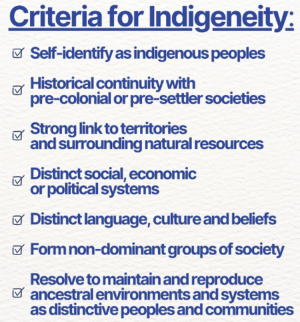
In 1986, the United Nations’ Special Rapporteur on Discrimination Against Indigenous Populations, José Martínez Cobo, was commissioned to compile a list of criteria for indigeneity. Though not universally accepted, it is revealing to check against the Jewish experience:
Particular insight on this topic was provided by the two aboriginal leaders in attendance; the Honourable Justice Harry LaForme who is Anishnabe from Canada, and Sheree Trotter of Indigenous Embassy Jerusalem who is Māori from New Zealand.
“Israelis have many weaving similarities to the indigenous people of Canada," said LaForme. “They have a distinctive language, culture, traditions, historical link, and the resolve to remain distinctive.” He observed the numerous parallels of peoplehood, oppression, displacement and attachment to ancestral lands.
Cultural Continuity
“If genetics tells us where people come from, culture tells us what they kept,” observed Deych.
“And here the Jews have no rivals...No other contemporary group maintains such direct continuity with the cultures of ancient Israel and Judea.”
Every Jewish tradition and holiday refers to the agricultural calendar in Israel and ties to the land, with religious rituals referencing Jerusalem.
In his talk, “We Are Back,” Ian McGonigle from Maynooth University (Ireland) reinforced the “Jewish connection to every rock, tree and river” in describing winemakers in Judea and Samaria who are reviving ancient traditional techniques.
Indeed, one farmer told him, “there is something very special in this vineyard. The two kinds of vines that we planted are mentioned in our Talmud…it means [that] after two thousand years, we [are still here].”
Continuous Presence
“Despite being exiled, displaced and colonized multiple times, the Jewish people have maintained an unbroken connection to Israel,” stated online influencer JewishPrideAlways.
Avi Picard from Bar-Ilan University reinforced this idea in his talk, “Indigeneity as a Factor in Israel’s Immigration Policy.” Whereas the movement of people is contingent upon push (persecution, intolerance) and pull (better job opportunity) factors, making aliyah (‘going up’) to Israel is different. They are “returning as repatriots," said Picard.
In a manner similar to Armenia, Ireland and Greece which have a claim of the state based on identity, “Israel is not an immigration country - it’s a return country.”
Lilach Rosenberg-Friedman echoed this idea in discussing the often overlooked yet central experiences of women. “‘Indigeneity’ is not only an abstract claim or doctrine,” she argued. “But also a lived, everyday - and gendered - experience.”
So What is the Verdict?
With these facts in mind, the speakers systematically went through each criteria of indigeneity for the Jewish people and Israel - and checked off each box.
“The State of Israel [may] have been established in 1948, but the Land of Israel has held a central place in Jewish history and tradition for over 3,000 years.”
Justice LaForme corroborated this finding, “The Jews are the indigenous people of Israel," ending with, “Miigwetch(‘thank you’ in Anishnabe) - ahm Israel chai.”
But What About…
Yet when one attends a talk or protest, these claims are often undermined, with the term Zionism and indigeneity being weaponized as a means to discredit Israel.
The continuous efforts to simplify the conflict into a binary of indigenous-settler/colonial; oppressed/oppressor is unable to account for the continuous Jewish presence in the land. Instead, facts are adapted to confirm a narrative of an oppressed Palestinian indigenous people subjugated by white colonial Israeli settlers.
Speakers such as Ori Freiman and Havatzelet Yahel reinforced the need to address the ‘8th front’ in the Israel-Gaza war on campuses and in the public led by social justice warriors disseminating misinformation and catchy chants devoid of historical complexity.
Israel's strength has in fact been used as proof against its indigeneity due to not fitting the narrative of being marginalized, said Yahel.
“Israel as a Colonial Power”
McMaster University professor Freiman is at the forefront of a leading database keeping track of the ‘industry’ of anti-Zionist rhetoric. In a bid to support the Palestinians, the movement frequently descends into undermining Israel's right to exist.
There have also been efforts to link indigenous arguments with the Palestinian movement, to undercut and subvert the Jewish connection to the land.
The concept of Palestinian indigeneity has been carefully curated in both the academic and public discourse, said Yahel. While it gained traction following October 7, the anti-Israel colonial state narrative was already in place, and just needed reinforcement by chants and taglines.
“As an Indigenous Person…”
An additional concern is when aboriginal people use their own status to justify claims made against Israel, immediately garnering credibility due to their identity. Parallels are often made between the Palestinians and subjugated indigenous peoples. This was exemplified by when Māori leader Debbie Ngarewa-Packer gained notoriety through shouting, “Palestine is the last bastion of resistance against global western colonialism. If Palestine is not free, neither are we.”
According to Justice LaForme who is Anishnabe, those who appropriate aboriginal terminologies about resistance, occupation and colonialism for their own purposes, are merely disseminating “false narratives and ideologies of hate.” Beyond subverting the documented and continuous Jewish presence in the land, such actions are “anathema to our seven sacred teachings” which include love, wisdom, truth, courage and respect.
In fact, he argued, “Israel is the world’s most successful decolonization project.”
Māori professor Trotter from Indigenous Embassy Jerusalem echoed this sentiment. She condemned the bias in the media and the selective understanding of nuance. In her opinion, “They flatten historical complexity, downplaying difference and context, in favour of a simplistic binary.” Rather than actually help the Palestinian situation, “this merely serves to efface the moral agency of both Israeli and Palestinian civilians,” commented Trotter.
So What Is It?
While protesters seek to undermine the Jewish connection to the Land of Israel and claim colonialism,“The Balfour Declaration should be understood not as a statement of British colonial ambition, but [rather] as a recognition of Jewish indigeneity and a commitment to decolonize the land in favor of its original people,” said Deych.
Critical thoughts in a critical time.