



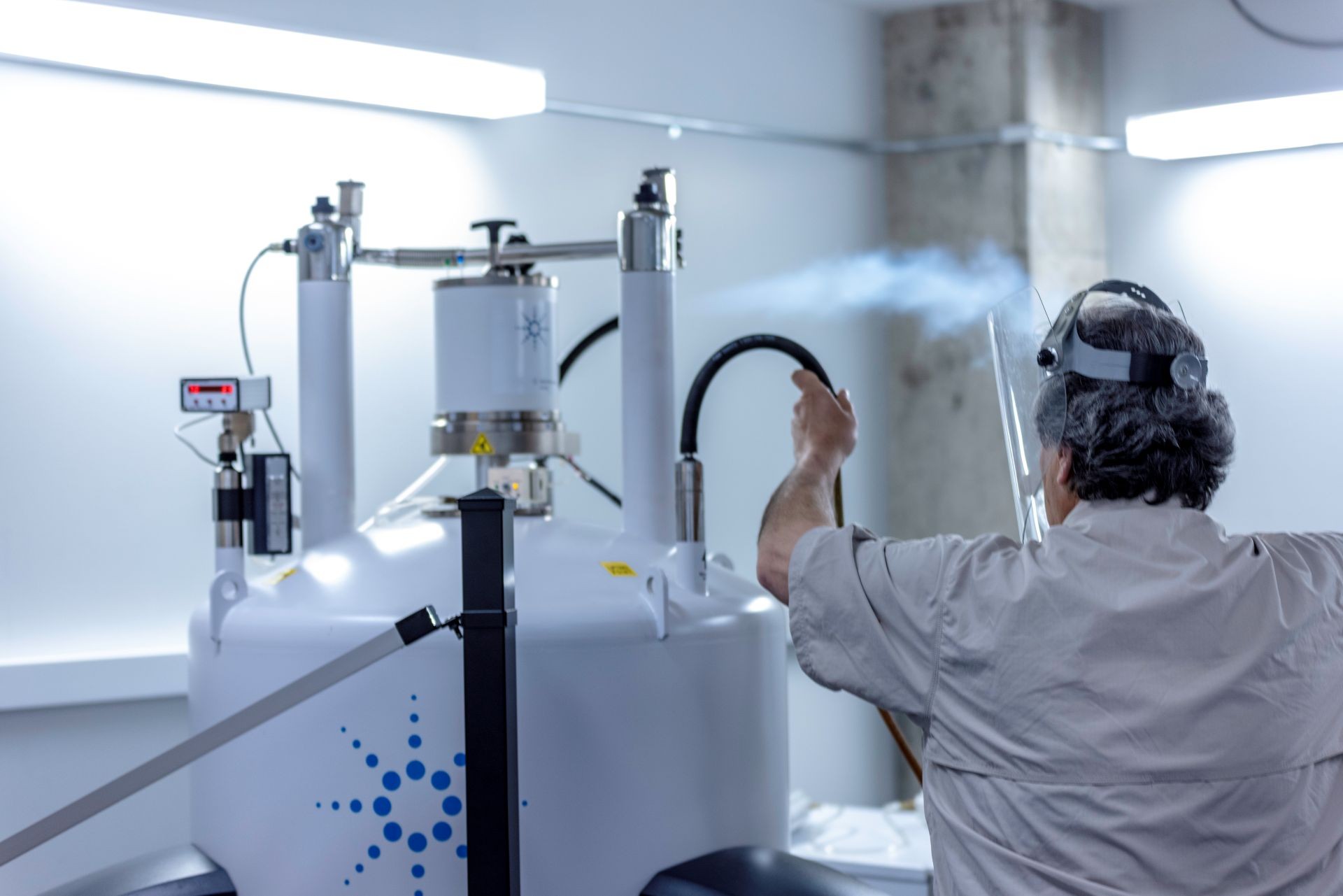
 “By acquiring this instrument, our department will be able to continue to offer our researchers and students access to cutting-edge NMR capabilities for another five to 10 years,” says Peter Pawelek, professor and chair of the Department of Chemistry and Biochemistry.
A new piece of equipment at Concordia’s Department of Chemistry and Biochemistry will give students and researchers more opportunities to get hands-on experience with a powerful tool used to understand the molecules that make up the world around us.
The department recently received a 400 MHz nuclear magnetic resonance (NMR) spectrometer as an in-kind donation from CDN Isotopes, a brand of LGC Standards. The instrument adds capacity to the department’s existing NMR facility, which includes 300 MHz and 500 MHz spectrometers.
LGC Standards is a global manufacturer of quality assurance and research tools serving industries including pharmaceuticals, environmental testing, food and beverage, forensic science, industrial manufacturing and scientific research. It acquired Montreal-based CDN Isotopes in 2020.
For researchers, the additional capacity will mean less time waiting for routine measurements and more flexibility in how instruments are used. For students, it will mean more opportunities to learn how NMR spectroscopy is used in practice — from preparing samples and acquiring data to interpreting the resulting spectra.
“By acquiring this instrument, our department will be able to continue to offer our researchers and students access to cutting-edge NMR capabilities for another five to 10 years,” says Peter Pawelek, professor and chair of the Department of Chemistry and Biochemistry.
NMR spectroscopy is an essential analytical technique in chemistry and biochemistry. Researchers use it to determine molecular structures, monitor chemical reactions and characterize compounds. The technology is particularly important in research projects where scientists need to confirm what they have produced before moving on to the next stage of an experiment.
That is often the case in multi-step synthesis projects. Researchers may need to confirm the structure of a newly produced compound before proceeding with the next step. With an additional instrument available for routine proton and carbon NMR measurements, researchers will be able to obtain those results more quickly, while leaving the department’s higher-capacity 500 MHz instrument available for more complex experiments.
The instrument will support research in areas including synthetic organic chemistry, medicinal chemistry, biochemistry, materials science, polymer science and chemical engineering.
It will also make a difference in the classroom and in student research. Undergraduate students completing independent research projects through courses such as CHEM 419 and CHEM 450 will have greater access to the analytical data they need to advance their work. Graduate students, meanwhile, will benefit from fewer scheduling constraints and faster access to results.
“It represents a rare opportunity to acquire a highly valuable research instrument and strengthen our NMR capabilities,” says Marika Dochia, technical supervisor in the Department of Chemistry and Biochemistry. “Together with our existing instruments, it will allow us to better support both internal research activities and external users.”
The donation grew out of relationships developed through the Montreal Nuclear Magnetic Resonance (NMR) Community, a network connecting academic and industry professionals who work with NMR technology. Over the years, researchers and technical specialists from different institutions have worked together on issues ranging from instrument maintenance and technical expertise to the long-term sustainability of specialized scientific equipment.
That collaborative spirit helped bring the 400 MHz spectrometer to Concordia.
Rather than being retired, the instrument will continue to be used for research and teaching, extending the useful life of a high-quality scientific resource.
Learn more about research centres and facilities in the Department of Chemistry and Biochemistry.
Discover the many ways you can get engaged and support the next generation of Concordians.