

Date & time
Monday, March 23, 2026
2:45 p.m. – 3:45 p.m.
2:45 p.m. – 3:45 p.m.


Ghassan E. Jabbour
This event is free.
John Molson Building
1450 Guy St.
Room 6.425
Yes - See details
Silicon continues to be the backbone of modern electronics, photonics, and many energy technologies. Yet conventional wafer-based manufacturing is resource-intensive, energy-demanding, and not well suited to the growing need for ultrathin and unconventional silicon form factors. In this seminar, I will share our group’s recent work on the first steps of direct production of free-standing ultrathin silicon substrates via melt spinning. Using a custom rapid-solidification process, we fabricate polycrystalline silicon ribbons roughly 1 cm × 5 cm in size and about 20 µm thick directly from the melt, without relying on wafer thinning, chemical etching, or temporary support substrates.
What makes this approach particularly interesting is that it opens a distinct processing window for silicon, where wheel speed, quench rate, wetting, and melt flow strongly influence ribbon formation, thickness, surface morphology, and microstructure. Our structural, chemical, and electrical characterization reveals large polycrystalline grains, twin boundaries, little detectable bulk oxidation, limited surface contamination, and measurable electronic transport after minimal post-processing, including Hall-derived carrier concentration, resistivity, and mobility. I will present this work through a Chemical and Materials Engineering lens, emphasizing rapid solidification, process-structure-property relationships, and more materials-efficient semiconductor manufacturing. I will also discuss how these ultrathin silicon substrates may open opportunities in lightweight inorganic electronics, membrane structures, textured surfaces, MEMS, and future photonic and semiconductor integration, including co-packaged optics.
About the speaker:
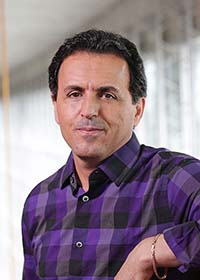
Ghassan E. Jabbour is a Full Professor in the School of Electrical Engineering and Computer Science at the University of Ottawa, where he holds the Tier 1 Canada Research Chair in Advanced Materials and Devices. He is also Director of the CFI Center for Hybrid Interfaces and Intelligent Thin Films (HIIT) and leads the NSERC CREATE program QuantM-MALL.
Professor Jabbour pioneered the field of reactive self-assembly of nanoparticles and quantum dots using printing techniques, with major contributions to flexible and rugged electronics, photonics, and smart textiles. His work has been featured on the covers of leading journals, including six covers of Advanced Materials, and has earned two Best Poster Awards from the USA National Academy of Engineering. He was also the only academic invited to speak on Capitol Hill in Washington, D.C., where he addressed congressional staff on low-cost fabrication of light-emitting devices. Among the honors and awards are a Fellowship of SPIE and the European Optical Society, as well as the title of Distinguished Professor of the Academy of Finland. He has delivered more than 660 plenary, keynote, and invited presentations worldwide, more than 107 industrial collaborations, and has contributed to securing over $780 million in research funding through the research centers and initiatives he has led. Professor Jabbour supervised more than 270 HQP.
© Concordia University